President Tinubu Declines Assent to Central Gaming Bill, Reaffirms States’ Constitutional Authority

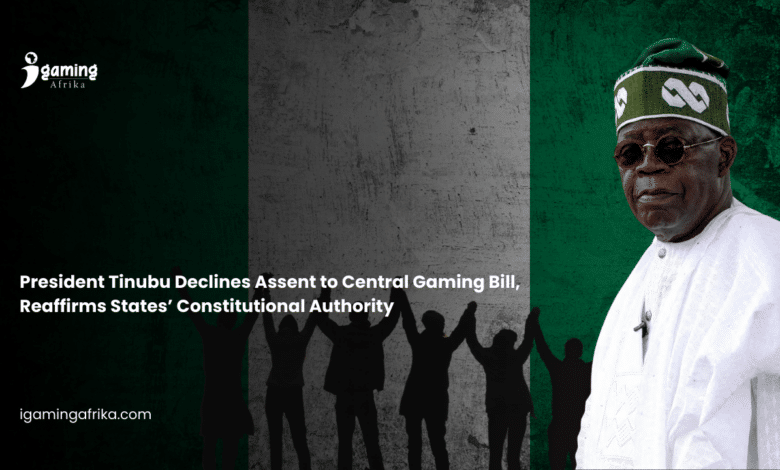
President Bola Ahmed Tinubu has formally declined to assent to the Central Gaming Bill, ending months of debate over the proposed centralisation of lottery and gaming regulation in Nigeria. The decision halts efforts to consolidate oversight of lottery and gaming activities under a single national authority.


The President made his position clear during a meeting of the All Progressives Congress (APC) National Executive Committee (NEC), where he stated that gaming and lottery regulation fall outside the legislative competence of the Federal Government.
“What I want you to forget is centralised lotto. Go and read the Constitution again. It is a residual matter,” Tinubu said. “Residual matters belong to the exclusive legislative authority of the states.”
He warned against any further attempts to advance the bill, stressing that he would not approve legislation that contradicts constitutional limits. “Don’t tread near it. There’s no need for us to argue,” the President said. “I am a constitutional democrat. I read it and that it was coming to me, I won’t sign it.”





President Tinubu’s refusal to sign the bill has now effectively closed the matter. According to state officials and regulators, the decision reinforces Nigeria’s federal structure and affirms the principle that powers not expressly granted to the Federal Government remain with the states.
With the bill unsigned, regulation of lottery and gaming activities will continue to be administered by state authorities within their respective jurisdictions, in line with constitutional provisions and the Supreme Court’s interpretation.

What the Central Gaming Bill Sought to Do
The Central Gaming Bill, passed by both chambers of the National Assembly in December, sought to repeal the National Lottery Act and establish a single, federal regulatory framework for lotteries, betting, online gaming and other gaming activities across Nigeria.
Supporters of the bill argued that a centralised system would improve oversight, harmonise standards and address the rapid growth of online and cross-border gaming. However, state governments and regulators consistently objected, citing constitutional and legal constraints.
Read Also: 360,000× Monster Mega Hit Shows the Power of Black Lagoon Games
Supreme Court Judgment at the Core of the Dispute
Opposition to the bill was grounded in a landmark Supreme Court judgment delivered in November 2024, in which the apex court held that lottery and gaming are not items on the Exclusive Legislative List and therefore fall within the legislative competence of state Houses of Assembly, except in the Federal Capital Territory.
The ruling effectively nullified the application of the National Lottery Act across the states and clarified that the National Assembly lacks the authority to regulate gaming nationwide.
States Maintain Constitutional Position
Following the judgment, several states, including Lagos and Enugu, maintained that any attempt to reintroduce federal control through new legislation would amount to a breach of the Constitution and a disregard for the authority of the Supreme Court.
State regulators, including the Lagos State Lotteries and Gaming Authority (LSLGA), said they engaged with industry stakeholders to underscore the importance of federalism, legal certainty and respect for existing lawful regulatory structures. Concerns were also raised that a centralised gaming framework would undermine state autonomy, disrupt established regulatory systems and create uncertainty for operators and investors.