For much of the past decade, Africa’s iGaming sector has been discussed in the language of promise rather than performance. Investor decks and conference panels have repeatedly framed the continent as “the next frontier,” a market defined by demographic potential and future scale. What that narrative often overlooks is that African iGaming is already operating, evolving, and in some jurisdictions, maturing but on terms that differ sharply from those of Europe or Asia.


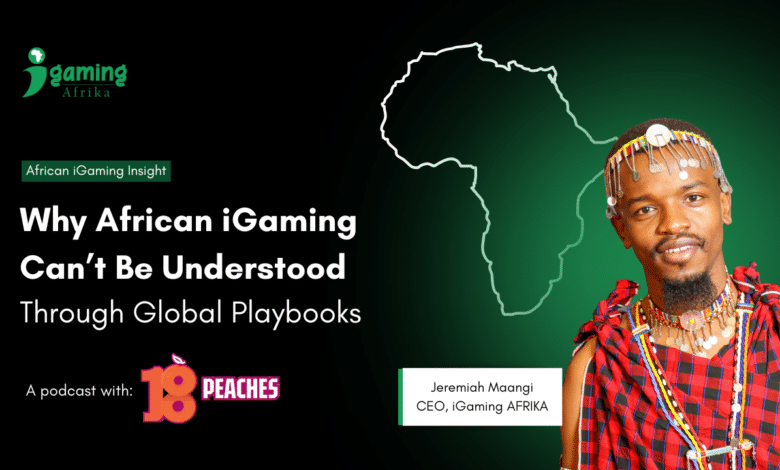
That reality came into sharp focus during a recent Peach Marathon podcast by 18Peaches, where Maria Vartanians, Sales Manager at 18Peaches, sat down with Jeremiah Maangi, Chief Executive Officer of iGaming AFRIKA and President of Afrika Group. Jeremiah described an iGaming ecosystem that is already operating, shaped by regulatory changes, infrastructure constraints, cultural specificity, and a growing emphasis on community-driven growth.
Jeremiah’s perspective is grounded in firsthand operational experience. He entered the iGaming industry in 2018, joining Sahara Games as a Marketing Manager at a time when the operator was active across Kenya, Nigeria, and Uganda. Working across multiple jurisdictions gave him early exposure to the realities of African gaming markets, where regulation, consumer behavior, and infrastructure vary sharply from country to country.
Building Access in a Fragmented Market
That experience shaped his view that the core challenge facing iGaming in Africa was not demand, but access. Operators, suppliers, regulators, and affiliates were active across the continent, yet often disconnected from one another. Information was fragmented, market intelligence travelled unevenly, and relationships were frequently built in isolation.




“When the decision to create iGaming AFRIKA came up, it’s because we saw an opportunity. There were events happening in the industry, there were people operating in the ecosystem, but when you talk about how you can access them easily, it was limiting because we didn’t have a community where you can come and access all of them at one place,” said Jeremiah.
iGaming AFRIKA was created in response to that gap. Initially launched as a media platform, it later expanded to include consultancy, events, and a professional community designed to improve visibility and information flow within the African gaming ecosystem. The aim was to make participation easier and more transparent for those already operating within the industry.

Events, Regulation, and Why Kenya Matters
The emphasis on access and connectivity also underpins the establishment of the iGaming AFRIKA Summit 2026, scheduled to take place from 4–6 May 2026 in Nairobi, Kenya. While Europe and Asia host dense calendars of gaming conferences, Africa has historically lacked large-scale, pan-regional events capable of bringing local operators and international suppliers together on genuinely equal footing. Engagement has often been limited to brief meetings at global expos, interactions that rarely translate into sustained local understanding or long-term market alignment.
The summit’s structure reflects a deliberate attempt to address that imbalance by prioritising inclusivity. Free entry tickets, a first for Africa’s gaming industry, are designed to lower barriers for local stakeholders, while paid tiers provide full access to conference programming and enhanced networking opportunities.
“We have this as the first ever event within the gaming industry in Africa to offer delegates a free entry ticket. This, of course, will guarantee limited access to various areas within the Expo. If you need full experience of the entire exhibition, conference, etc., you will need to upgrade your ticket and get one of the paid tickets. We are ensuring that there is inclusivity by having this free entry ticket that will give you at least some form of access to the summit,” said Jeremiah.
Location is equally strategic. Nairobi’s relatively open visa policy and strong international connectivity make it one of the continent’s most accessible cities for global delegates, removing a logistical friction point that has historically constrained African participation in international industry events.
Kenya’s appeal as a host country for the summit is further reinforced by recent tax reforms that have reshaped its gaming landscape. Under the 2025 Finance Act, excise duty on betting and gaming was reduced to 5%, while withholding tax on player winnings was cut from 20% to 5%. A 15% tax on gross gaming revenue continues to apply across several segments of the market, regulations that are favorable to industry players already operating in the market or looking to enter it.
Read Also: Kenya Announces Significant Reduction in Betting Taxes
These regulatory and operating conditions, Jeremiah mentioned, attract operators and shape how products are designed, marketed, and ultimately consumed.
Why Localisation Matters
One of the most common mistakes made when analysing African iGaming markets is assuming that player behavior follows patterns seen in more established markets. In practice, player preferences are shaped by very local factors including disposable income, attitudes to risk, and levels of trust in platforms and payment systems. Across several African markets, this has translated into a clear preference for games and features that give players a sense of control. Cash-out functionality and crash-style games have gained traction because they allow players to make decisions during play rather than wait passively for outcomes.
“Players feel comfortable playing where they feel like they are in control. That’s why games like crash games have really skyrocketed within a very short period of time, because when players play these games, they 100% feel like they are the ones who are determining at what point they can win or not,” Jeremiah said.
Bonuses and promotions remain important tools for attracting players across African iGaming markets, but Jeremiah was clear that they come with risks that are often underestimated. In environments where identity verification systems may be uneven and enforcement capacity varies from market to market, poorly structured bonus offers can quickly be exploited. Jeremiah warned that without strong internal controls, promotional strategies can expose operators to abuse and reputational damage. In that line, Jeremiah argued that technical capability and fraud prevention are as critical to long-term success as marketing creativity. Operators entering African markets, he suggested, must invest as much in backend systems and monitoring tools as they do in acquisition campaigns.
“You have to ensure that your teams are up to the task, so that players do not see this as a loophole to come and play and win without following the due procedures,” he said. “Players can always come and take advantage of bonuses, register multiple accounts, and if you do not have a system that can track some of these things, it will harm your reputation and brand.”
According to Jeremiah, products that perform well in African markets increasingly reflect local cultural references rather than relying on generic global designs. Visual identity, colour palettes, and sound design all play a role in making games feel familiar and relevant to local audiences. Just as important is whether those games actually work in everyday conditions. Network quality, device capability, and data availability vary widely across the continent, and those realities shape the player experience as much as game design.
“The games you produce must be able to be used on light versions, so that they can work on any device and actually under extreme circumstances, where the networks are not very well off. That shows you the experience that people have on the ground, that the games you produce must be able to be used on light versions, so that they can work on any device,” he said.
“Globally, customer service has been one of the key pillars of most of the brands,” Jeremiah said. “We didn’t see that in Africa in the past, but now we are seeing companies trying to focus a lot of emphasis on making their customers happy because it automatically leads to more and improved retention.”
That same logic underpins his observations on affiliate marketing. While structured affiliate ecosystems have long been standard in Europe, Jeremiah noted that African operators are only now beginning to build comparable networks. Rather than relying solely on broad advertising and brand-led acquisition, operators are increasingly working with local publishers and community platforms that already carry credibility with specific audiences.
“Affiliate marketing in the global gaming ecosystem is quite developed. You look at brands such as Bet365, they have a very strong affiliate network and platform. It is something that I’m starting to see being deployed by most African companies in the gaming space. And therefore, it’s because it comes with unique audience and traction,” Jeremiah said.
Jeremiah believes that in the days to come, adaptability will define the next generation of African iGaming leadership. “You have to be adaptable to different changes in the environment you operate in,” he said. “If you are not a person who is willing to move that direction, then you can be left behind.”