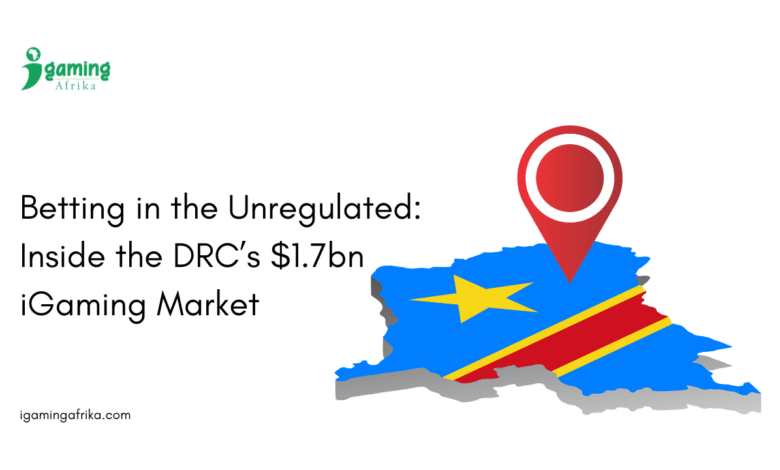
The numbers are striking. The iGaming market in the Democratic Republic of Congo is estimated to be worth around $1.7bn a year, placing it ahead of several better-known African gaming markets. In reality, however, the state captures only a tiny share of that value reportedly around $1m annually while much of the industry operates in legal grey areas that benefit operators but leave regulators, consumers and public finances exposed.


The DRC did not set out to build a billion-dollar iGaming industry. Its rapid expansion is the result of broader forces reshaping African digital economies, that is, widespread mobile phone adoption, the rise of mobile money, and a young, tech-savvy population increasingly comfortable with online transactions. Betting platforms were quick to plug into this ecosystem, scaling rapidly as players signed up in large numbers.
What failed to keep pace was regulation. Most of the country’s gambling laws were written for a different era, designed to govern physical betting shops and casinos rather than mobile-first platforms serving millions of users through smartphones. Although a 2020 law was intended to modernise the sector, key implementation measures were never fully rolled out, leaving both operators and authorities navigating a legal grey zone.
According to reporting by iGaming Business, this has resulted in a fragmented system where responsibility is unclear, reliable data is scarce, and regulators struggle to assess the true scale of online gambling activity.


Read Also: Nigeria’s Tax Act 2025 Clarifies VAT Treatment For Betting and Lottery Stakes
Nowhere is that imbalance more visible than in public revenue. While private betting activity generates billions of dollars each year, government income from the sector remains minimal. Industry figures acknowledge that operators do contribute financially, but not through a standardised or transparent framework.


One prominent operator CEO described the situation in comments to iGaming Business: “Operators do pay, yes, but they pay whatever suits them. In other words, we effectively pay what benefits us. All the while, the state has no means of monitoring its regulatory policies. For some, 7% GGR might be $100, for others, 7% might be $100,000. It all depends on the operator’s good faith.”
Mobile money sits at the center of both the market’s growth and its regulatory challenges. It has enabled betting platforms to reach millions of users outside the traditional banking system, making deposits and withdrawals fast, familiar and widely accessible. This convenience has been a major driver of scale supported by platforms like M-pesa, Airtel Money, Orange Money and Africel Money.
At the same time, it has made oversight far more difficult. Betting transactions are frequent, low in value and processed almost instantly, creating serious visibility challenges for authorities. In a country of around 112 million people, most digital transactions flow through a small number of dominant mobile money platforms, concentrating both activity and risk.
Legal constraints add another layer of complexity. Transaction data is protected by the Autorité de Régulation de Poste et de Télécommunication, limiting regulators’ ability to access or share information. While legislation exists to protect personal data and strengthen digital governance, crucial implementing measures have yet to be finalised.
This has produced a regulatory impasse. As one industry source observed, without access to reliable data, oversight becomes largely theoretical. “How can you manage what you can’t even measure?” the source asked. “The problem is that the 2020 law still awaits its implementing decree to specify the concrete conditions for data collection and sharing.”
Restrictions on personal data processing further complicate enforcement. “The processing of personal data is only authorised with the consent of the individual or upon requisition by the public prosecutor’s office,” the source said. “We are in a deep grey zone, caught between the imperative need for fiscal transparency and the strict, yet still poorly defined, protection for user privacy.”
These gaps do not only affect public finances. They also shape the experience of players. In well-regulated markets, operators are required to meet clear standards on age verification, responsible gambling, data protection and dispute resolution. In the DRC, such safeguards depend largely on individual operators’ internal policies rather than enforceable national rules. Some platforms voluntarily apply international best practices, while others do not, leaving consumers with uneven protection and limited recourse when problems arise.
These concerns are echoed by Louis Richard Tshimbalanga, CEO of Kinshasa-based consultancy Congoflex Sarl and a long-time observer of the Congolese betting market. Tshimbalanga has consistently pointed to the gap between the size of the iGaming economy and the state’s ability to oversee it, warning that the absence of reliable data makes meaningful regulation almost impossible. “There is no accurate estimate of the market. Operators are active, revenues are significant, but the absence of a functioning regulatory framework makes it impossible to measure the true scale of activity,” he said.
At the institutional level, much of the uncertainty is shaped by the role of the Société Nationale de Loterie (SONAL). Established by Ordinance No. 84-155 of 4 July 1984 as the state body responsible for lotteries and betting pools, SONAL originally held a monopoly over lotteries and sports betting. Today, however, its position is far less defined. In the absence of a dedicated online gambling regulator, SONAL has increasingly sought to assert authority over private operators, including by demanding a monthly 7% share of gross gaming revenue. Running in parallel to SONAL’s claims is the role of the Ministry of Finance, which asserts its authority through the collection of a 10% tax on every winning ticket.