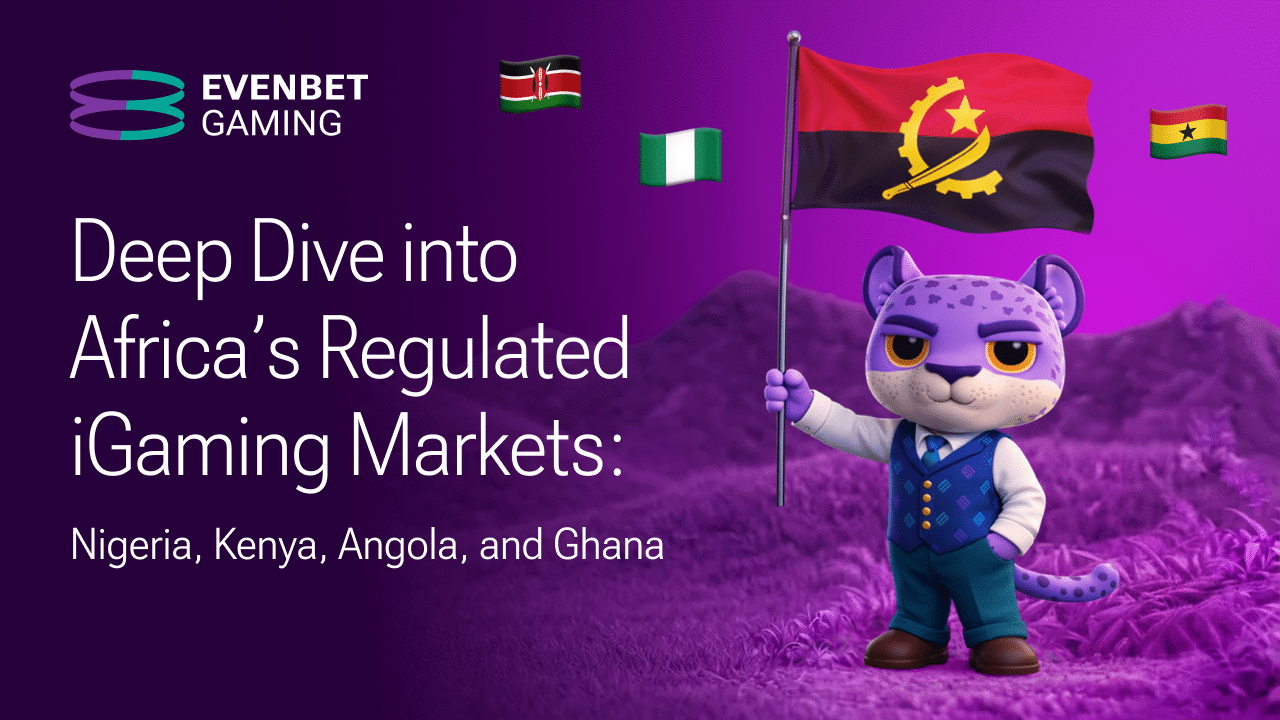
Deep Dive into Africa’s Regulated iGaming Markets: Nigeria, Kenya, Angola, and Ghana

A detailed analysis of growth drivers, licensing costs, and player preferences in Sub-Saharan Africa. Why Nigeria leads in volume while Kenya pioneers in tech.


Beyond South Africa: the new frontier of African iGaming
South Africa often steals the spotlight in African gambling discussions. But look closer at the map. While one giant dominates the south, four other nations are quietly rewriting the rules of the game.
Nigeria, Kenya, Angola, and Ghana represent a massive, tech-savvy population hungry for digital entertainment. They aren’t just “emerging” anymore; they are regulated, active, and highly profitable for those who understand the local pulse.
“A close look at other Sub-Saharan countries is necessary for both online operators and providers, – says Nastia Karma, Business Development Executive in Africa at EvenBet Gaming. – In South Africa, the operators are still losing the fight to legalize casino games and poker, but in numerous rapidly growing markets, the regulation is already favourable towards these verticals. Kenya, Angola, and some other countries allow entering the continent legally and testing player preferences without risks”.





Nigeria: the high-volume heavyweight
Nigeria is the engine of African sports betting. With over 200 million people and a passion for European football that borders on the religious, the market size is staggering.
The Regulatory Tug-of-War Operating in Nigeria requires navigating a dual-layer system. There are the National Lottery Regulatory Commission (NLRC) at the federal level and state boards like the Lagos State Lotteries and Gaming Authority (LSLGA).


- The Cost. A federal sports betting license costs approximately 100 million NGN (FocusGN: FSGRN New Rules 2026), with a 11% flat tax on GGR effective from January 1, 2026, across all categories;
- The Player. Mobile-first is an understatement. Over 90% of bets happen on mobile devices (iGamingToday: Nigeria Report 2025), mostly on affordable Android smartphones;
- Product Fit. While sports betting is king, “Crash” games and virtual sports are booming. Total iGaming GGR in Nigeria is projected to reach $3.63 billion by late 2025 (iGamingToday Data).
“Despite state-by-state regulatory rules, Nigeria remain a leading emerging African iGaming market with good internet penetration, high digitalization, and an overwhelming interest in sports betting, useful to cross over to casino and poker”, notes Nastia Karma.
Kenya: the gold standard of mobile integration
Kenya changed the world with M-Pesa. This mobile money revolution turned the country into the most mature digital betting market in the region. Unlike other markets, Kenya’s infrastructure is built entirely around instant mobile transactions.
- Primary Regulator. The Gambling Regulatory Authority (GRA), which recently succeeded the BCLB to centralize oversight and enforce stricter player protection rules;
- Licensing Conditions. To obtain a license, operators must demonstrate a minimum share capital and undergo a rigorous fit-and-proper test. The annual license fee for online gaming is approximately KSh 10,000,000, and the regulator now mandates a security bond to guarantee player payouts and tax compliance (GRA Licensing Update 2026);
- Taxation. Following the Finance Act 2025, Kenya moved to a “wallet-flow” model. Operators must collect 5% on every deposit and 5% on every withdrawal (Finance Act 2025). This system ensures immediate revenue for the state and simplifies auditing;
- Payment Success Rate. Transaction efficiency hits 98% due to deep integration with M-Pesa and Airtel Money (Safaricom Business);
- The Player. Urban internet penetration has reached 85% among Gen Z (DataReportal 2026). Kenyan players are highly literate; they study odds and form like professionals and demand platforms with instant, automated withdrawals.
The “High Stakes” Challenge. The Kenyan government is aggressive with taxation. Frequent shifts in excise duties mean operators must have a flexible platform. However, the high literacy rate and trust in digital payments mean players spend more per session here than in neighboring countries. They understand odds, they study form, and they value platforms that offer instant withdrawals.
“Like most other Anglophone countries, Kenya is leading in introducing online entertainment, including gaming. With the recent changes toward player protection and universal rules, this country is set to become one of the first mature markets on the continent”, says Nastia Karma.
Angola: the Lusophone dark horse
Angola is often overlooked because of the language barrier, but it offers a unique entry point into a space less crowded than its English-speaking neighbors:
- Why Angola is different. The Instituto de Supervisão de Jogos (ISJ) implemented a new Gaming Law (Law 17/24) on October 28, 2025 (PLMJ Legal Alert);
- Market Insight. Online licenses are now valid for 10 years under exclusive regimes. The regulator began accepting new online applications in February 2025 (PPC Land: Angola Licensing);
- The Strategy. Use “Angolan” or “Brazilian” Portuguese. Players in Luanda seek high-graphics experiences that feel like a luxury escape rather than just basic sports stats.
Read Also: EvenBet Gaming Launches Poker Solution with Hollywoodbets in South Africa
“Don’t be deterred by the language and culture barriers! With a population of 40 million and one of the highest internet penetration rates, Angola is definitely worth adapting the products for Lusophone audiences, especially after many companies have already done that for Brazil. And regulation here is probably the most progressive in Africa”, adds EvenBet’s expert.
Ghana: the stable hub of West Africa
Ghana is the “safe harbor.” It offers a stable political environment and a transparent regulatory system managed by the Gaming Commission of Ghana.
The Economics of Success in Ghana:
- Licensing. An online sports betting license requires a minimum stated capital of $2,000,000 for foreign-owned entities (Legalstone Solicitors: Ghana Gaming Guide);
- Taxation. Operators pay a 20% tax on GGR (EY Tax Alert 2025), but the 10% withholding tax on player winnings was repealed in April 2025 to boost market activity;
- Demographics. With a median age under 22, the audience is native to mobile interfaces and social features.
Technical barriers: how to actually win
You cannot copy-paste a European sportsbook into Africa and expect it to work. You will fail. To win, you must solve three technical problems:
- Data Consumption. Mobile data is costly. Successful “Lite” apps focus on fast loading. In Nigeria, 87% of players prioritize apps that work well on 4G networks (iGamingToday Statistics);
- Latency. Use local Content Delivery Networks (CDNs). Players expect a “One Click” experience, as 33% of Kenyans spend over 6 hours daily on high-speed social platforms (Medium: Kenya Digital Numbers);
- Trust via Payouts. Payout speed is your best marketing. If a win doesn’t hit an M-Pesa or Flutterwave wallet in seconds, trust evaporates.
The final verdict
The African market is not a monolith. Nigeria offers raw scale. Kenya offers tech-savvy users and automatic “wallet-based” taxation. Angola is your gateway to the Lusophone niche. Ghana provides the most stable environment for long-term planning.
“The era of heavy, complex platforms is over. The winners in Sub-Saharan Africa will be those who provide a seamless, low-data, one-click journey”, summarizes Nastia Karma. Meet her and the EvenBet Gaming team at SiGMA Africa at stand 077 to discuss online poker and casino opportunities across the continent.