Denis Mudene on How Digital Oversight and Regional Collaboration Are Shaping Uganda’s Gaming Landscape

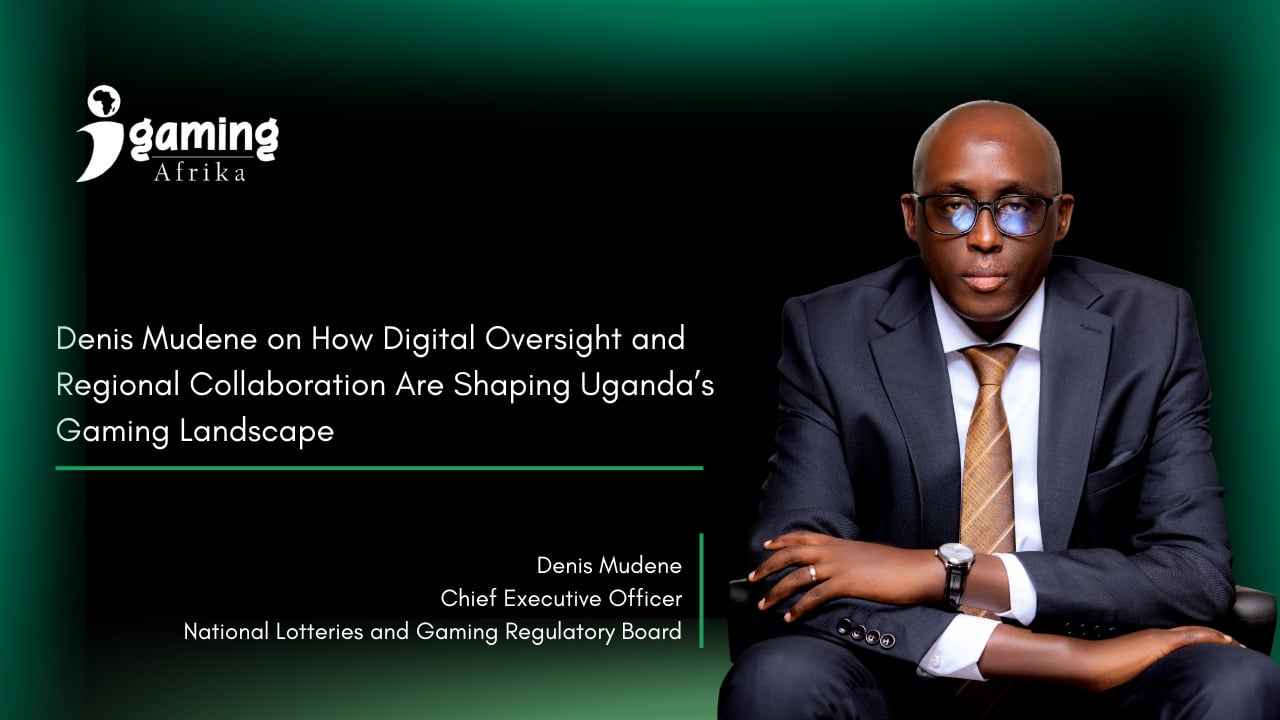
At SIGMA Africa 2026, Denis Mudene Ngabirano, CEO of the National Lotteries and Gaming Regulatory Board (NLGRB) of Uganda, shared insights with iGaming AFRIKA on how the country is navigating challenges such as offshore competition, the integration of mobile money, and the goal of transforming Africa from a technology consumer into a global innovator.


As the African gaming market evolves, regulators will have to move beyond just being traditional oversight to being active partners in the development of new technologies. A key theme of Denis’s strategy is the need for a unified African front. With operators working across borders in Uganda, Kenya, Tanzania, Botswana, and South Africa, regulators are increasingly collaborating to standardize approaches to responsible gaming, software requirements, and broader regulatory practices.
“Many African regulators are coming together so that we work together in, one, protecting the players, but also ensuring that we have standardized approaches, especially on responsible gaming, software, and machines, and to me that is very key. I think the regional operation is a non-negotiable aspect that we need to focus on,” Denis stated.
Coordination will ensure that player protection and regulatory standards remain consistent across the continent.




One of the primary challenges facing Ugandan regulators is the presence of offshore online companies operating without local licenses. To counter this, Denis outlines a cooperative strategy aimed at “disrupting enforcement” conducted between the NLRGRB, the Central Bank of Uganda, and the Uganda Communications Commission.
Read Also: Fintech Giant 4G Capital Hits US$1 Billion in Loans Disbursed to Kenyan and Ugandan Entrepreneurs.

He explained: “We are more about doing a disruptive enforcement onto their platforms, and we are doing this in collaboration with other government agencies, like our central bank and also our communications commission, the entity that is charged with regulating the internet, the Uganda Communications Commission.”
Instead of using a strictly confrontational approach, the NLGRB is using the “Follow the Money” approach, tracking the payment service providers in order to block unauthorized financial flows. However, the overall aims of NLGRB are to have these entities regulated and recognized as legitimate businesses. As such, they encourage these businesses to enter into the legitimate marketplace, and if they meet the criteria of the licensing process, then it is easy to get licensed.
Uganda’s gaming landscape is uniquely defined by its financial infrastructure, with 99% of gaming transactions conducted through mobile money. While this high penetration has fueled operator growth, it also provides the NLGRB with a powerful regulatory tool.
Denis noted that mobile money integration makes it significantly easier for the regulator to monitor the industry’s financial volume and trace transactions. This digital footprint is necessary for the sake of transparency, but it also raises social issues. The regulator is working to combat the “get rich quick” mentality among youth and reinforce that gaming should be considered only as a form of entertainment and not viewed by players as a way to make a living.
Denis also emphasized the importance of Africa taking a more active role in the global tech ecosystem. While highlighting that the continent has traditionally been a passive consumer of technology rather than a creator or innovator, he advocates for platforms like the iGA Summit to showcase local talent, educate youth in Uganda and Kenya about the technical aspects of the industry, and empower them to develop their own systems, reducing dependence on foreign technology.
“Kenya has young, tech-hungry youth that have the potential and have the skill to actually develop some of these systems. I mean, there’s no better way than iGaming AFRIKA giving them this platform. So, it’s that narrative we need to shape,” Denis stated.
The NLGRB has set an ambitious path for the future, aiming to become a model regulator for Africa within the next five years. This vision will be powered by disruptive technologies such as AI and machine learning to enhance oversight and compliance.