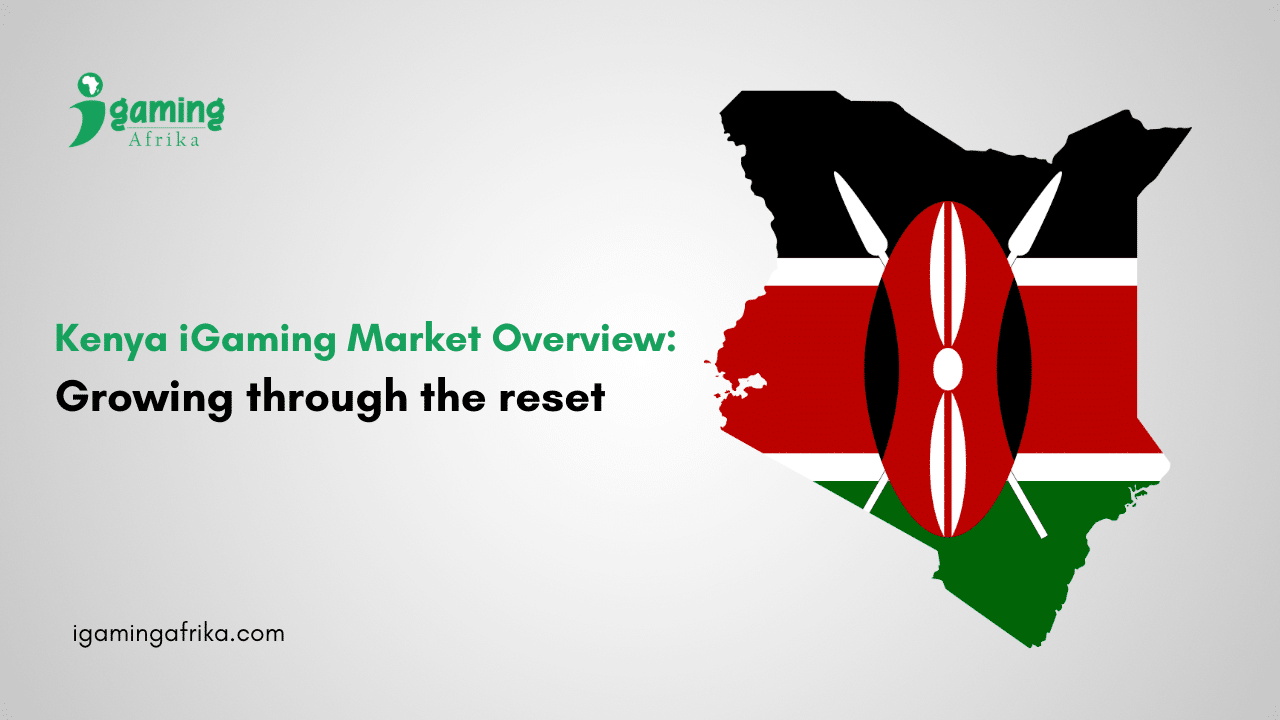
Kenya is rebuilding its iGaming framework from scratch while demand, competition, and tax reform press forward.


Kenya’s iGaming regulator has been dissolved, licensing is frozen, and a new authority is being stood up under the Gambling Control Act 2025. It is the biggest structural overhaul since the industry was first regulated in the country.
Yet demand has not stalled, the market continued to grow through the transition period, and with 58 million people at a median age of 21, the fundamentals remain intact. This overview covers regulation, market dynamics, and the competitive landscape using Blask data.
Blask metrics overview
- Blask Index — real-time measure of market demand volume for iGaming brands in a given country, based on normalized search data.
- BAP (Brand’s Accumulated Power) — a brand’s percentage share of total market demand in a specific country and period.
Macro snapshot
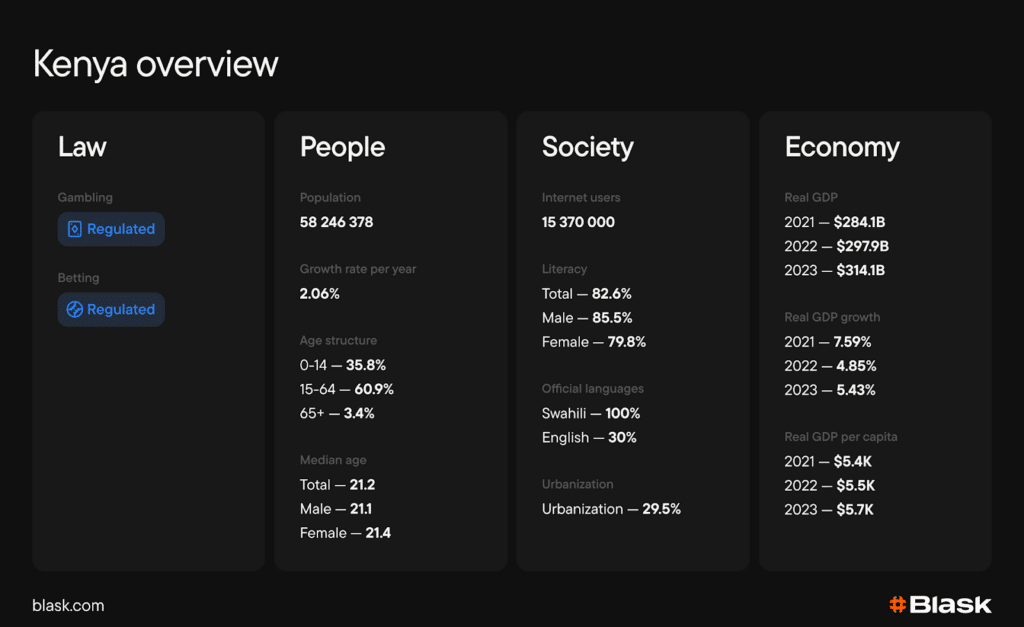
Kenya is home to 58.2 million people, with a median age of 21.2, one of the youngest betting populations in East Africa. Internet users number 15.4 million, translating to roughly 26% penetration. Mobile devices account for approximately 67% of all web traffic, making smartphone-based betting the primary access channel.


Regulation: a full reset
Kenya’s iGaming market is open and actively regulated, with both gambling and betting formally licensed. The Gambling Control Act 2025 has triggered the most significant structural overhaul since the industry was first regulated, replacing the legacy framework, dissolving the existing regulator, and creating a new authority with expanded powers.
Read Also: Blask wins Best AI solution at SiGMA Eurasia Awards 2026


Key timeline
- 1966 — Betting, Lotteries and Gaming Act (Cap 131) enacted, establishing the BCLB as Kenya’s gambling regulator.
- 2019 — Government crackdown on unlicensed operators; SportPesa halts operations after parliament imposes a 20% excise tax on stakes.
- June 2025 — Finance Act 2025 restructures betting taxation, reducing excise duty from 15% on wagers to 5% on deposits and replacing the 20% withholding tax on winnings with a 5% tax on player withdrawals.
- July 2025 — BCLB approves 99 gaming companies for the 2025/2026 financial year.
- August 2025 — Gambling Control Act 2025 receives presidential assent, dissolving the BCLB and establishing the Gambling Regulatory Authority (GRA).
- October 2025 — BCLB suspends all annual license applications to facilitate transition to the GRA.
Tax stack for operators
5% excise duty on deposits from mobile wallets to betting accounts, 5% withholding tax on player withdrawals, and 30% corporation tax on taxable income. Kenya’s Parliamentary Budget Office estimated the restructured tax regime would more than double gambling revenue collection from $41.5M to $88M.
Licensing today
Kenya operates a single licensing path through the BCLB, soon to be the GRA. The board approved 99 companies for 2025/2026, with annual licenses expiring on June 30. Foreign operators are prohibited unless registered locally. During the transition, all new and renewal applications remain frozen, and existing licenses continue operating under current terms until expiry.
Market dynamics: resilient climb
Blask Index dipped mid-year before surging through the second half of 2025, peaking in September as the European football season hit full stride, then holding above its starting point into early 2026. The trajectory follows a clear pattern shaped by the European football calendar and continental competition.
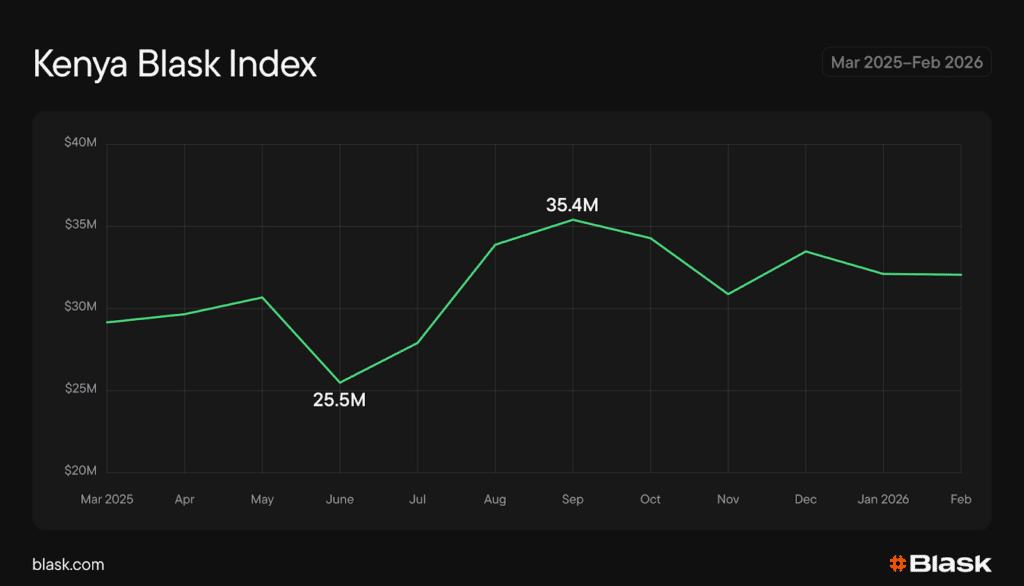
Mar–Jun: off-season slide. Blask Index fell steadily through the spring, reaching its lowest point in June. The 2024–25 Premier League season concluded on May 25, and with European leagues entering off-season, Kenyan bettors, overwhelmingly football-focused, pulled back.
Jul–Sep: season-launch surge. Demand recovered sharply as the 2025–26 Premier League kicked off on August 16. Blask Index climbed through July and August before peaking in September, coinciding with the opening weeks of the Champions League league phase.
Oct–Feb: AFCON lift and stabilization. A brief dip around November, driven by the October international break pausing Premier League fixtures, gave way to renewed momentum. AFCON 2025 launched on December 21 in Morocco, and despite Kenya’s Harambee Stars failing to qualify, the tournament sustained betting interest through January. Blask Index settled into early 2026, maintaining levels above the prior year’s starting point.
Competitive landscape: one-brand dominance + breakout challengers
Betika remains Kenya’s clear market leader, but its grip is loosening, shedding roughly 5% of BAP over twelve months. Together with GameMania and SportPesa, the top three brands command over 56% of total market demand. This is not an evenly split oligopoly; Betika alone still holds more BAP than the next two brands combined, but the gap is narrowing fast.
About Blask
Blask is an AI-powered platform for iGaming and gambling market analytics. The company turns fragmented open-source signals into real-time insight on brand visibility, player demand, and baseline revenue metrics, helping teams move first, spend smarter, and reduce risk across global markets.