Mozambique’s casino rules take effect on Friday. One brand holds 62% of the market

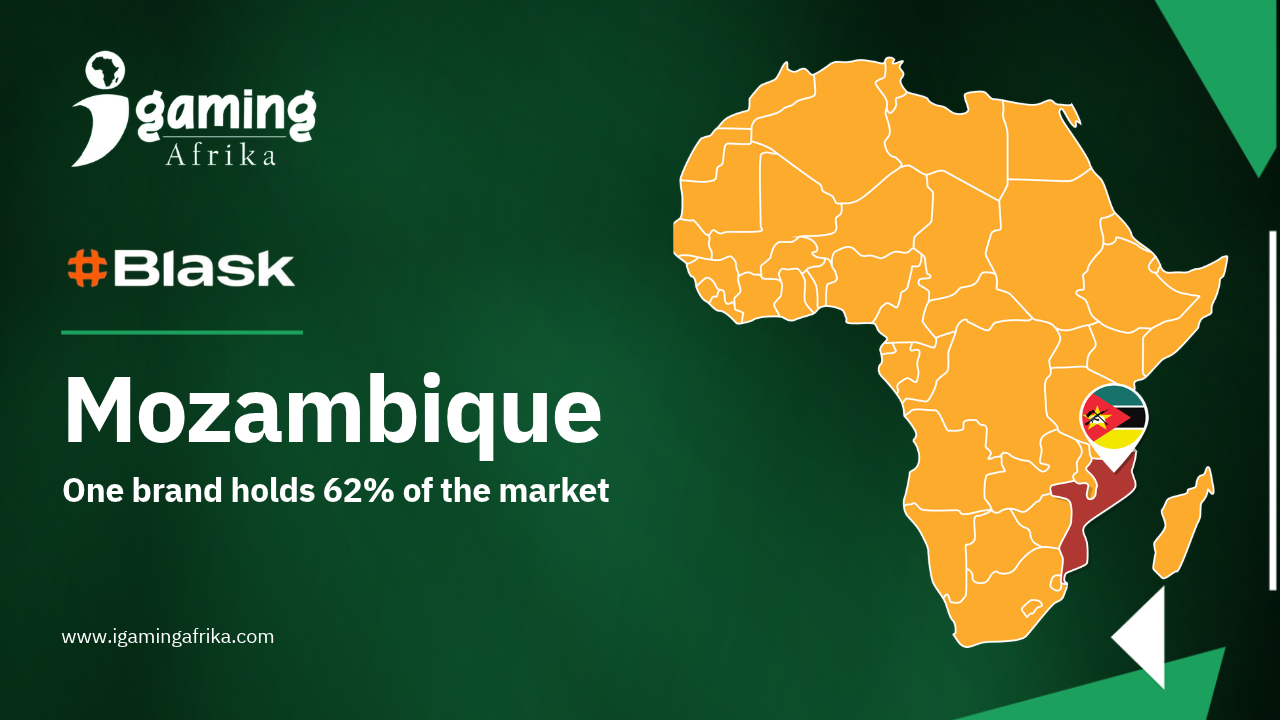
The new concession is open only to operators already licensed in the country, and locally licensed brands already take 98.7% of demand.


From Friday 20 November, anyone offering online casino-style games in Mozambique needs a concession of their own. Betting licences already exist in the country; the decree adds a separate concession for games of chance.
Decree 61/2026 sets the terms, and entry is expensive: at least MZN 100M ($1.56M) in share capital, MZN 25M ($391,000) in guarantees, and two contributions of at least 2.5% of revenue each. Applications are not open yet, but the brands that lead the market are already clear.
Blask Metrics



- Blask Index measures demand for iGaming brands in a country.
- BAP (Brand’s Accumulated Power) is projected market share of a brand.
- CEB (Competitive Earning Baseline) is a projected market revenue.
| Figures are shown as they appeared in Blask on 17 November 2026. |
Entry costs at least $1.96M
Only companies registered in Mozambique can hold a concession, and they have to be public limited companies. Land-based casinos already operate in the country, and their owners may apply, as may betting and online gaming operators that already hold a local licence.
Where the owners are companies, at least 26% of the share capital must belong to Mozambican-registered firms for as long as the concession runs, the Mozambican business press reported on 15 October.

The upfront cost has three parts.
| Requirement | MZN | USD |
| Paid-up capital | 100M | $1.56M |
| Guarantee for legal obligations, player balances and fines | 15M | $235K |
| Guarantee for the special gambling tax | 10M | $156K |
| Minimum before trading | 125M | $1.96M |
On top of that come two contributions of at least 2.5% each of annual revenue after player winnings, one for social projects and one for tourism. The decree keeps them separate from tax.
The tax rate is missing
Article 87 sets no rate for the special gambling tax. It points to separate tax legislation, and the decree fixes no date for applications or for a launch. A concession holder would know what to spend but not what to pay.
Falling tax revenue is the reason the government gives for the reform. Land-based casinos paid MZN 359.5M ($5.6M) in tax in 2025, 54% of the MZN 666.1M ($10.4M) the budget assumed, Lusa reported, citing Ministry of Finance data.
The special gambling tax overall raised MZN 161M ($2.5M) in the first half of 2026, 8.1% less than a year earlier. The government partly blames online alternatives for the drop in land-based casino visits.
The decree names who may apply, and the eligibility test points at brands already operating in the country. The shape of the licensed market is largely settled before the first concession is granted.
Betway holds 61.9% of a market that is 98.7% locally licensed
In Mozambique, iGaming demand fell 47% between January and July 2026, then won back about two-thirds of the loss by September.
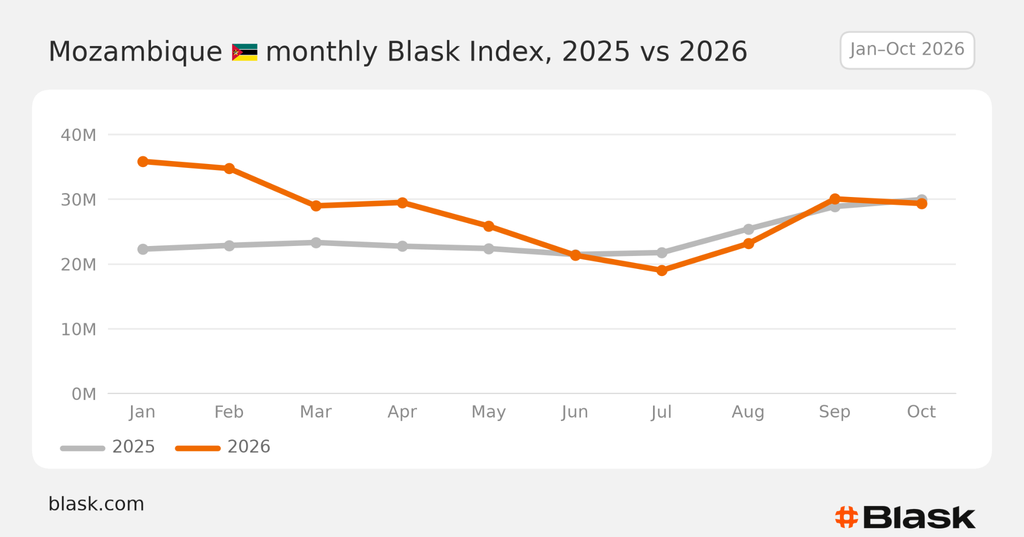
Of the 43 brands Blask tracked in October, Betway took 61.9% of demand, more than the next four combined. The gap widened in September: a 29.7% jump in country demand carried Betway from 54.4% to 64.1%, taking nearly ten points off the rest of the field in a single month. October gave back about two of them as demand flattened.
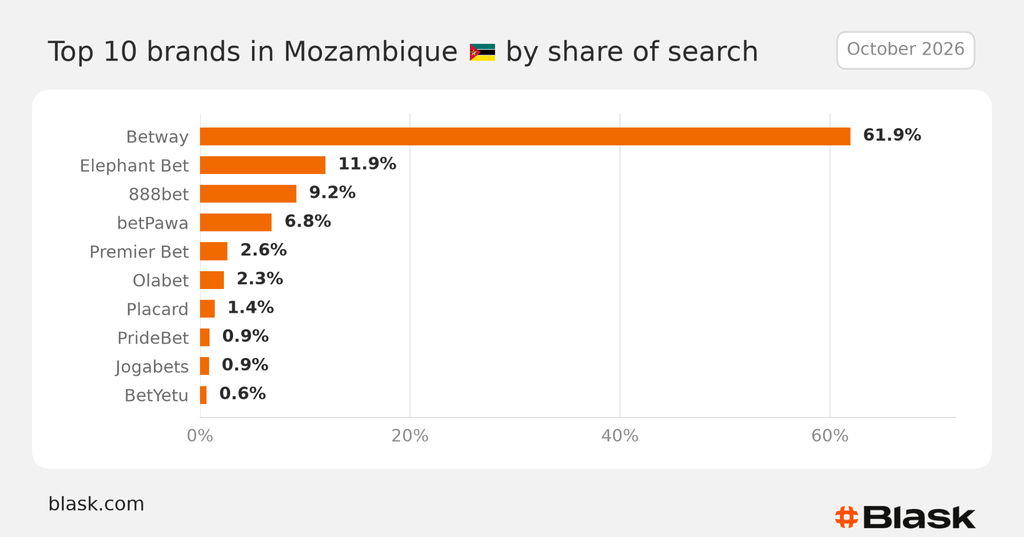
Behind the leader the market thins fast. The next four brands, Elephant Bet, 888bet, betPawa and Premier Bet, share 30.6%, and the remaining 38 split 7.5%.
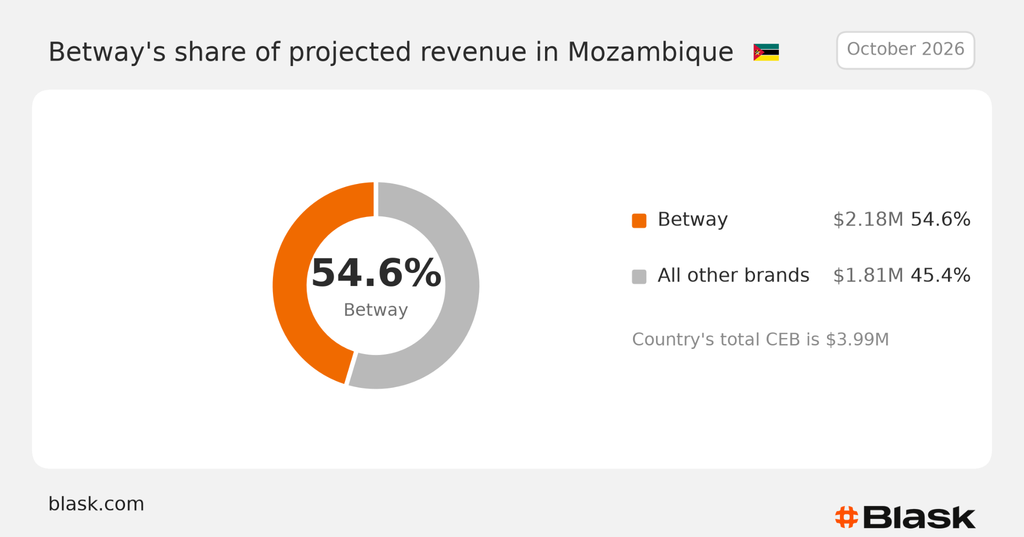
Mozambique’s October 2026 CEB was $3.99M (range $2.96M–$7.07M), 8% above October 2025. Betway alone accounts for 54.6% of the country’s projected revenue.
Brands with a Mozambican licence took 99.6% of October demand, brands serving the market from a licence elsewhere 0.4%.
Read Also: Bet365 gained share in North Africa’s two largest iGaming markets in October
An unlicensed site can be blocked within four days
If the Gaming Inspectorate (IGJ) finds an unlicensed site, it orders the operator to close and remove it within 48 hours. If nothing happens, telecom companies and internet providers are told to block it, usually within another 48 hours. The tool works fast.
The data suggests there is little for it to do. Brands serving Mozambique from a licence elsewhere took between 0.1% and 0.5% of demand in each of the ten months to October. On that reading, blocking protects a market that has already moved to locally licensed brands, and the concession decides who serves it.
“This approval is important because it gives us a legal instrument that will also enable us to combat foreign betting sites that enter our cyberspace,” Danilo Mussá, president of the Mozambican Association of Online Games and Betting, said in August.
Bottom line
Mozambique has a legal route to an online casino concession, a price for it and a supervisor to enforce it. The tax rate that decides whether the $1.96M is worth paying will come from separate tax legislation, and no date for applications has been set.
Until both exist, 20 November settles the framework and leaves the market where the data already put it, with one brand holding three-fifths of the demand the regime will tax.
About Blask
Blask provides independent market intelligence on global iGaming: demand by brand and market, market-size benchmarks, competitive positioning and game performance. The platform processes billions of geo-tagged searches and normalises them into brand-level metrics. More at blask.com.