Exclusive: Fisayo Oke on Advocacy, Enforcement, and the Future of Responsible Gaming in Nigeria

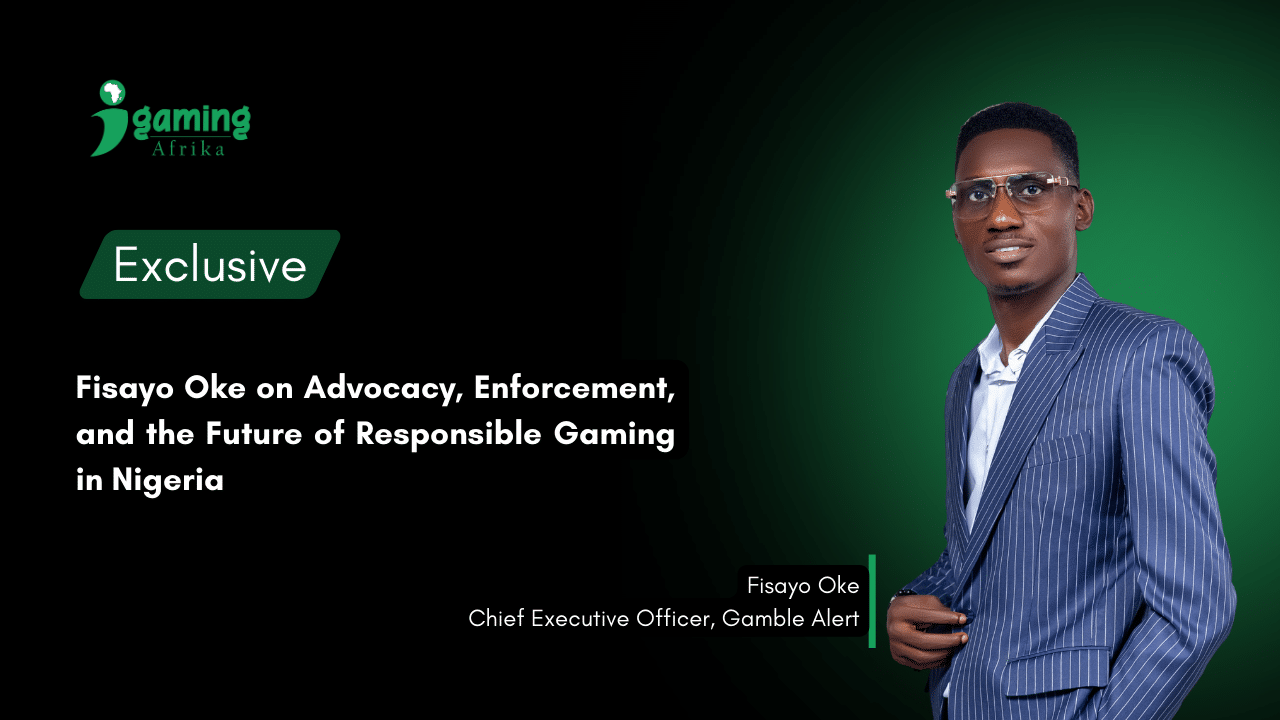
During an exclusive interview with iGaming AFRIKA Magazine, Fisayo Oke, Chief Executive Officer, Gamble Alert, a leading responsible gaming advocacy organisation, reflects on a landmark recognition from the Lagos State Lotteries and Gaming Authority, the growing public health risks posed by underage gambling, and the urgent need for collective action across Nigeria’s betting ecosystem. The conversation explores the intersection of research, advocacy, treatment, regulation, and technology, offering rare insight into what it will take to build a safer, more sustainable gaming industry in Nigeria and across Africa.


iGaming AFRIKA: Congratulations on receiving the Lagos State Lotteries and Gaming Authority Responsible Gaming Advocacy Award. What does this recognition mean for you and for Gamble Alert? And how do you see it influencing your future initiatives in promoting responsible gaming across Nigeria and potentially beyond?
Fisayo Oke: Thank you very much. We see this award as a meaningful recognition of the work we do. Personally, I believe that public protection, education, and policy advocacy must work hand in hand. This recognition affirms that Gamble Alert’s efforts, combining research, advocacy, and treatment, are making an impact and are not being overlooked by the industry. It reinforces our mandate in the responsible gaming space and motivates us to expand our initiatives further, building across Nigeria and eventually extending to other African markets.
iGaming AFRIKA: Recent data from Gamble Alert points to a worrying trend: underage gambling, with nearly one in three teenagers aged 13 to 15 already participating, often influenced by peers, family members, and pervasive gambling advertising. Considering these social and media pressures, what strategies is Gamble Alert prioritising to prevent early exposure to gambling, and how can parents, schools, and regulators take a more proactive role in addressing this growing public health concern?
Fisayo Oke: The data you’re referring to truly states that one in three teenagers between the ages of 13 and 15 are already gambling, and that’s an urgent public health concern for us and for everyone in the country. But to be fair, that data was collected from a particular local government. So, while we may be able to extend that to the entirety of Lagos, caution must be taken to say that this is focused on the community, and we also focused on public secondary schools.



Read Also: Gamble Alert Uncovers Deep Social Pressures Behind Rising Underage Gambling
So, it may not be the same for private secondary schools in the same region. Generally, it shows us that whether it is one in three or four, a lot of teenagers are already involved in gambling activities. And we think, as I said earlier, that’s an urgent public health concern. We’re expanding our school-based curriculum, moving to different communities in the country.

We’ve already done about four states in the whole Southwest, and there are six states in the Southwest. We are looking to comb through the entire Southwest and then more to the Southeast, which are aspects that are part of Nigeria. We believe that because children are increasingly exposed to gambling, we could equip them daily with the right information to use.
Apart from that, we are currently engaging with gaming regulators across different regions, and we are advocating for responsible advertising. First is the law and policy; giving operators distance buffers when it comes to advertising in areas where students or teenagers are more likely to be; and we think that the places where they are more likely to be are schools, cyber cafes, research centers, just about any place where you would find children in good numbers, there should be restriction of advertisement in that environment. There are certain provisions already in the laws, but we are asking for even more.
Let’s have something even more solid, in terms of the distance between sites and operating platforms, betting shops, retail outlets, and school environments. So, we’re looking at that. The third one is community and parental engagement. We’ve been expanding our academic tours, and we’ve done several of them for five years, and seven editions, close to 30,000 students. We’re expanding this to even involve the community and the parents themselves.
What our research showed us is that the normalisation of gambling by parents or important others significantly impacts whether children will end up gambling or not. In fact, most of the students who spoke to us during our research started gambling because their parents sent them to gamble, or an elderly neighbour in the community, sent them to gamble.
So, we’re expanding to ensure that the communities themselves and the parents learn about the risks of underage gambling and the dangers inherent in it. And we’re expecting that by doing that, we would have reduced the amount of underage gambling participation in the entire country. We believe that schools also must begin to incorporate in their curriculum now gambling prevention amongst their students. When we were in high school or secondary school, we used to have counselors in schools who would talk to us. So, we think that that should be brought back so that these students get to know what to do better, and that’s what we are currently working on.
iGaming AFRIKA: Lagos and the Southwest are major hubs for Nigeria’s betting industry, with many operators competing for market share. In this competitive environment, how does Gamble Alert ensure its responsible gaming initiatives reach both operators and players effectively? And which strategies have proven most successful in creating meaningful impact?
Fisayo Oke: Gamble Alert’s strategy is very clear; we don’t want to exist simply as critics of the gaming industry, pointing out what has or hasn’t been done. At the same time, we also do not want to be an organisation that operators engage with merely to tick a compliance box. Our goal is to be a value-adding partner in the sustainability of the industry. That’s why, in everything we do, we deliberately carry the industry along. We do not work from a distance or in isolation; we actively involve operators, regulators, and other stakeholders.
If the industry has contributed to certain challenges, then the industry must also be part of the solution, and we have positioned ourselves to facilitate that. What we’ve realised in the past five years is that when operators see that responsible gaming is being positioned as part of a long-term business viability, they respond better. And that’s what we’ve been doing. So, you could see Gamble Alert training gaming operators, and we’ve done several of those. So rather than looking at the policy and then condemning it in its entirety, we will draft, share with them and then ask for their opinion.
We send in our opinion on the creation of interventions, and we’ve realised that this has proven very successful. And it also speaks about the quality of work that we do. It helps us also to find out exactly the pain points of gaming operators and regulators, as much as we’re looking at the pain points of the players themselves. Also, when it comes to the outreach and helpline services, we work together with industry stakeholders. For instance, if you go to about 15 to 20 gaming platforms currently in Nigeria, you will find Gamble Alert listed as the responsible gaming helpline.
That happened because we’ve been working together with these organisations, and players get the opportunity to receive the help they need. We got the opportunity of getting players directly reaching out to Gamble Alert for help because when they go on a betting platform, they see Gamble Alert as the responsible gaming organisation they are to reach out to. We get a volume of customers who can speak to us, and they can get all the help that they need. Also, most people who are reaching out to us are those who are actively involved in it, and they need help.
Finally, we get data, which is very important to us. When customers reach out to Gamble Alert for help, we’re able to generate insights from our conversation with them, then share anonymized data insights with the industry to let them know what the trends look like, and again, what they need to do better to reach the goal of having a healthy gaming environment. That’s what we’ve been doing in the past five years.
iGaming AFRIKA: The recent Responsible Gaming Symposium by Gamble Alert highlighted gaps in regulation, operator safeguards, and public awareness. From your perspective, what are the systemic barriers that prevent responsible gaming initiatives from being truly effective, and how do you plan to address them?
Fisayo Oke: Thank you for mentioning the symposium. What we did at that symposium was necessarily just to bring all relevant stakeholders together. In fact, we brought regulators across different states and operators across the country. And then we had healthcare professionals, persons with lived experiences, and communities being represented, including the media. We wanted people to ask all the questions that they would have, so that the stakeholders, the persons who are particularly in charge of the activities of the industry, can hear directly from the horse’s mouth what the problem is that is currently ongoing in the country.
At that symposium, gaming operators, regulators, and community stakeholders were able to identify some of the persistent barriers in the industry, one of which would be the fragmented regulation of gaming activities across different states. So, it means that across different states, you find different standards for responsible gaming enforcement. For instance, if Lagos state has a very strong and solid responsible gaming regulation, you may go to a different state, and they don’t have it at all.
Some unscrupulous gaming operators may take advantage of that by going to a state where they have a lax responsible gaming framework, operating there without incurring any cost, and continuing to get patronage from vulnerable populations. And we think that this is a challenge.We also learned from the conversation that there’s a limited enforcement capacity even where the policies exist.
So, some of the states have come up with fantastic gaming policies. But then, when it comes to enforcement, because Nigeria is quite a big country, and then even the states are quite large, and you know that in different communities, especially in the suburban areas where gambling exists, you see that because of the limited amount of resources, enforcement may not extend to those environments.
Read Also: Gamble Alert 2025 Snapshot: Prevention, Research and Treatment
Furthermore, think about having twenty, thirty licensed operators in the country, and only a few of them are doing significantly well in terms of responsible gaming. It doesn’t encourage them because they think that if they invest money and time in responsible gaming, and others are not doing it, and there is no repercussion for not doing it, there’s no incentive for doing it. So, it discourages them as well.
Another point raised by participants at the symposium was the absence of a unified self-exclusion portal or framework. And we are happy that after that symposium, we saw that the Lagos State Lotteries and Gaming Authority launched the SafePlay platform. I’m sure you are aware of that. It is a unified self-exclusion platform for the entire gaming industry, particularly in Lagos State.
We’re hoping that extends to other states. So, when a person excludes themselves on the Safe Play platform, they are automatically excluded from all other gaming platforms across different categories.
As I said, we’re happy that SafePlay is already coming on, and we’re hoping to work with them to achieve that. We are currently working very hard with the industry stakeholders, talking about regulators and the operators alike, to ensure that there is industry-wide adoption of this responsible gaming, particularly all the issues that I have highlighted at this symposium that they addressed.
Read Also: Responsible Gambling: Is It Just About the Players?
We’re also happy that the Association of Nigerian Bookmakers, that is, the trade unions of all the sports betting companies in the country is working with Gamble Alert hand in hand, and we’re addressing all these barriers one after the other. We are making significant progress in that regard. We’ve, in fact, been going on different advocacy programs together. We are also working with them to ensure that there is long-term investment in public education, treatment, and research.
We’re currently building stronger partnerships with regulators, operators, civil societies, and communities. So, for us, the objective is that we want to shift responsible gaming to a long-term gesture. We want it to be a mandatory thing. There should be shared accountability amongst all stakeholders.
iGaming AFRIKA: Collective action was a central theme of the Symposium, but lasting change requires measurable outcomes. How does Gamble Alert plan to track and evaluate whether the commitments made by operators, regulators, and advocacy groups are genuinely reducing gambling-related harm over time?
Fisayo Oke: Evaluation for every nonprofit is always a tough task, but then, for us, how we have started it is to divide it into three tiers for monitoring and evaluation. The first thing is that we want to assess operator readiness. Currently, we train gaming operators, even regulators. What that does is that the standard for responsibility is being defined by Gamble Alert, guided by the law.
The regulations and laws provide the framework and standards, but we go a step further by bringing stakeholders together across different states. We train them on what is expected and connect these requirements to industry best practices. Once trained, operators have a clear standard to follow, they understand how to manage different situations, know who to contact when customers need support, and can implement the necessary tools.
We then monitor compliance by reviewing their platforms and visiting retail outlets to ensure that the responsible gaming measures we have taught are actively in place. There is also an assessment of the responsible gaming policies. Every gaming operator is expected to have responsible gaming policies on their platform. We look at these policies. We assist some of them in drafting these policies on their different platforms. Their customer interaction protocols are very important to us.
Customers now contact us directly with complaints, some of which (non-RG) we then forward to operators to ensure timely and effective responses. In Lagos State, for example, there is robust regulation outlining how operators should manage customer interactions and the technical systems they must have in place. Our role is to monitor compliance with these standards, assessing whether operators are implementing them correctly. Where gaps are identified, we ensure that corrective action is taken, because meeting these requirements is not optional, it is mandatory.
For regulators, we monitor the level of enforcement being carried out. For example, in Ibadan, we identified a gaming operator displaying misleading gambling content, in violation of responsible gaming policies. We reported this to the regulator, who took prompt action. Additionally, we discovered that the same operator was allowing underage children into their outlets, which we also reported for corrective measures. This process is part of how we actively track and ensure the enforcement of responsible gaming policies.
We review the regulatory requirements, and whenever we identify gaps, we raise them with the relevant regulators. For example, we have identified loopholes in laws across different states that could be exploited by unscrupulous operators, and we engage regulators to address these issues. This feedback is taken into account to ensure that future drafts of laws and regulations incorporate necessary improvements. We also monitor the level of compliance being recorded by regulators, which allows us to effectively track and evaluate the commitment to responsible gaming.
The final area I want to highlight is player harm indicators. When people reach out to us, we collect data to monitor treatment cases and identify emerging trends. In addition, during our community outreach across multiple states, we gather feedback, not to instruct, but to understand public perceptions of gambling, gambling-related harm, and where support is most needed. It’s one thing to provide help; it’s another to ensure that people actually feel supported. This feedback also informs our public awareness efforts and helps us measure impact. All of this forms part of our broader five-year plan, spanning 2023 to 2028.
So, our strategy is to show the outcome that gambling harm is decreasing across different populations. We want to know which interventions are working. So, at the end of the five years, we want to be sure that these interventions worked, or if they did not work, what additional reforms will be needed. So that’s how we track some of these metrics.
Read the full interview in our digital magazine: