Exclusive: Brenda Mabaso shares on how regulation acts as moral architecture and influences governance in Africa’s iGaming industry

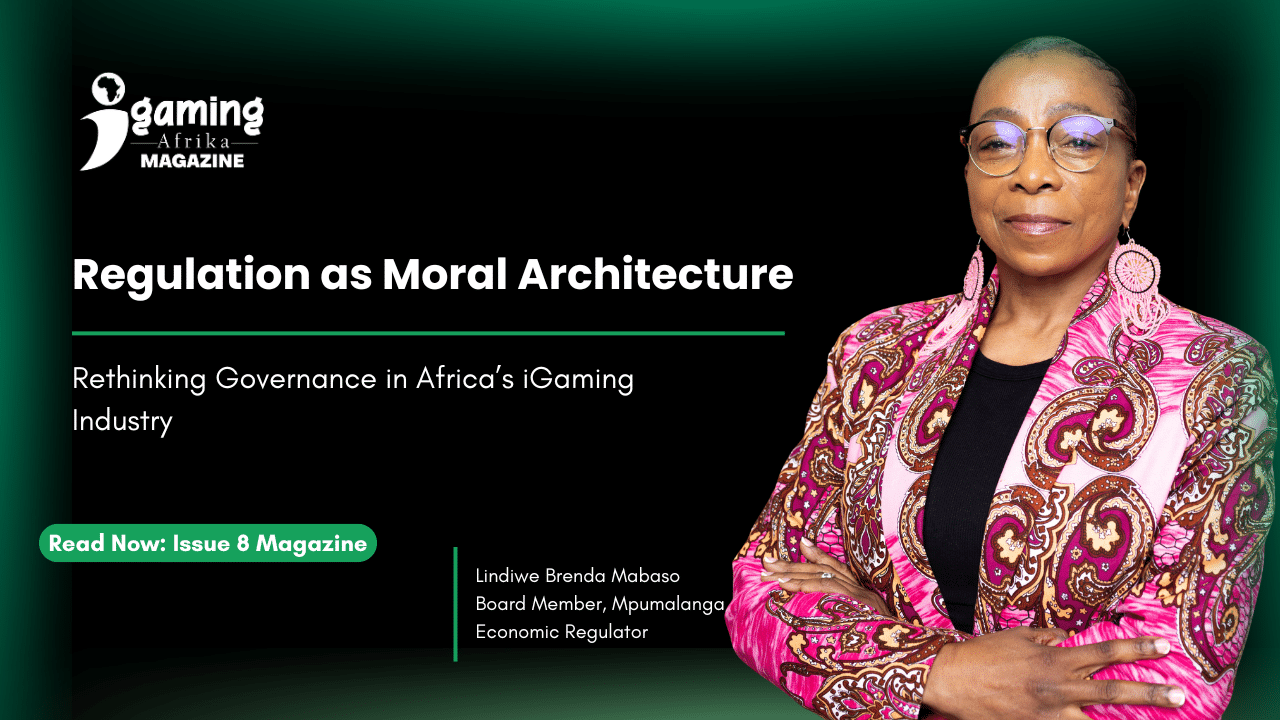
In a fast-changing world driven by digital advancements, shifting regulations, and a growing emphasis on social responsibility, governance has never been more essential. Brenda Mabaso, a Board Member at the Mpumalanga Economic Regulator, provides insightful commentary on how regulatory leadership can foster sustainable gaming environments. She delves into the challenges posed by digital disruption, the importance of ethical governance, and the promotion of women in leadership roles, while also exploring the current landscape and prospects of iGaming in Africa.


iGaming AFRIKA: Could you briefly introduce yourself and share how your journey into the iGaming sector began, including the pivotal moments that shaped your path into regulatory leadership?
Brenda Mabaso: I am Lindiwe Brenda Mabaso, a Governance Practitioner, women’s leadership advocate, and currently a Board Member of the Mpumalanga Economic Regulator (MER). My career has largely been anchored in economic regulation, trade policy, and institutional governance across public entities and the Parliament of South Africa. I have been involved with the establishment of Industrial Zones in South Africa, and in my stint with the International Trade Administration Commission (ITAC), where I was a Deputy Chief Commissioner, which gave me exposure to the regulatory space at the international level, as we dealt with the administration of tariffs and trade negotiations. Moreover, having been an Economic Content Advisor in Parliament really gave me a broader understanding of the importance of Governance structures and the need to ensure that these structures are well governed and regulated to support economic growth.
My entry into the gaming and gambling sector was therefore not accidental; it was a natural extension of regulatory oversight within economic development. What became pivotal for me was realising that gambling is not just an entertainment economy; it is a high-impact regulatory environment that intersects revenue generation, social risk, technological disruption, and ethical governance. A defining moment was recognising how governance quality in this sector directly shapes public trust. In gambling, regulation is not administrative; it is moral architecture. That realisation deepened my commitment to regulatory leadership.
iGaming AFRIKA: As a board member of the Mpumalanga Economic Regulator, how would you describe the current regulatory climate in Mpumalanga and, more broadly, within South Africa’s gambling sector?
Brenda Mabaso: Mpumalanga operates within a nationally structured framework, but implementation remains provincial. The current climate is both stable and under pressure. Stable in terms of legislative architecture. Under pressure due to digital acceleration.






South Africa’s gambling sector is mature in land-based regulation. However, the exponential growth of online betting, particularly mobile-based wagering, is testing institutional agility. Regulators are navigating a rapidly evolving technological environment while ensuring compliance, transparency, and social safeguards remain intact. The regulatory conversation has shifted from “control” to “adaptive governance.”
iGaming AFRIKA: Regulation requires balancing economic growth, revenue generation, consumer protection, and social responsibility. In practical terms, what are the most pressing challenges provincial regulators are navigating today?
Brenda Mabaso : Indeed the sector has very pressing emerging challenges and there are immediate tensions that stand out for me, which truly come with the evolving economic dynamics and these are the: Digital expansion vs. enforcement capacity, with online betting platforms scaling faster than traditional oversight models; secondly, the revenue generation aspect vs. social harm mitigation, noting that Provinces also rely on gambling taxes to drive economic activities vs the regulatory lag; thirdly Artificial Intelligence (AI) betting algorithms.

Provinces rely on gambling taxes, yet must mitigate problem gambling, offshore operators, and crypto-based transactions, which introduce new governance risks.
The central challenge is not whether to regulate but rather how to regulate intelligently in a borderless digital economy.
iGaming AFRIKA: The rapid growth of online betting has significantly altered the gambling landscape. From a governance standpoint, are current provincial frameworks sufficiently equipped to regulate digital gambling, or are there still structural gaps that require urgent reform?
Brenda Mabaso: The frameworks were designed for a geographically bounded industry. Online betting is borderless, data-driven, and algorithmic; the sufficiency of the frameworks is being tested, and fortunately, the discussion and action on this has started at the national level. While legislation provides authority, structural gaps remain in cross-provincial coordination, real-time data monitoring, technological audit capacity and enforcement on how to integrate offshore operators. We need a more harmonised national-provincial digital oversight model, supported by advanced regulatory technology (RegTech). Governance must be technologically fluent indeed.
iGaming AFRIKA: What has been the most complex or challenging decision you’ve contributed to in your regulatory capacity, and what did it reveal about the realities of regulatory leadership?
Brenda Mabaso: Complex decisions often involve licensing determinations where economic opportunity meets community concern. What I have learned is that regulatory leadership is rarely about popular decisions; it is about defensible decisions. You must balance evidence, law, stakeholder interest, and long-term impact.
Regulatory leadership requires intellectual independence and ethical steadiness.
iGaming AFRIKA: When you reflect on your tenure at the Regulator, what impact do you hope your contribution will have on the integrity and long-term sustainability of the sector?
Brenda Mabaso: I hope to contribute to strengthening institutional integrity, ensuring that decisions are transparent, evidence-based, and resilient against undue influence.
Long-term sustainability depends on three things: Strong governance systems, Responsible industry conduct, and public trust. If the public trusts the regulator, the sector survives.
iGaming AFRIKA: In 2021, you founded The Mentorship Academy to build a pipeline of young women leaders through structured mentorship. What inspired you to establish the programme, and what specific gap were you aiming to address?
Brenda Mabaso: I founded The Mentorship Academy (TMA) after observing that talented young women often lack structured access to leadership exposure, strategic networks, and confidence-building ecosystems. The gap was not competence; it was access and structured development.
Leadership is rarely accidental. It is architected. The Academy provides structured, sequenced, and intentional mentorship, not informal advice, but developmental infrastructure. What is unique about this platform is that it connects women with highly experienced networks, who become mentors, and these mentors come from diverse sectors internationally, allowing women to interact even online – this is an e-mentoring platform.
It is important to note that on the establishment of TMA, I realised the importance of backing up this initiative with evidence-based solutions, thus I am doing academic research with the University of Northampton in the United Kingdom, just to ensure that we have a well-informed, transformative and impactful mentorship program. By so doing, we are also ensuring that the activities of Women in Gaming (WiG) are not just event-driven but also technically sound to provide the sector with competent women leadership. “So, this is not just about WiG and TMA but rather an initiative to ensure that we drive diversity, efficiency and productivity in the sector; thus, we call upon industry players to partner with us in making this initiative a success.
iGaming AFRIKA: How did the partnership between The Mentorship Academy and Women in Gaming Africa come about, and what shared objectives underpin this collaboration?
Brenda Mabaso: The partnership emerged from a shared recognition: representation in gaming leadership must be deliberate.
Women in Gaming Africa understands industry realities. The Mentorship Academy provides structured developmental architecture. Together, we aim to:
- Build leadership pipelines.
- Demystify regulatory and technical pathways.
- Increase female participation in compliance, technology, operations, and executive leadership.
The TMA-WiG partnership is therefore a strategic alignment between sector access and structured empowerment.
iGaming AFRIKA: How do you see the partnership between The Mentorship Academy and Women in Gaming Africa evolving to support more women entering the gaming industry in the coming years?
Brenda Mabaso: I see three phases: First, is the Exposure – Introducing young women to regulatory, compliance, and tech roles. Secondly, the Capacity Building – Technical and governance training, and third, is Placement & Sponsorship – Active placement pipelines and executive sponsorship.
The future must move beyond inspiration toward institutional integration. We must see a future where the sector is serious about gender diversity and inclusion, a sector that buys into the establishment of an Academy to drive these developmental priorities whilst enabling them to focus on the bottom line – “income generation”. The WiG-TMA initiative is a support structure within the sector, and truly, other sectors have established such structures, for example, the Chartered Accounting sector.
Read the full interview in our digital magazine: