Egypt alone, then everyone else: Africa’s Blask Index at the 2026 World Cup group stage

Nine African teams, one dominant market. Blask World Cup Index data from the 17-day group stage reveals how the continent’s iGaming demand is actually distributed.


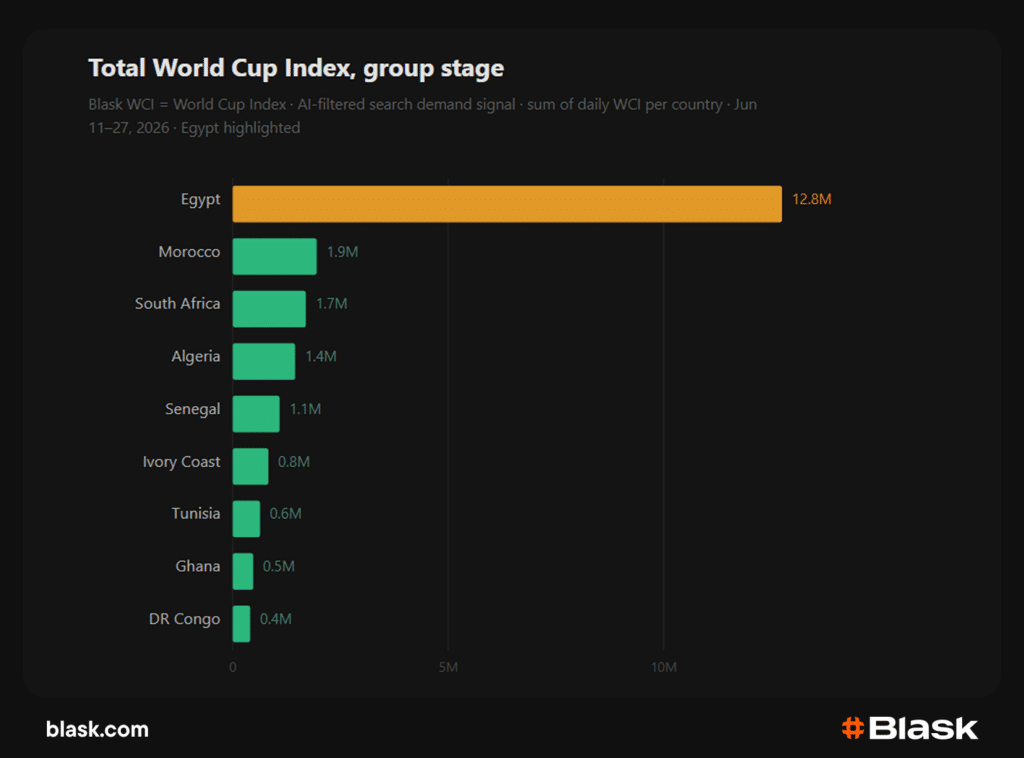
For the first time in history, nine African countries competed at a single World Cup. The expanded 48-team format gave the continent its largest-ever representation. The group stage ran for 17 days, from June 11 to June 27, creating an extended window of betting demand. Nearly 60% of the total African World Cup Index came from one country.
Blask metric:
- World Cup Index (WCI) reflects the users’ interest in the World Cup.
Egypt is an Africa’s outlier
Egypt won one match, drew two, and advanced to the knockout stage, where the Egyptian team will face Australia on July 3.




Egypt ranked third globally out of 43 countries tracked. Its total WCI exceeded the combined WCI of the other eight African markets, and its average daily demand was 6.7 times higher than Morocco’s.
On June 27, Egypt’s final match against Belgium, the WCI hit its tournament peak — more than twice what Morocco produced on its best day, and roughly three times what DR Congo generated in its entire group stage.

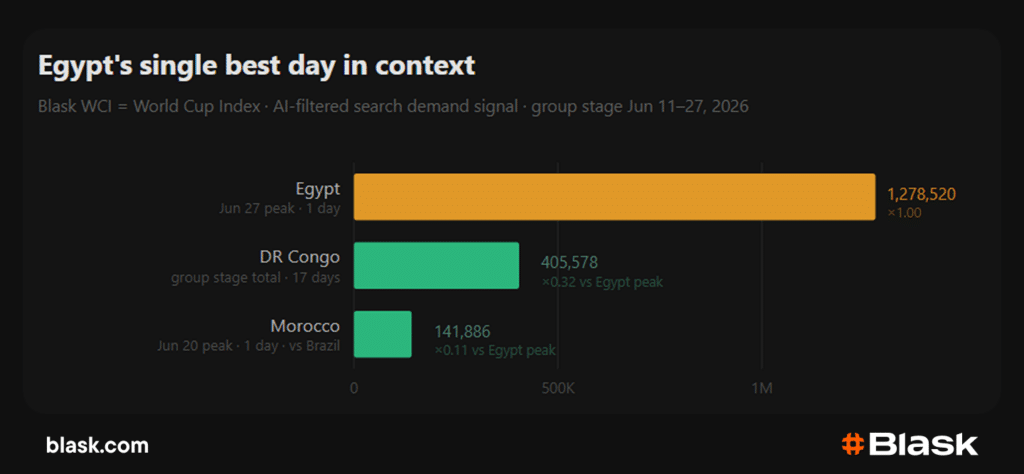
Egypt’s quietest day — June 11, before its fixtures had meaningfully begun — was still higher than the peak values of Ghana, DR Congo, and Tunisia across the whole group stage. That scale reflects a massive, largely unregulated offshore betting audience in a country where formal licensing remains highly restricted.
The Maghreb cluster — Morocco, Algeria, Tunisia
Three North African neighbours — three distinct tournament trajectories.
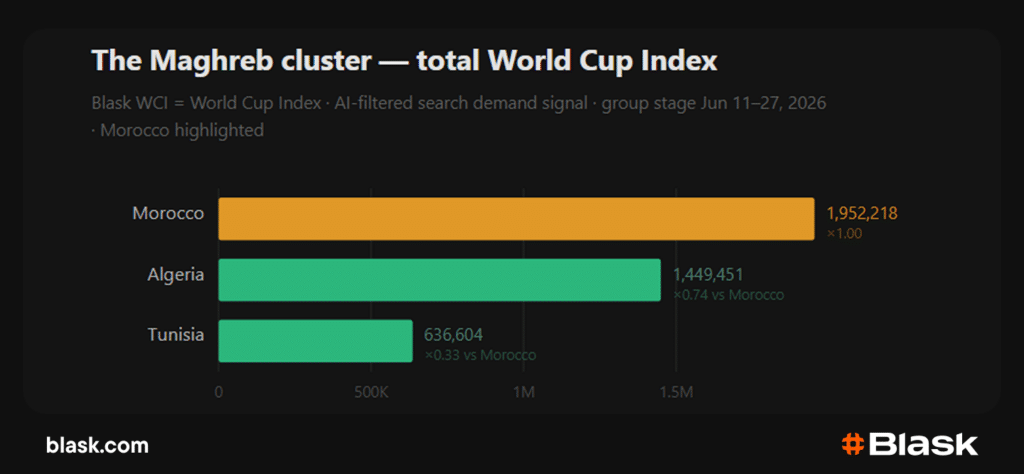
Morocco ranked 16th globally — the second-largest African market, more than three times larger than Tunisia and 35% ahead of Algeria. Its peak came on June 20 against Brazil, nearly double its opening-day figure and the clearest example in the dataset of fixture prestige as a demand driver.
Read Also: betPawa takes more than a half of the DR Congo market
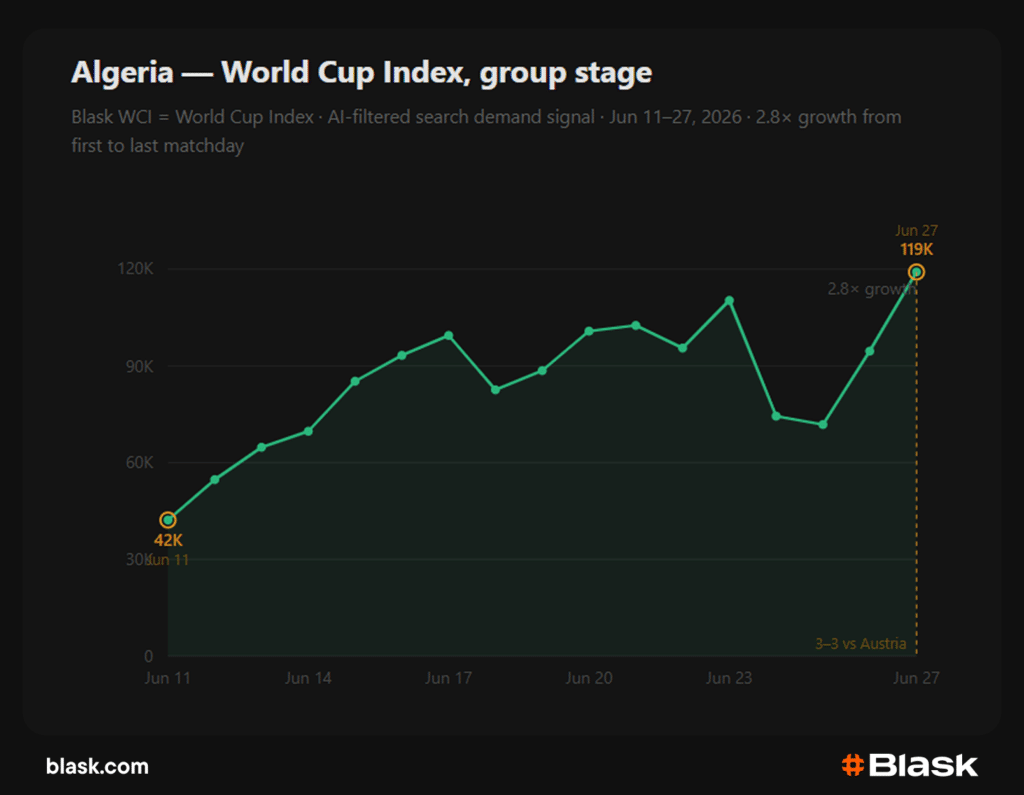
Algeria showed the most dramatic growth trajectory of any African market: starting at roughly the same level as Senegal, it grew nearly threefold across 17 days, peaking on the final matchday during a tense 3-3 draw against Austria with qualification implications.
Tunisia, ranked 30th, has the lowest WCI among the Maghreb clutter. Its peak came on June 21 — the day after a 0-4 loss to Japan — suggesting post-match users’ activity rather than anticipation. Even at that high point, Tunisia fell well below Morocco’s worst day and barely exceeded what Algeria was averaging in week two. On Tunisia’s final matchday, when the team was effectively already eliminated, interest dropped to its group-stage low.
South Africa — the most consistent signal
South Africa ranked 19th globally — the only Sub-Saharan African country in the top 20 — and was closely matched with Morocco and Algeria in total group-stage demand.
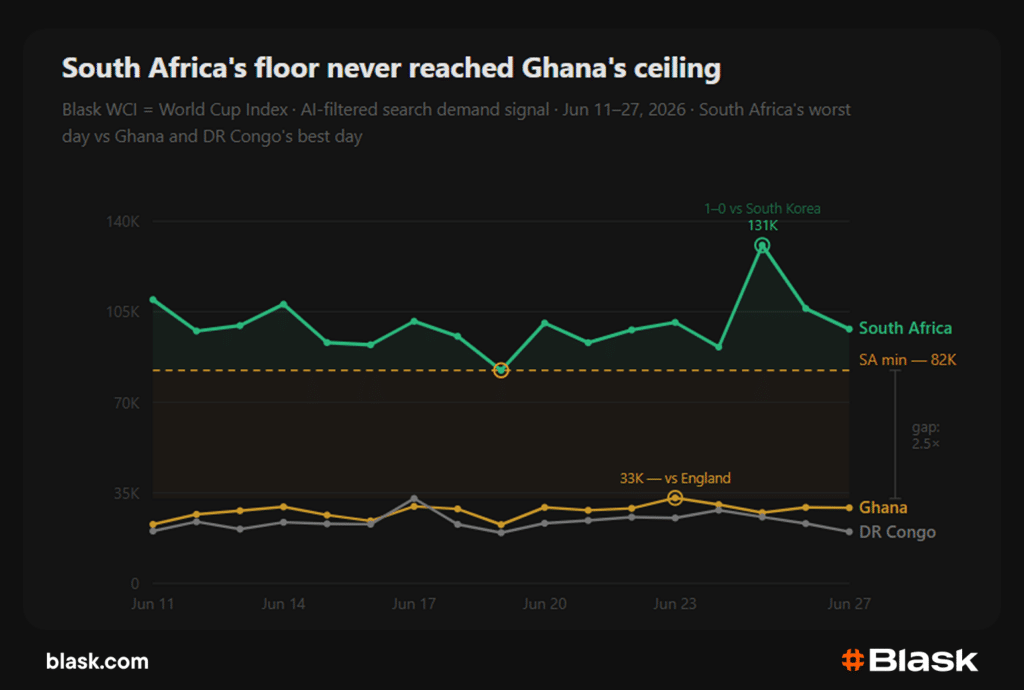
What distinguishes South Africa is not the scale but the shape. Its daily WCI barely moved across 17 days: from its floor on June 19 to its peak on June 25, demand grew by only 1.6x — the tightest range of any African market. Algeria, by comparison, swung nearly 3x between its lowest and highest day.
Even on South Africa’s quietest day, its demand was higher than anything Ghana or DR Congo produced on their best. That consistency points to an established, active betting audience that engages structurally — not one that shows up only for match days and disappears in between.
West Africa — four markets, one pattern
Senegal, Ivory Coast, Ghana, and DR Congo all show the same structural signature: demand spikes sharply on matchdays and drops back to roughly half between games, with no accumulation of interest from one fixture to the next.
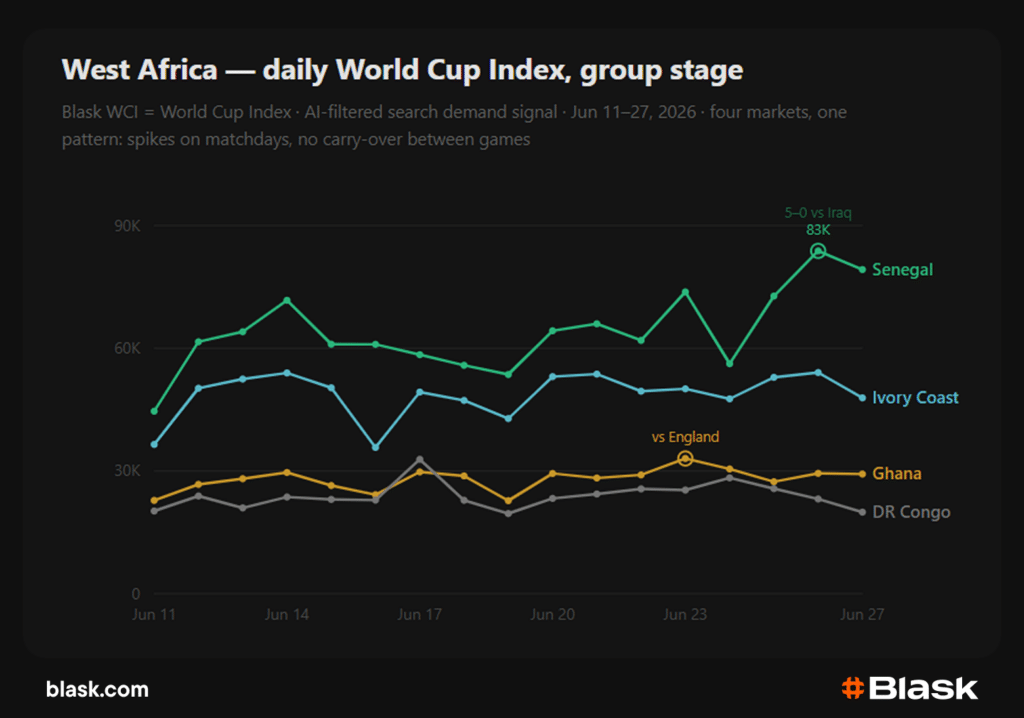
Ivory Coast recorded the flattest daily profile of all nine African markets — a range of just 1.5x between its quietest and busiest days, even tighter than South Africa’s already-narrow 1.6x. Senegal, the largest of the four, peaked on June 26 following a decisive 5-0 win over Iraq, briefly reaching a level close to South Africa’s typical mid-tournament day.
Ghana’s highest day came from a fixture against England and barely exceeded DR Congo’s single-match high. A market that needs England as its opponent to outperform the dataset’s smallest player has an organic demand problem, not a tournament one.
Bottom line
Africa sent nine teams to the 2026 World Cup and produced divergent iGaming results. Egypt is a category of its own, generating 60% of continental demand and ranking third globally. Morocco, South Africa, and Algeria form a functional second tier. West Africa’s four markets confirm that cultural participation in World Cup betting is real — but the data scale remains modest.
About Blask
Blask is an AI-powered platform for iGaming and gambling market analytics. The company turns fragmented open-source signals into real-time insight on brand visibility, player demand, and baseline revenue metrics, helping teams move first, spend smarter, and reduce risk across global markets.