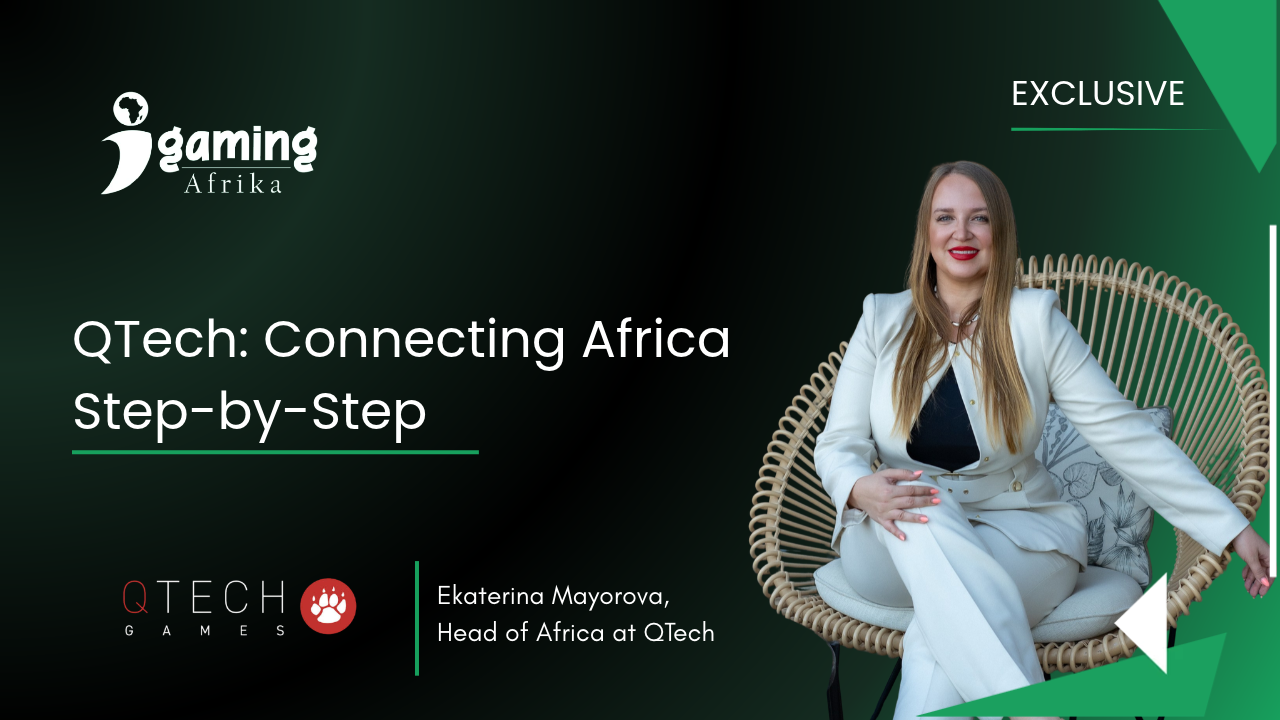
10 questions with Ekaterina Mayorova, Head of Africa at QTech, who unpacks the leading aggregator’s continued success on the continent and its new Africa Connect 2026 initiative for early December


What’s the idea and your inspiration behind QTech’s Africa Connect 2026 push?
It’s a new networking initiative for us and our partners in one of our most consequential markets for growth. As you know, we’ve been in Africa for the past few years now and have really been putting our combined shoulders to the wheel to forge cohorts of dedicated personnel, new partnerships, cutting-edge tech innovations, and more localised solutions that speak to both East and West Africa. Wherever you set your scene on this exciting continent, QTech will go the extra yards to make our platform work for you, alongside its associated value-added services and tools. That’s always been our message, but now Africa Connect 2026 is a perfect distillation of that intent.
After a record-breaking year of growth and awards wins in East and West Africa, it’s a timely juncture for us to reflect on the year’s achievements, celebrate success stories with existing partners, and look forward the exciting opportunities and factors that are all coalescing in 2027 to shape the future of Africa’s iGaming sector.
More specifically, why have you chosen Tanzania and Nigeria as your two stops in early December?
These two sites in the commercial capitals of each respective country have been chosen for their travel routes, alongside an overarching confluence of convenience for our partners and prospective attendees. After all, our goals with Africa Connect is to provide elevated stages for learning, networking, and collaboration across Africa’s iGaming community at two of its most promising industry hubs, with Dar es Salaam and Lagos recognised as the commercial heartbeat of growth and innovation on the planet’s second most populous continent.





These gatherings are also an opportunity to express our appreciation to our valued partners for their continued trust, support, and collaboration. So, a special year-end initiative bringing together operators, providers, and industry luminaries for two exclusive networking dinners in East and West Africa, proudly sponsored by Onlyplay and TaDa Gaming, made total sense.
As East and West Africa continue to develop as key iGaming markets, Africa Connect will aim to encourage meaningful conversations, exchange valuable market insights, strengthen existing relationships, and frame new prospects for collaboration in 2027.

For any African readers who may not be familiar with the concept, where does QTech sit in the gaming value chain as a leading aggregator for Africa?
First and foremost, we are a gaming aggregator, connecting game suppliers with operators through one simple integration. Instead of an operator having to integrate dozens of studios individually, we provide a single technical and commercial gateway to over 200 suppliers. QTech sits right at the pivot in the middle of the value chain, bridging premium and emerging-market game providers with online and retail operators, delivering a curated library through one API, one contract, and one back-office. That’s our role: to remove friction, speed up launches, and help operators scale efficiently across multiple regions.
Our success is premised on the strength of our underlying proprietary platform and a willingness to work in genuine collaboration with all our partners, no matter their size, to achieve mutual targets. What works in one market won’t by extension work in another, even if it’s a neighbouring one. So, collaboration is essential for capitalising on specific market demands and embracing innovations that drive growth (e.g. local data that empowers our fine-grained recommendation engine or rolling out a four-window interface for engagement) while also negotiating evolving technical challenges.
In short, we’re always improving our platform’s functionalities to optimise performance. And by gathering, observing, and refining raw data, we can identify and capitalise on emerging trends. Being an aggregator, we have a true advantage in data since we see data from both operators and suppliers across several markets. Effective collaboration also involves understanding the relationships within the data and developing strategic plans to action and take advantage of those insights. Last year we invested a lot in data and BI, and we will continue doing so in order to be even more data-driven than we are today. This development will benefit all our suppliers and operators with invaluable insights in the near future.
How does content diversity and design affect player behaviour, especially in fast-growing markets like Africa?
Being local is the key. In high-growth regions like West and East Africa, content diversity matters enormously because player demand evolves very quickly, and it’s also shaped by local realities such as mobile usage, data costs, device types, and payment preferences. Elsewhere, from what we’re observing, design directly impacts behaviour when it comes to: faster game cycles increasing repeat play; familiar mechanics reducing friction and increasing adoption; and local themes and culturally relevant formats significantly deepening engagement.
From your experience working across markets, what role should aggregators play in helping Africa’s growing group of operators comply with local regulations?
Commercially, operators want content that performs, by which I mean games that engage, retain, and convert. But we, of course, adhere to regulators and licensing bodies that expect the ecosystem to prove it can manage risk, particularly around fairness, player protection, and transparency.
We concentrate on the right content for the right market, supported by strong controls, trusted partners, and the ability to switch, configure, or segment content depending on regulatory requirements.
Read Also: QTech Announces Africa Connect 2026: Exclusive Networking Dinner in Tanzania
Technology allows games to be customised and localised. How does localisation affect both player engagement and responsible gaming outcomes?
Localisation is one of the biggest drivers of engagement. However, responsible gaming outcomes matter just as much. If localisation is done properly, it can and will support safer gambling. Ultimately, QTech curates content not just for entertainment value, but for market suitability and long-term viability.
What are the compliance challenges currently?
Howe long have you got?! As we’ve discussed, delivering content that is market-appropriate has been another maxim for success for us. You must support your operator partners with clear documentation, technical reporting needs, and integration transparency. And you’ve also got to ensure that content can be managed and configured in line with varying local requirements.
At QTech, we’re deeply focused on emerging markets, so we understand that compliance isn’t a box-ticking exercise – it’s a practical requirement for long-term success and market access.
Why can’t a one-size-fits-all approach work in Africa?
I think we all know that a singularity model can’t be mapped across Africa’s ever-changing landscape, which is closer to resembling a ruffled patchwork quilt than a smooth cohesive blanket. That said, there’s certainly a place for unified strategies and cross-border learnings which is another reminder of the impetus, and indeed demand, for more exclusive events like Africa Connect across the continent. There’s a plethora of pioneers emerging in front of our eyes here – from outstanding operators, through progressive technological innovators and regulatory leaders, and on to distributors with the requisite scope and localised expertise to reliably ensure the provision of the most engaging and varied content.
One of QTech’s key pillars in our commercial vision is to partner with both challenger and established brands to maximise market position by harnessing local awareness and expertise. And this breakout Africa Connect initiative, staged in conjunction with our good friends at Onlyplay and TaDa Gaming, will achieve that against a refined, salubrious backdrop.
Against a backdrop of AI and tech progress, how can understanding human behaviour help companies create safer and more engaging digital experiences?
Technology continues to change the way we work, and that’s a digital tide that is only rolling one way. Against that, human nature and its needs remain. Everyone still wants to feel heard, seen, empathised with, and ultimately: connected. And, again, that’s the underlying need that our inaugural Africa Connect events are looking to satiate with some elite dinners and networking opportunities.
The digital mediums we’ve created occasionally make communication faster but less satisfactory, since we lose the facial expressions, emotions, and many of the non-verbal cues that make face-to-face conversations so meaningful and preferable. At the same time, technology gives us incredible flexibility. My role allows me to work from anywhere, which means I can spend more time in African countries learning about their cultures, and visiting partners both ongoing and new in real life. It makes all the difference.
Understanding human behaviour helps companies build better experiences because, at the end of the day, technology is a happy servant, but an unhappy master. Unless you’re into watching those sci-fi movies about the rise of the machines!
Looking ahead, how do you see the role of aggregators evolving in 2027 and beyond?
At its essence, of course, a gaming content aggregator connects game suppliers with operators through one streamlined integration. Instead of an operator having to integrate dozens of studios individually, we provide a single technical and commercial gateway to a wide portfolio of content.
At QTech, we’ve always believed that sustainable growth, above all in emerging markets, comes from combining great content and deploying it in targeted packages, based on our product specialists knowing what works well in any given market. That parcellation, alongside local refinement through technology, must also be underscored by an understanding that sustainable growth depends on player protection and long-term trust. That’s the only viable way forward for a sustainable and healthy ecosystem.