Tunisia gives Live Dealer a rare mass audience. In Africa’s largest Sub-Saharan markets, the vertical almost disappears behind betting.


Live dealer interest in Africa follows a geographic divide. The category’s weighted share is 13% across the four Maghreb markets with active Blask category data. It falls to 0.18% across the five largest Sub-Saharan markets outside South Africa.
The country sits between the two groups at 1.4%. Yet its broader category mix looks unlike either one. Data for August 2025–July 2026 shows three distinct versions of African iGaming demand rather than one pattern.
Category mix is a share of non-branded iGaming search by product category. Brand queries excluded.





Method: Shares use aggregated Blask category demand for August 2025–July 2026 and level-one categories only. The Sub-Saharan chart shows the five largest markets by total category demand, excluding South Africa. Mauritania has no active category data, so the Maghreb comparison covers Tunisia, Morocco, Algeria and Libya.
Maghreb: Tunisia puts Live Dealer in the mainstream
Tunisia is the regional outlier. Live Dealer takes almost a quarter of category demand, more than Online Casino and close to the country’s Fantasy share. Dealer-led games are one of the main category routes in Tunisian search demand.

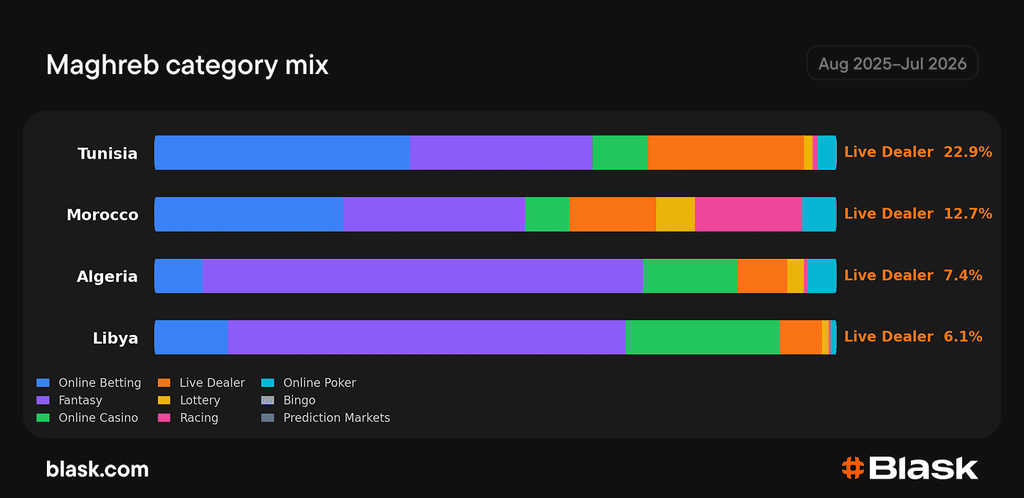
Morocco confirms that the Tunisian result is part of a wider regional pattern. Its Live Dealer share is smaller but still almost twice the Online Casino share. Algeria and Libya lean towards Fantasy, while Live Dealer remains visible in both and edges past Online Betting in Algeria.
Sub-Saharan Africa: betting leaves almost no room
The five largest Sub-Saharan category markets outside South Africa share a much narrower structure. Online Betting absorbs most measured demand in Tanzania, Cameroon, Uganda, Nigeria and DR Congo. Live Dealer’s combined weighted share is around one-seventieth of the Maghreb figure.
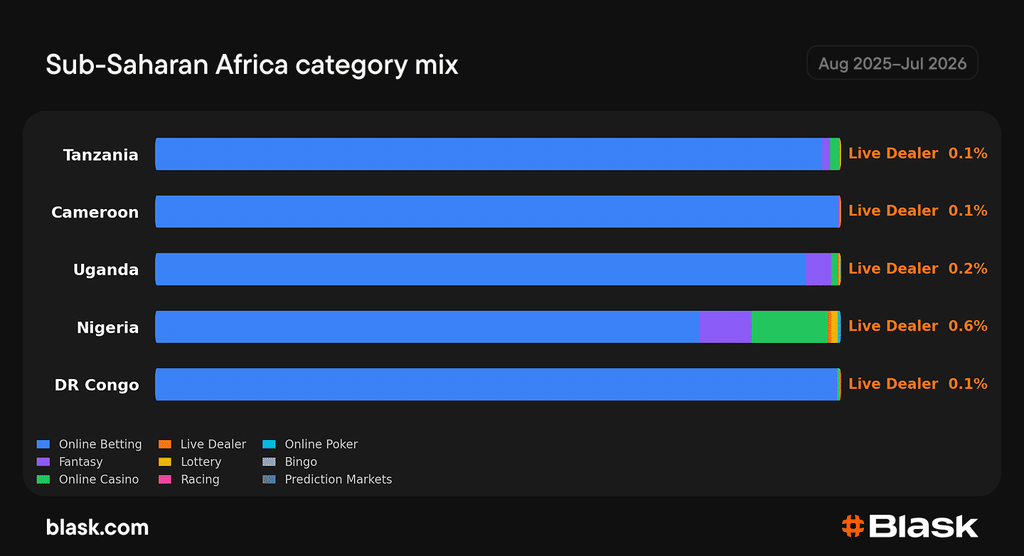
Nigeria offers the widest mix in this group. Online Casino and Fantasy both register as meaningful alternatives to betting, but Live Dealer remains marginal. Tanzania, Cameroon, Uganda and DR Congo compress even further around one vertical. Their category demand is less a casino-versus-betting contest than a betting market with a thin tail of other products.
Read Also: African markets in Blask which have different structures
South Africa: casino interest without a Live Dealer surge
South Africa breaks the Sub-Saharan betting-heavy structure without approaching Maghreb levels of Live Dealer interest. Sportsbook search still leads, but Online Casino, Fantasy and Lottery each hold substantial shares. The result is a more balanced discovery market than Tanzania, Cameroon, Uganda, Nigeria or DR Congo.
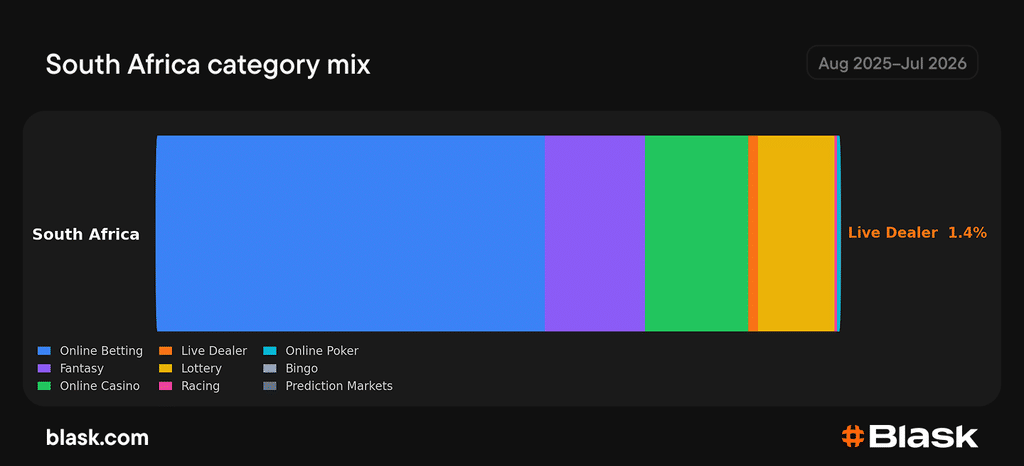
Live Dealer does not receive an equal lift from that broader casino interest. Its share is about eight times the Sub-Saharan weighted figure, but about one-ninth of the Maghreb aggregate. South African users search for casino products without often separating dealer-led tables into a major category of their own.
Bottom line
The Sahara separates two category behaviours. Live Dealer is a standalone discovery product in the Maghreb, led by Tunisia. In the largest Sub-Saharan markets it occupies only a trace of demand behind Online Betting, while South Africa builds a broader casino audience without developing the same dealer-led search habit.
The open question is whether Live Dealer remains a North African speciality or begins to take share as Sub-Saharan casino demand broadens beyond betting.
Method: Shares use aggregated Blask category demand for August 2025–July 2026 and level-one categories only. The Sub-Saharan chart shows the five largest markets by total category demand, excluding South Africa. Mauritania has no active category data, so the Maghreb comparison covers Tunisia, Morocco, Algeria and Libya.
About Blask
Blask is an AI-powered platform for iGaming and gambling market analytics. The company turns fragmented open-source signals into real-time insight on brand visibility, player demand, and baseline revenue metrics, helping teams move first, spend smarter, and reduce risk across global markets