Tackling Fraud and Risk Management in Kenyan iGaming: A Podcast with Gertrude Kirenga

The fast-paced evolution of the African iGaming landscape has shifted from traditional 90-minute sportsbooks to fast-paced crash games and instant-payout casinos. Operators now face a dual challenge of protecting their revenues and ensuring platform integrity while delivering a seamless, enjoyable user experience that keeps players coming back.


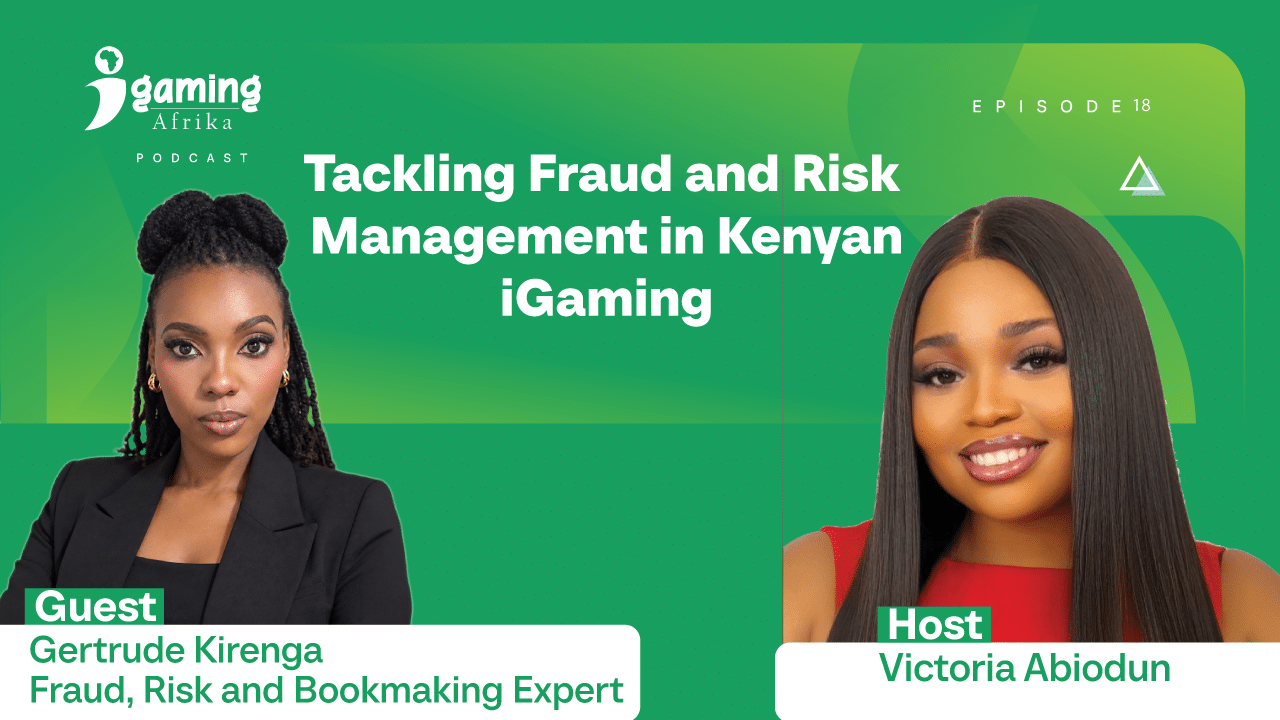
In Episode 18 of the iGaming AFRIKA Podcast, Abiodun Victoria sat down with Gertrude Kirenga, a fraud, risk, and bookmaking expert specialising in the Kenyan market, to explore her professional journey, from starting out in customer service to building expertise in risk management.
In the discussion, Gertrude highlights the difficulties that operators encounter and the various strategies they can employ to prevent fraud, ensuring a safe and secure environment for all users.
Fraud in iGaming is broadly categorized into internal and external vectors: Internal fraud occurs when employees manipulate backend systems or misappropriate funds. Gertrude explains that preventing this requires solid internal checks, such as a maker-checker system, weekly and monthly system audits, and role-based access controls.






“We put checks in place, something we call like a maker-checker system. We do not have one person initiating a direct deposit to an account and the same person approving this transaction. If I am initiating a deposit into someone’s account, there has to be someone else approving the same transaction.”
These multi-tier checks ensure that every transaction is verified and legitimate. Restricting sensitive system access, such as account crediting or game outcome manipulation, by department further minimizes potential abuse. Kirenga also points to whistleblowing as a difficult but vital necessity to prevent a single bad actor from shutting down an entire operation, leaving innocent colleagues jobless.

Read Also: Responsible Gambling in Africa: The Growing Need to Protect Players – A Podcast with Fisayo Oke
On the external side, the most common threat risk managers face is bonus abuse, particularly through duplicate accounts. Fraudulent users often open multiple accounts under a single name or device to exploit welcome promotions or free bet offers. To mitigate this, risk teams use digital tracking.
“A customer would see, ‘Okay, there’s some free money from me being new.’ So this customer probably would open two, three, four accounts under the same name. So now to curb this, what we come back and say is. We’ll only have one bonus issued to one account, we’ll have one bonus issued to, let me see, one IP address. We’re only going to issue one bonus to one account per one device.”
By combining device fingerprinting and IP tracking, operators can protect their promotional budgets while keeping campaigns lucrative for legitimate players.
Risk teams exist to protect betting platforms from losing money due to internal or external threats. However, going too far with security measures can have the opposite effect. If legitimate players face too many restrictions or unnecessary hurdles, they may become frustrated and leave the platform. Gertrude stresses the importance of avoiding rigid, one-size-fits-all rules that could negatively affect the overall player experience.
“We usually say there’s a very thin line between fraud and risk and providing a good customer experience for your customers. So, once you keep these stringent measures and then they keep on affecting your legitimate customers, they will drop off. A little bit welcoming for these customers, and then as they go along playing, as you continue monitoring their customer behaviour, you now keep on segmenting them and tailoring your measures to different categories.”
By segmenting users based on risk, a low-risk customer can enjoy seamless and uninterrupted play, while strict checks are isolated for flagged, high-risk activities. This keeps platforms welcoming for most players while still defending platform revenue.
The Kenyan market is heavily driven by mobile money payments, particularly Safaricom’s M-Pesa pay bill services. While mobile money provides incredible convenience and simplifies the Know Your Customer (KYC) onboarding process, it also introduces highly creative fraudulent schemes.
Kirenga recalls a case where fraudsters exploited betting platforms’ pay bill services to steal rent money from unsuspecting tenants. They gave tenants the platform’s Pay Bill number but instructed them to use the fraudster’s mobile number as the account number, sending the money straight to their betting wallet. The funds were quickly withdrawn, leaving the tenants out of pocket.
To protect the public and close this loophole, Kirenga’s team established a strict, unbendable platform policy:
“For any payment that will be made to the platform, it is the phone number that makes the payment that will receive the funds, regardless of the account number that is used during the transaction.”
Although this unbendable policy sometimes frustrates customers who make genuine deposit mistakes, Kirenga emphasizes that sticking to tight rules is essential for closing loopholes and mitigating company and consumer liability.
Kirenga views artificial intelligence not as a threat to risk analyst roles but as an essential asset that increases efficiency. As she explains, “AI has been a game-changer in fraud detection, not in any way taking my job, instead helping me do my job better and effectively.”
In risk management, AI helps operators segment customers, manage odds, and strengthen sports integrity. By utilizing data from providers such as Genius Sports, Sportradar, and LSports, operators can set competitive odds and adjust margins in real time. Additionally, AI assists risk teams in profiling players, targeting promotions, and applying measures like withdrawal checks for high-risk users, while enabling low-risk players to enjoy a smoother experience.
Despite its benefits, AI can fail to capture crucial contextual details, meaning human analysts must remain in the driver’s seat. As such, Gertrude says that while AI handles the heavy lifting of profiling, it requires human intelligence to interpret the nuances and make final business and incentive decisions.
Fraud prevention is closely linked to social responsibility and responsible gaming. Using tools like self-exclusion, timeout periods, and deposit limits helps protect players from financial problems. Kirenga explains that while these measures might reduce short-term profits, they create a trustworthy and sustainable gaming environment.
Monitoring player behavior also plays a key role in catching fraud. For example, if a player who usually deposits small amounts suddenly deposits KES 50,000 or KES 100,000 without placing any bets, it signals a possible issue.
“Why are you making deposits close to or huge deposits, a sum of deposits, or 50,000 sums of deposits, and you’re wagering little to zero or little to none, and you let your money sit in for close to two or three days, and then you come back and later make a withdrawal? Most cases, this is someone who is engaging in money laundering.”
As Kenyan iGaming continues to evolve, Gertrude highlights a few major trends that are likely to shape the industry over the next five years.
These include Peer-to-Peer (P2P) wagering, which lets users challenge friends in skill-based games, like a version of Candy Crush with bets. Also, using blockchain technology is expected to be important because it offers secure, trustworthy, and proven payment systems. Lastly, Esports integration is anticipated to establish competitive Esports as a major wagering category, further diversifying the gaming landscape in Kenya.
For young professionals looking to build a career in risk, fraud, or compliance, Kirenga’s advice is:
“Go for it. If you’re interested in it, if you have the passion for it, go for it. Don’t let anything hold you back. Come with an open mindset. Come with a creative mind to build exciting offers and promotions. Come with an analytical mindset. And you never know, you could be building the next big thing.”