The African iGaming Playbook: Strategies for Growth and Innovation in 2026

Africa’s iGaming industry has grown rapidly, driven by digital transformation, mobile penetration, and a young, tech-savvy population. The continent is now one of the fastest-growing gaming markets globally, but today, success demands more than simply launching products. Operators, regulators, and technology providers must master a complex ecosystem of understanding players, harnessing cutting-edge technology, and navigating regulatory frameworks to stay ahead in this rapidly evolving landscape.


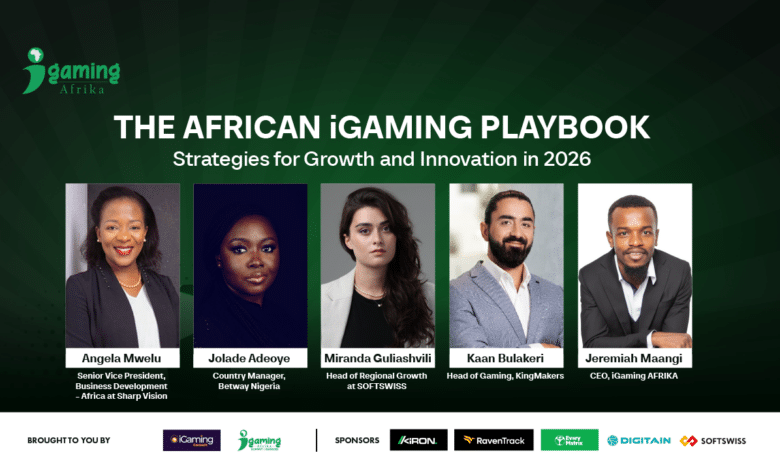
Recognizing these evolving dynamics, iGaming AFRIKA, in partnership with iGaming Consult Africa and the iGaming AFRIKA Summit hosted a webinar titled, “2026 iGaming Trends: An African Perspective“ uniting industry leaders to explore the challenges, opportunities, and emerging trends set to shape Africa’s iGaming landscape in 2026. The discussion, supported by Digitain, EveryMatrix, Kiron Interactive, RavenTrack, and SOFTSWISS, offered a forward-looking platform for insights, dialogue, and strategic perspectives from the continent’s leading voices in gaming.
The panel featured Jolade Adeoye, Country Manager at Betway Nigeria, Kaan Bulakeri, Head of Gaming at Kingmakers, Miranda Guliashvili, Head of Regional Growth at SOFTSWISS and Angela Mwelu, Senior Vice President of Business Development – Africa at Sharp Vision. Jeremiah Maangi, CEO of iGaming AFRIKA moderated the session.
Putting the Player First
A central theme that resonated throughout the webinar was the critical importance of understanding and segmenting the player base. African markets are highly diverse, and the panelists repeatedly emphasized that a uniform, one-size-fits-all approach is destined to fail. Success in one market does not automatically translate to success in another, even if the markets appear similar on the surface. Each country and even regions within countries presents unique cultural, economic, and technological landscapes that directly influence player behavior, preferences, and engagement. As Kaan put it, “One-size-fits-all doesn’t work in terms of markets, the peoples of certain markets and countries.”




Jolade reinforced this by highlighting the need for tailored offerings that reflect different customer segments. “You have to look at different segments, from mid-tier to VIP customers, and provide tailored solutions.” Segmenting the player base is not merely about categorizing customers by spend, it also involves understanding behavioral patterns, product preferences, and even payment adoption trends. For instance, while Nigeria and Ghana share similarities as Anglophone West African markets, the way players interact with platforms, deposit funds, and engage with products is strikingly different. Mobile money penetration is higher in Ghana, while Nigerian players may prefer alternative Payment Service Providers (PSPs), particularly for higher-stake transactions. These nuances influence everything from bonusing strategies and content personalization to responsible gaming education.
Panelists stressed that a data-driven approach is essential. By analyzing historical player behavior, platforms can anticipate customer needs, deliver the right content to the right segment, and mitigate potential risks such as bonus abuse or churn. The ability to understand and act on these insights is increasingly what separates successful, sustainable operators from those that struggle to gain traction.


Personalized content and player-centric experiences are the natural extension of this segmentation. Kaan emphasized that delivering the right content to the right player segment is essential for engagement and long-term retention. “In Africa, personalized and localized content is the future,” said Kaan. “It’s about customizing games, lobbies, and promotions for different segments, female players, high-stake users, and younger demographics.”
Harnessing Tech and Strategy for Africa’s iGaming
In Africa, technology is only as effective as the strategy behind it. Far from being a mere operational tool, it forms the backbone of both business success and player engagement. Platforms, software, and AI systems provide the infrastructure, but without a deliberate approach tailored to diverse markets, their full potential remains untapped. What excites players in one region may fall flat in another, making local insights, real-time analytics, and strategic deployment essential for operators seeking to thrive in this dynamic environment.
Operational efficiency and strategic use of technology go hand in hand. While platforms provide the framework, their effectiveness depends on how operators integrate them into daily operations and decision-making. Real-time analytics, machine learning, and AI empower operators to detect unusual betting patterns, flag potential bonus abuse, and prevent fraudulent activity before it escalates. Yet, as highlighted by Jolade, human teams remain essential as local staff can respond to anomalies, resolve disputes, and act on insights faster than any automated system alone. “You need automated verification tools, fraud detection systems, AI-driven insights, and local teams equipped to act fast. Technology and operational capacity must go hand in hand,” she noted.
Intelligent use of platforms is equally vital. Operators cannot simply rely on default features, they must actively filter offerings, monitor behavior, and integrate insights into everyday decision-making. As Miranda emphasized, “It’s really important that those bonus offerings or any other kind of activities can be filtered out from the operator’s perspective. Because while the providers take the responsibility to customize everything, it’s also important from the operator’s perspective to make sure that they are filtering out because the operator knows their audience the best.”
Beyond security and risk mitigation, technology is driving personalization across the player journey. Operators are leveraging analytics, machine learning, and AI not only to detect unusual betting patterns or prevent bonus abuse but also to deliver customized experiences from tailored casino offerings to localized sports betting and gamified engagement. Integrating these insights into promotions, content, and gameplay ensures that players feel recognized and engaged at every touchpoint. “It’s not just about having technology, it’s about using it intelligently. Platforms can help identify patterns and provide insights, but operators need to integrate those tools into their daily operations and decision-making,” Miranda added.
Navigating Regulation in Africa’s iGaming Boom
Regulation and taxation remain pivotal forces shaping the trajectory of Africa’s iGaming industry. As the sector expands, operators must not only focus on technology, player engagement, and content, but also carefully navigate regulatory frameworks that vary significantly across the continent. Angela Mwelu, highlighted the diversity and complexity of African markets, “Operators need to integrate with emerging technologies to detect suspicious behavior, ensure compliance, and protect players. Each African market has its own rules, timelines, and interpretations, and operators must adapt accordingly.”
A central challenge highlighted during the session is the limited real-time visibility many regulators currently have. Batch reporting, still prevalent in several jurisdictions, can delay the detection of risks such as tax leakage, fraud, and underage or problem gambling. Angela noted that tools like Centralized Monitoring Systems and AI-powered Analytics are essential to give regulators timely oversight: “Central Monitoring Systems provides a unified view of the entire ecosystem, allowing regulators to track transactions as they occur, identify anomalies instantly, and quantify tax liabilities in real time. This level of visibility empowers authorities to detect risks early, close any compliance gaps, and also make faster evidence-based decisions,” she said.
Panelists also stressed the value of proactive collaboration between operators and regulators. Sharing aggregated data insights, participating in compliance initiatives, and maintaining open communication fosters trust, reduces operational friction, and strengthens adherence to local laws. Angela highlighted that advanced regulatory frameworks require continuous skills development: “Regulators must identify gaps and invest in tailored training for operational staff and governing boards. Technology is evolving rapidly, and so must regulatory expertise.”
Taxation remains another key factor influencing market growth and consolidation. According to Jolade, recent updates in Nigeria, including clarifications around state and federal licensing and the introduction of URL licenses, have simplified operations and allowed operators to scale more confidently. Conversely, markets with high or inconsistent taxation may force smaller operators out, leaving only those with sufficient capital and operational resilience. Malawi, for example, has proactively reduced tax rates to encourage investment and innovation, creating a more favorable environment for operators.
Angela further highlighted the importance of localized compliance strategies. Operators must adapt to differences in reporting cadence, advertising standards, payment systems, and data sovereignty requirements in each country. Integration of behavioral analytics, AI monitoring, and predictive tools allows operators to flag unusual betting patterns, detect potential fraud, and intervene early in responsible gaming cases. Such proactive measures not only protect players but also align operators with regulator expectations, supporting sustainable growth.
Why Adaptation and Simplicity Will Shape the Future of iGaming Innovation in Africa
Personalisation is rapidly reshaping the iGaming experience, from recommendation engines and playlists to lobby design and how games are matched to specific player segments. Much like a TikTok-style ecosystem, content is increasingly curated to individual preferences, making this an area operators and suppliers must closely watch and actively invest in.
“I think the horizon ahead will have to be far more technology-driven. While we are already producing custom games, the next step is truly personalising the player experience. I’ve participated in panels with highly technical experts who are focusing specifically on this space. Today, most websites still present more or less the same lobby to every user. So think of the very commonly given Netflix examples, think of Spotify examples of how they are really able to personalize your experience in their playlists, in their recommendation engines. Think of a TikTok world, right? So even to the extent of the lobby experience, all the way to which games are addressed to which customer segment is an absolute area to watch and invest in,“ noted Miranda.
When it comes to understanding where the industry is headed, Miranda encouraged industry stakeholders to explore the 2026 iGaming Trends Report by SOFTSWISS, which brings together insights from leading voices across the sector. Developed with significant time and input from industry opinion leaders, the report spans key themes such as responsible gaming and artificial intelligence, offering a practical reference point for navigating emerging trends.
She also warned against blindly applying global trends to African markets, noting that while artificial intelligence dominates industry conversations, innovation must follow adaptation, not the other way around. “Everyone is talking about trends and AI, and AI is everywhere. But when we speak about Africa as a market, we can’t simply implement or push operators, or even players to accept every new trend. First, everything has to be adapted, and only then does innovation make sense. This market demands simplicity above all else, especially given realities such as internet infrastructure.
We’ve seen a lot of discussion around ideas like VR casinos and sweepstakes, but we always need to take a step back and do a reality check. This is Africa, where simplicity is key and adaptation to each individual country matters more than innovation alone,” she said.
Copyright 2025 Media-Tech iGaming Technology Limited. Permission to use quoatiotions from this is granted subject to appropriate credit being given to the www.igamingafrika.com as the source.