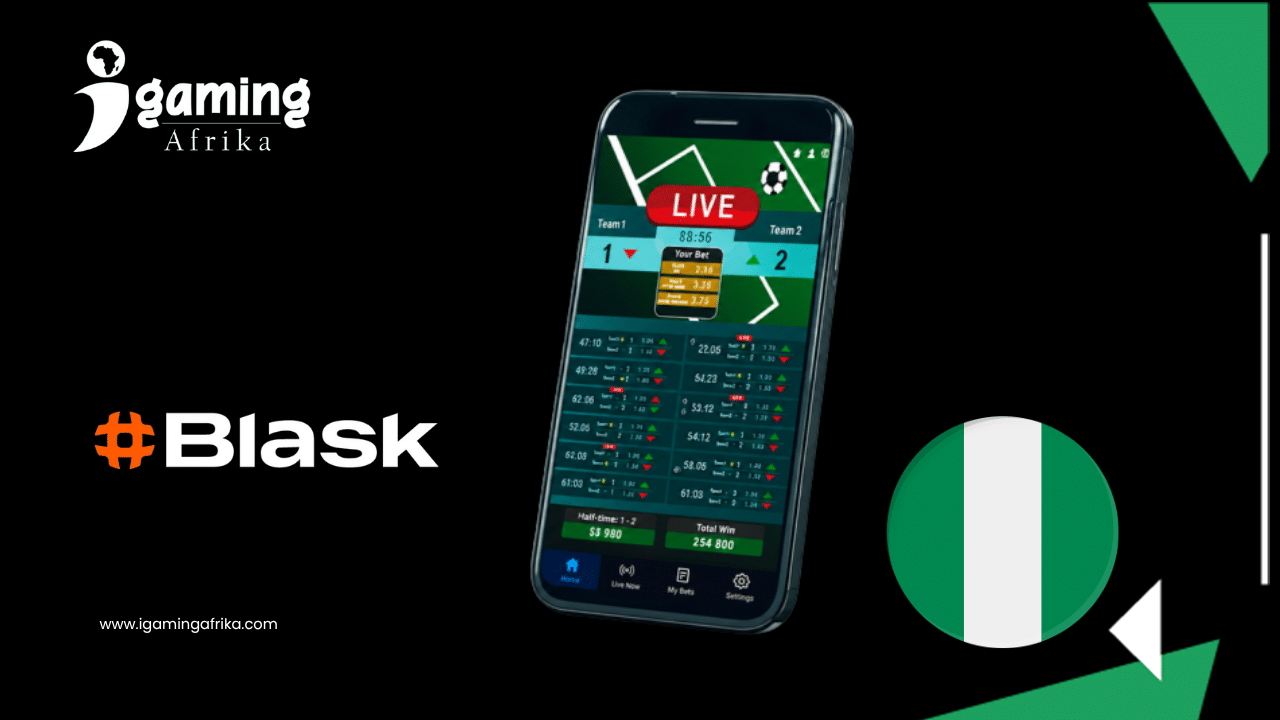
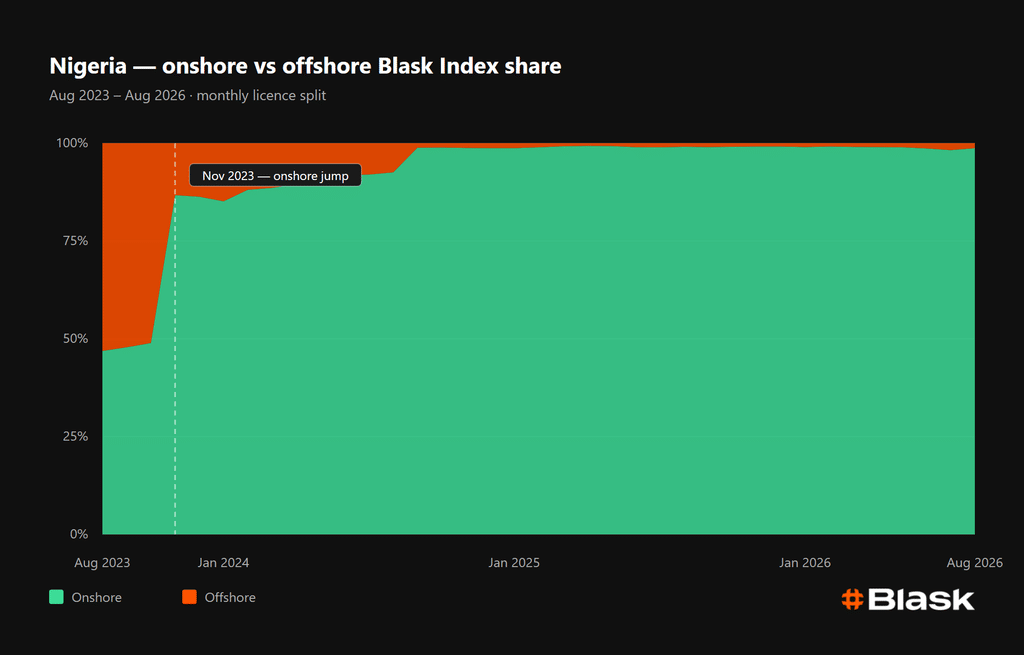
From August 2023 to August 2026, Nigeria’s Blask Index moved from a near-even onshore–offshore split to about 99% onshore.


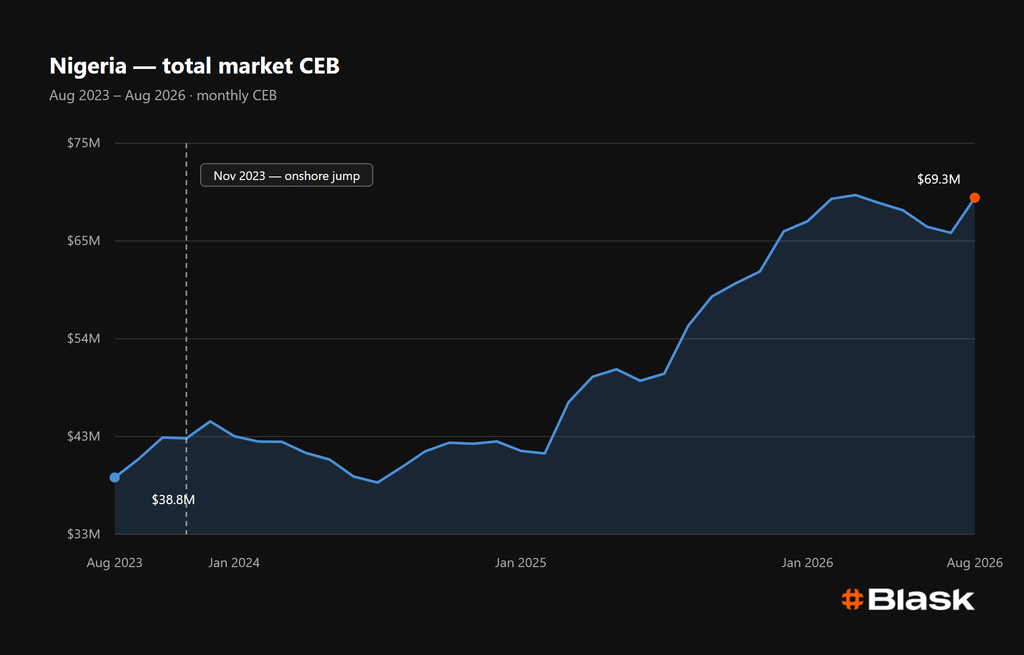
In Nigeria, onshore demand absorbed all Blask Index, with the sharpest step in November 2023. Over the same window, total CEB for the market rose near 79%. This article explains why this dramatic movement has been made and which brands won from it.
Blask metrics
- Blask Index shows a demand for iGaming in a country or for a brand inside that country.
- BAP (Brand’s Accumulated Power) is a brand’s share of total market demand in that country.
- CEB (Competitive Earning Baseline) is modelled baseline revenue potential for the market or licence slice (onshore or offshore).
How the onshore–offshore Index split moved
In August 2023 Nigeria’s Blask Index was almost balanced, about 47% onshore and 53% offshore. September and October barely moved that line.
Then November 2023 broke it: onshore Blask Index jumped to about 87% in a single month. Onshore CEB moved with it, from about 42% onshore in October to about 83% in November.



Blask Index licence split did not snap back. Through 2024 and 2025 the onshore share kept widening. By August 2026 sat at about 99%, with the offshore share of Index around 1%.
What lined up with that turn
The Index tip landed one month after Lagos tightened the unlicensed shelf.

In early October 2023 the Lagos State Lotteries and Gaming Authority warned players away from 43 firms it said lacked a Lagos licence. FIJ found that 14 of those names already held National Lottery Regulatory Commission approvals. The fight was federal versus state, with Lagos insisting on its own paper.
Local names already held most BAP. Enforcement raised the cost of looking offshore. The Supreme Court ruling of 22 November 2024 that nullified the National Lottery Act reshaped the map a year later.
Who led in August 2023 and August 2026
The brand table follows the same arc: continuity at the top, licence cleanup underneath.
August 2023 was a two-horse race, Bet9ja (offshore) and SportyBet (onshore). BetKing, MSport and betPawa filled the mid-single digits with an offshore lean in the tail.
Read Also: Mali iGaming demand fell twice in July and August
By August 2026 SportyBet led the top-tier leaderboard, with Bet9ja and BetKing following them. MSport and betPawa remained in the top five, both onshore in the later series. Former offshore regulars such as 1xBet slipped into low single-digit or sub-1% BAP.
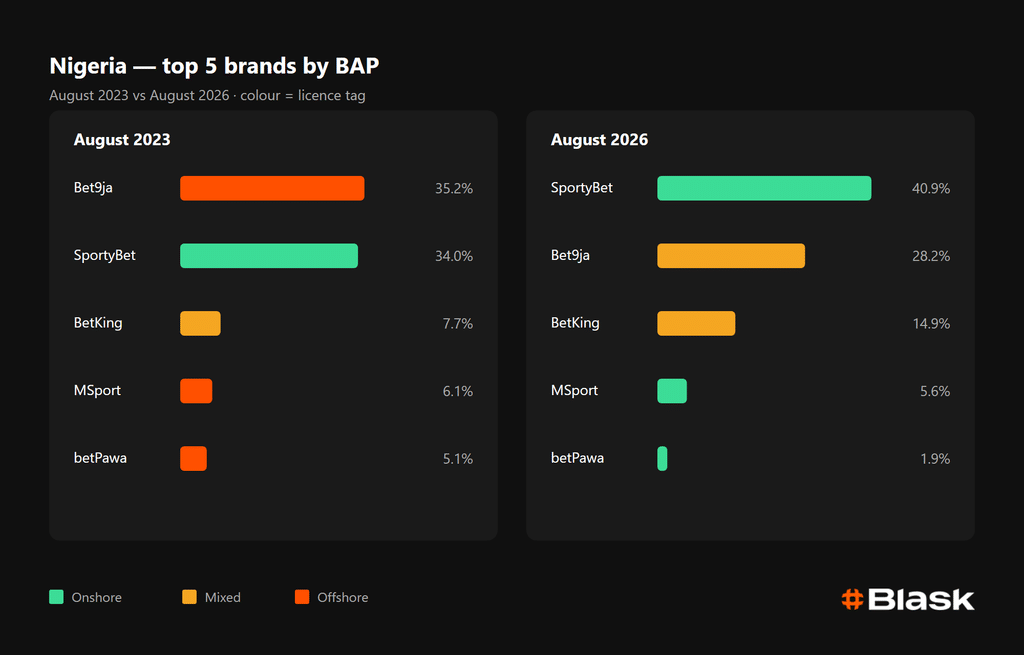
The operator takeaway is concentration plus tagging. Nigeria elevated the onshore-ready half of an existing duopoly and stripped mass from the offshore shelf.
Did total CEB grow after the flip
Channelization here meant redistribution of attention inside a larger pie.
Total CEB rose by about 79% from August 2023 to August 2026. Mid-2024 softened in absolute terms even as the onshore Blask Index kept rising. From early 2025 the market climbed again and settled on a higher plateau through 2026.
Bottom line
Nigeria’s Blask Index swung from a near-even onshore–offshore split in August 2023 to about 99% onshore by August 2026, with the decisive step in November 2023 after Lagos pressed unlicensed operators. SportyBet and Bet9ja remained the demand core while offshore BAP thinned, and total CEB rose from about $38.8M to about $69.3M over the same span.
About Blask
Blask is an AI-powered platform for iGaming and gambling market analytics. The company turns fragmented open-source signals into real-time insight on brand visibility, player demand, and baseline revenue metrics, helping teams move first, spend smarter, and reduce risk across global markets