Payment Infrastructure: Solving Cross-Border Payouts in African Gaming

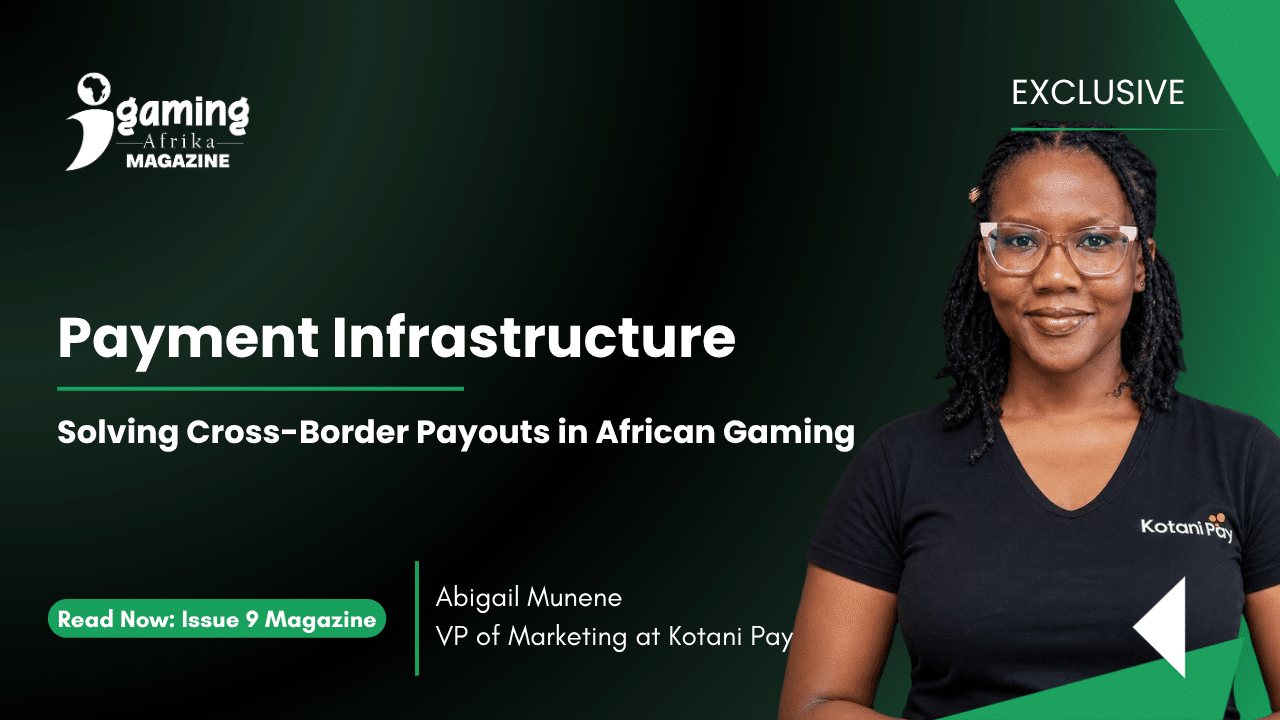
Africa does not lack a payment infrastructure. I mean, there’s already a thriving fintech ecosystem of digital wallets, mobile money, and internet banking systems. But why is smooth transaction still a major issue to operators and players? Well, in this interview with Abigail Munene, VP of Marketing at Kotani Pay, she sheds light on the main problem, fragmentation.


Africa’s payment landscape has changed quite a bit in recent years. From where you sit, what do you think is the biggest payment challenge the continent still needs to solve?
Definitely fragmentation. Africa has multiple countries, currencies, payment systems, regulators, and consumer behaviors, and they don’t all speak to each other. What works in Kenya may not work the same way in South Africa, Togo, or Morocco.
We have built incredibly strong local payment systems. Mobile money is a great example of that. The challenge is what happens when you need those systems to work together across borders.
The cost of moving money also reflects this fragmentation. The World Bank reported that sending $200 to Sub-Saharan Africa cost an average of 7.9%. The cost varies significantly by corridor, with some intra-African corridors being considerably more expensive.





For businesses, the problem goes beyond the transaction fee. Expanding into a new market can mean integrating with new payment providers, navigating another regulatory environment, managing another currency, and then reconciling all those transactions.
Until we make these payment systems more interoperable, fragmentation will continue to be an operational cost for businesses.

We already have strong local systems like mobile money, bank transfers and digital wallets. So where do you think the real gaps are, particularly when money needs to move between African countries?
That will have to be interoperability. Africa doesn’t have a payment technology problem. In many markets, we have very sophisticated local payment systems. The gap is getting those systems to communicate with each other effectively across borders.
Take mobile money. M-Pesa is deeply embedded in Kenya, while MTN Mobile Money and Airtel Money are important across several other African markets. These systems work extremely well within their respective ecosystems, but cross-border movement introduces another layer of complexity.
Read Also: Sitting on Both Sides of the Table: A Compliance Leader’s Blueprint for Africa’s Gaming Future
Even when the same bank operates in multiple African countries, the payment infrastructure, regulations, currencies, and local processes can be completely different. So a business may integrate with a payment provider in one country and then have to essentially start the process again when it enters another market. That’s double work. It’s expensive, it’s time-consuming, and ultimately the cost gets passed down the chain.
We need infrastructure that allows businesses to connect once and access multiple payment ecosystems without having to rebuild their payment stack every time they enter a new market.
Different African markets have very different currencies, regulations, and payment habits. How much does that fragmentation make it difficult for businesses trying to operate across the continent?
Fragmentation is an operational cost for businesses. Imagine you’ve integrated with a mobile money provider in Kenya to give your customers access to M-Pesa. Now you also need to serve customers who prefer another network. Then you expand into another country and encounter a completely different payment ecosystem.
Every market comes with its own payment infrastructure, currencies, regulations and consumer behaviour. Then there’s compliance. As you expand, you need the right teams and processes to keep up with different regulatory requirements, transaction monitoring, and customer due diligence.
Reconciliation can also become a headache when you’re receiving and disbursing funds through different providers, currencies, and markets. Then you have trapped liquidity and settlement delays. Money can end up sitting in different markets while a business waits to move or reconcile it. This is why I think the conversation needs to move beyond simply asking, “Can I make a payment in this country?” The bigger question is, “How efficiently can I operate across multiple countries?“
When you look at everything happening across African payments, Web3 and gaming, what are you most excited about and what still makes you cautious about where we’re heading?
I am mostly excited by the curiosity I am seeing from businesses. From banks to iGaming businesses and fintechs, we’re seeing more companies integrate multiple solutions into their platforms rather than dismissing new technologies outright. There is a level of curiosity that is allowing businesses to dip their toes in, experiment and understand where these technologies actually create value. This is happening alongside a broader maturation of the regulatory conversation around Web3 and emerging technologies.
That combination of business curiosity, infrastructure development and regulatory clarity creates an interesting environment for African businesses to position themselves to compete in a global, increasingly digital economy.
Read Also: Beyond the Boardroom: Loyce Oluoch on Leadership, Governance and Africa’s Future
What makes me cautious is due diligence. With new technology comes unfamiliar risks. We need more education, more awareness and stronger due diligence around the platforms and infrastructure businesses choose to use. Innovation shouldn’t mean switching off your risk radar. If anything, the newer the technology, the more important it becomes to ask: Who am I dealing with? What are the controls? Where does the money move? What happens when something goes wrong?
The opportunity is huge, but responsible adoption is what will make it sustainable.