Limpopo Gambling Board Celebrates Court Victory Against Illegal Gambling


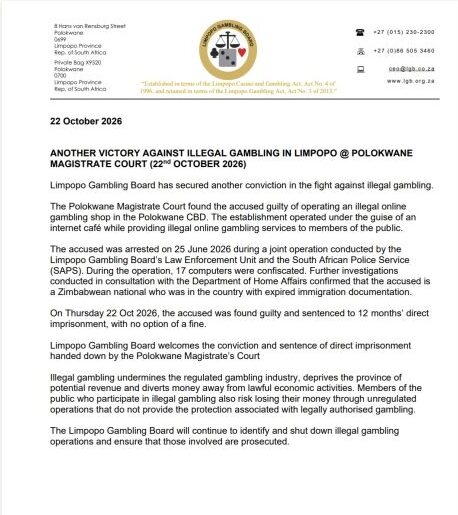
The Limpopo Gambling Board is celebrating a legal victory after the Polokwane Magistrate’s Court sentenced an illegal gambling operator to 12 months’ direct imprisonment, with no option of a fine.


The conviction marks a milestone for provincial authorities working to dismantle illegal betting operations that deprive the public purse of revenue and expose consumers to financial risks.
On 25 June 2026, the Limpopo Gambling Board’s (LGB) Law Enforcement Unit, in collaboration with the South African Police Service (SAPS), raided premises in Polokwane’s central business district (CBD). The premises operated as an internet café but were allegedly being used to provide unauthorised online gambling services. During the operation, the team seized 17 computer workstations used for online wagering.
Consultations with the Department of Home Affairs subsequently revealed immigration violations. The accused, a Zimbabwean national, was reportedly living and operating a business in South Africa with expired immigration documentation.






On Thursday, 22 October 2026, the court sentenced the accused to 12 months’ direct imprisonment, with no option of a fine. The LGB welcomed the ruling, describing it as a strong deterrent to unlawful gambling operations in the province.
The Polokwane case highlights an operating model that provincial regulators and researchers have observed across South Africa. In a study published in the International Journal of Social Sciences and Humanity Studies (Vol. 10, No. 1, 2018; ISSN 1309-8063), researchers Mmanoko Philemon Masogo of the LGB and Professor Jacob Tseko Mofokeng of Tshwane University of Technology analysed the spread of illegal online gambling shops across Limpopo, Gauteng and North West. Their study, titled “An Analysis on Illegal Online Gambling Activities: The Comparative Study within the Gauteng, North West, and Limpopo Provinces,” found that underground venues often follow a similar model.

Illegal operators may set up venues resembling ordinary internet cafés or small casinos, using desktop terminals with touchscreens rather than traditional slot-machine cabinets. These venues may have security gates and camera systems while running gaming software hosted on foreign servers.
Customers may assume that such venues are licensed or affiliated with land-based casinos, leaving them vulnerable to gambling in unregulated environments without the protections provided by law.
“Illegal gambling undermines the regulated gambling industry, deprives the province of potential revenue and diverts money away from lawful economic activities,” the LGB said following the judgment. “Members of the public who participate in illegal gambling also risk losing their money through unregulated operations that do not provide the protection associated with legally authorised gambling.”
Unlike licensed operators, which are subject to requirements such as game-fairness testing, internal controls, anti-money-laundering reporting, and contributions to public funds and responsible-gambling programmes, illegal operations offer no formal dispute-resolution process or consumer recourse.
Gregory Makoko, Limpopo Gambling Board CEO linked the conviction to the International Association of Gaming Regulators (IAGR) 2026 conference in Lima, Peru, writing: “Another victory for the Limpopo Gambling Board in combating illegal gambling—one of the priorities of IAGR 2026 in Lima, Peru.”
The LGB said it would continue to identify and take action against unlicensed gambling operations across the province.