Exclusive: Ladibo Abiose Shares Insights on Nigeria’s First Rehabilitation Centre

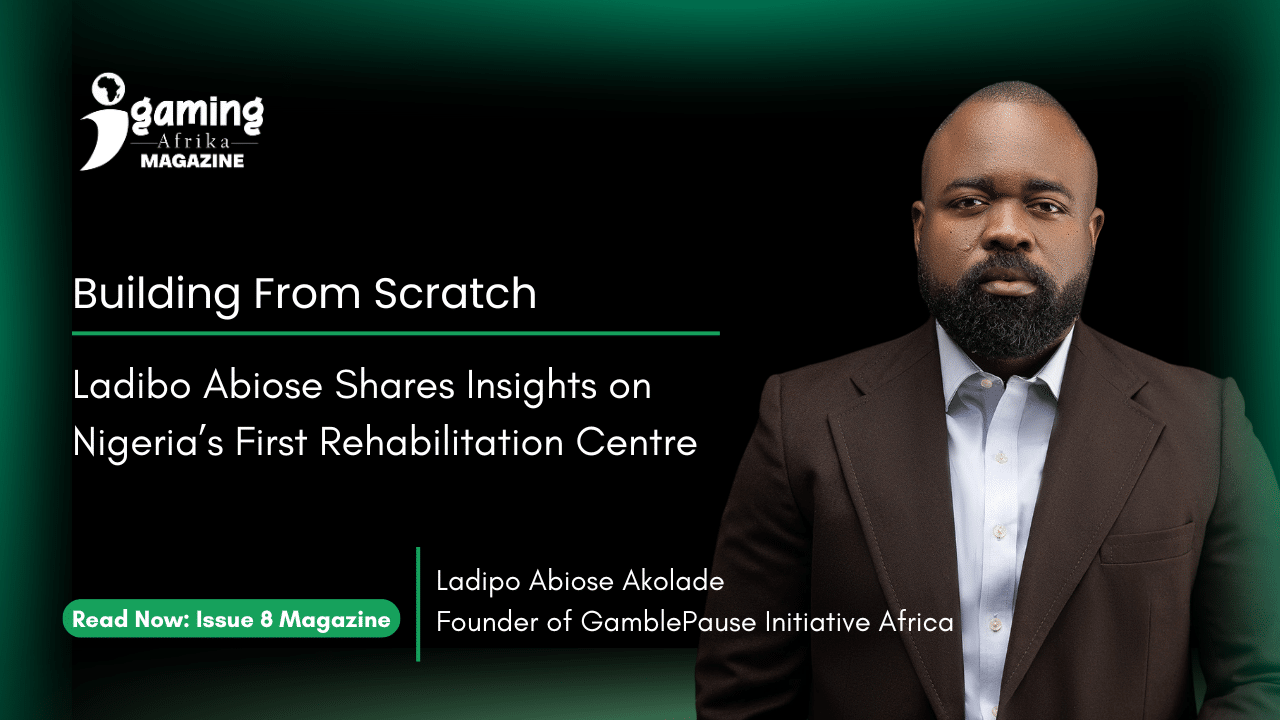
The launch of Nigeria’s first free gambling rehabilitation centre in 2025 marked a major step in addressing behavioural addiction. However, as shared by Ladipo Abiose Akolade, Founder of GamblePause Initiative Africa, Nigeria, in an interview with iGaming AFRIKA Magazine, the process exposed significant structural gaps. Gambling addiction remains under-recognised, underfunded, and often misunderstood, highlighting its continued absence within Africa’s public-health priorities.


iGaming AFRIKA: Could you briefly introduce yourself and tell us a bit about what you do?
Ladipo Abiose: My name is Ladipo Abiose Akolade. I work at the intersection of player protection, public health, and responsible gambling policy in Africa. My work focuses on understanding how gambling harm manifests within African socio-economic realities and building practical systems that reduce harm before it escalates. Over the years, this has involved counselling, community engagement, policy advocacy, and designing prevention-first digital tools that place protection directly in the hands of players and families. At its core, my work is about translating lived experience and data into systems that work at scale.
iGaming AFRIKA: What specific structural or operational gaps did you observe early in your engagement with the gaming industry, and how have those observations evolved as the African market has expanded and matured?
Ladipo Abiose: Early on, the most visible gap was the absence of structured player protection despite rapid market growth. Access expanded quickly, but safeguards did not. Over time, as markets matured, the gap became more nuanced: not only were protections missing, but many that existed were imported models poorly suited to African contexts. As the industry expanded, the gap shifted from “no tools” to “tools that exist but don’t work for how people actually live, earn, and gamble in Africa.”
iGaming AFRIKA: Before founding GamblePause Initiative Africa, what concrete cases, data, or recurring patterns convinced you that gambling harm was being systematically under-addressed?
Ladipo Abiose: The strongest signal came from repetition. We saw the same patterns across different countries and communities: young adults betting with rent or school-fee money, family members calling on behalf of someone who had withdrawn socially, and individuals seeking help only after debt or relationships had already collapsed. These were not isolated incidents; they were systemic. The absence of early-stage intervention meant people were reaching out for support only at the crisis point, which is the most expensive and least effective stage for intervention.





iGaming AFRIKA: In mid-2025, GamblePause launched Nigeria’s first free gambling rehabilitation centre. What challenges had to be overcome, and what did this reveal about public-health support for gambling addiction?
Ladipo Abiose: The biggest challenges were structural, not operational. Gambling addiction sits in a grey zone, neither fully recognised as a public-health priority nor clearly resourced within existing systems. Navigating regulatory clarity, funding sustainability, and professional capacity all required deliberate problem-solving. The process revealed that while substance addiction services receive some institutional recognition, behavioural addictions like gambling remain largely invisible in public-health planning, despite their growing impact.
iGaming AFRIKA: Since the centre’s launch, what metrics or evaluation frameworks do you use to assess long-term impact?
Ladipo Abiose: We track both quantitative and qualitative indicators. These include waiting times, session completion rates, relapse intervals, self-reported behavioural change, and referral outcomes. Equally important are qualitative markers, such as improved family relationships, employment stability, and reduced financial distress. Long-term impact in this field is not about instant cessation; it’s about sustained behavioural control and restored agency.

iGaming AFRIKA: Being named Clarion Gaming’s Safer Gambling Charity Partner places GamblePause on a global platform. How does this recognition change expectations?
Ladipo Abiose: It raises the bar significantly. Recognition at that level brings heightened expectations around governance, transparency, and measurable outcomes. It also creates responsibility: to demonstrate that African-led solutions can meet global standards while remaining locally relevant. Internally, it reinforced our commitment to strong data discipline, ethical partnerships, and long-term credibility.
Read Also: Nigeria-headquartered GamblePause Named Clarion Gaming Safer Gambling Charity Partner
iGaming AFRIKA: How does untreated gambling harm typically progress over time, and which stage is hardest to reverse?
Ladipo Abiose: Gambling harm often begins quietly, with occasional overspending, secrecy, and rationalisation. It then progresses into loss-chasing, emotional volatility, and social withdrawal. The most difficult stage to reverse is when gambling becomes intertwined with identity and hope, when individuals believe gambling is their only remaining option. At that point, the harm is psychological as much as financial.
iGaming AFRIKA: How do financial pressure and social-media narratives distort young bettors’ understanding of risk?
Ladipo Abiose: Social media compresses time and reality. Wins are visible, losses are hidden. In environments of economic pressure, this creates a dangerous illusion: that success is common, and failure is personal. Probability becomes emotional rather than mathematical. Young bettors often understand odds intellectually, but emotionally, they are influenced by narratives of escape and urgency.
iGaming AFRIKA: Where should responsibility sit between operators, regulators, governments, and players?
Ladipo Abiose: Responsibility must be shared, but not evenly. Regulators must enforce standards, operators must design safer products, governments must fund prevention and treatment, and players must be empowered with real tools. Currently, too much responsibility is placed on individual self-control and not enough on system design.
Read Also: Exclusive: Borah Omary Shares Insights on betPawa’s Marketing and CSR Strategy
iGaming AFRIKA: If regulators enforced only one evidence-based requirement in the next 12 months, which would have the most impact?
Ladipo Abiose: Universal, friction-free self-exclusion across platforms. Not fragmented tools, but systems that genuinely interrupt access. Evidence consistently shows that reducing exposure reduces harm faster than awareness campaigns alone.
iGaming AFRIKA: What barriers prevent people from seeking help, and how must interventions adapt?
Ladipo Abiose: The biggest barriers are stigma, fear of judgment, and cultural expectations around self-reliance, most especially in Africa. Many Africans see gambling harm as a moral failure rather than a behavioural health issue. Interventions must therefore be discreet, culturally aware, language-inclusive, and accessible without requiring public disclosure.
iGaming AFRIKA: What would indicate that Africa has moved to a prevention-led ecosystem?
Ladipo Abiose: When protection tools are embedded by default, not added after harm occurs. When funding prioritises prevention over crisis response. And when success is measured not only in revenue, but in reduced harm indicators
Read the full interview in our digital magazine: