From Scepticism to Scale: The Remarkable Rise of iGaming Affiliate Partnerships in Africa

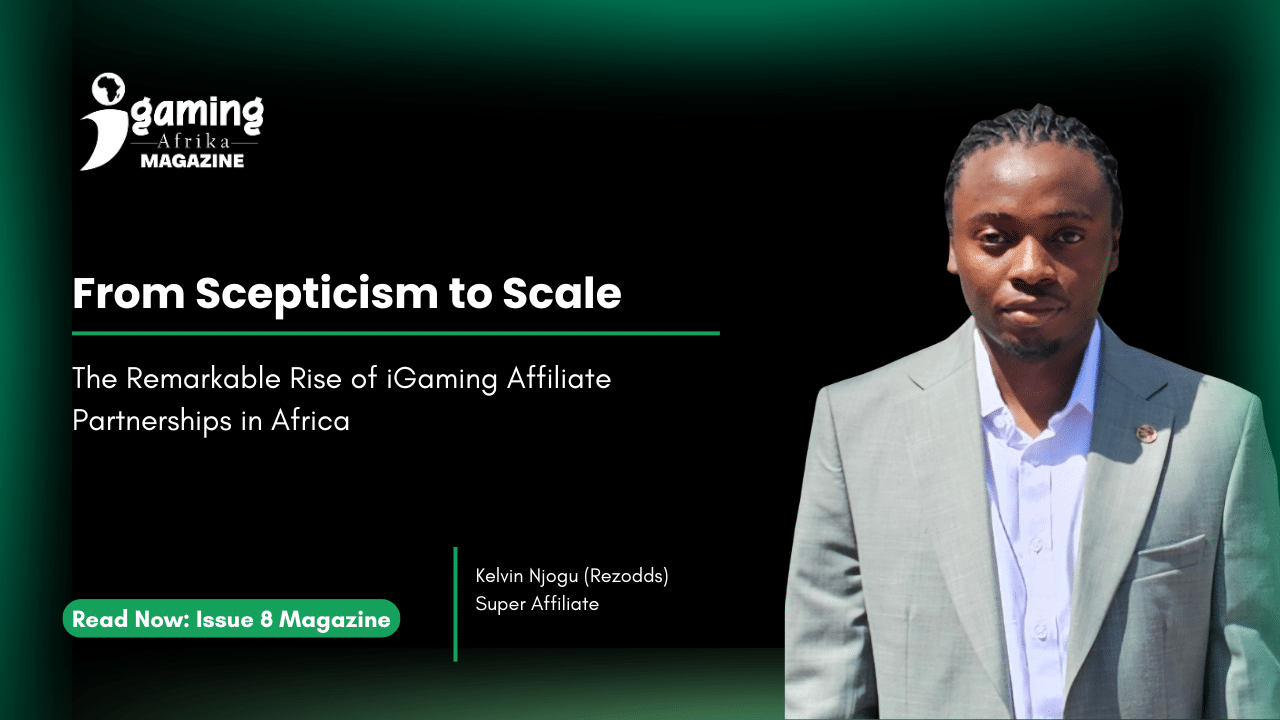
By Kelvin Njogu (Rezodds) – Super Affiliate


Eight years ago, I found myself in one of the most misunderstood, yet highly lucrative, corners of the digital economy: iGaming affiliate marketing. This is not merely a story about commissions and conversion rates; It is a story about pioneering a market, surviving its turbulence, and thriving through its evolution. If you are an affiliate marketer, whether seasoned or aspiring, or an operator looking to understand the African affiliate landscape, this article is written for you.
Humble Beginnings. Entering an Untested Market
When I first entered the betting affiliate marketing space eight years ago, the concept was virtually unknown across Africa. A friend who had been approached and signed up as an affiliate and subsequently an affiliate manager pulled me aside and explained the mechanics: refer players to a betting platform, earn a commission on their activity, repeat. It sounded straightforward. The reality was anything but.
My first affiliate partnership was with BetWinner, a foreign operator that, like many of its peers at the time, was trying to crack the African market with limited success. My traffic was modest, and my audience was small. But the real challenge was not my numbers; it was the market itself.





Kenya, at the time, was firmly in the grip of SportPesa, a local betting giant that had captured the imagination and the wallets of Kenyan bettors with extraordinary speed. The brand was everywhere on football jerseys, on billboards, on the lips of every sports fan in the country. Competing against that kind of brand dominance as a small affiliate pushing a relatively unknown foreign platform was, to put it plainly, an uphill battle.
Beyond the competition, there was the trust problem. When I tried to bring other marketers into the affiliate space alongside me, the conversations were difficult. The idea that you could earn a legitimate weekly commission simply by driving new registered and active players onto a betting platform was met with deep scepticism. Many people conflated it with pyramid or multi-level marketing schemes. A comparison that fundamentally misunderstands the model. Convincing eligible affiliates was a conversation that rarely ended in agreement. The market was not ready. The education was not there. And the infrastructure was barely in place.

The Commission Landscape Then and Now
When foreign operators first entered the African market, they came bearing two primary commission structures: Revenue Share (RS) and Cost Per Acquisition (CPA).
Revenue share arrangements at the time ranged between 25% and 40%. A figure that felt generous then but tells a very different story when viewed against today’s standards. CPA deals were straightforward: a fixed payment for every qualifying player deposited and verified.
Personally, I gravitated towards a combination of commission and CPA. It offered the best of both worlds with immediate income from acquisitions and long-term recurring revenue from active players. It was a model that rewarded quality as much as volume.
Fast forward to today, and the landscape has shifted dramatically. New platforms entering the African market, many of them aggressively hungry for market share, have pushed revenue share offerings to between 25% and 50%, with some operators dangling commissions as high as 60%. A figure that would have been entirely unheard of eight years ago is now a negotiating chip on the table.
The commission structure itself has also matured. Where operators once leaned heavily on pure RS or pure CPA arrangements, the market has moved towards hybrid models. A combination of revenue share, CPA, and fixed payments that reflects the increasingly sophisticated understanding operators now have of affiliate value. Heavy competition between brands has driven this evolution, and affiliates who understand how to leverage it stand to benefit enormously.
Read Also: Exclusive: Social media in iGaming: It’s Not About Reach, It’s About Relevance
How the Ecosystem Evolved Around Us
Affiliate marketing does not exist in isolation. It is shaped by every player in the broader iGaming ecosystem. And over the past eight years, that ecosystem has undergone a profound transformation.
Payment infrastructure is perhaps the most visible example. In the early days, affiliate commissions were paid almost exclusively in cryptocurrency. For many affiliates across Africa, this created a significant barrier. Navigating crypto wallets, managing exchange rates, and converting digital assets into usable local currency were not skills most people possessed. It was a friction point that quietly limited the growth of affiliate networks across the continent.
Today, the picture is radically different. Local payment platforms like mobile money services, local bank transfers, and region-specific digital wallets have been integrated into affiliate payment systems across the board. The ability to receive commissions directly into an M-Pesa wallet or a local bank account has removed a critical barrier to entry and opened the affiliate model to an entirely new demographic of marketers across Africa.
Gaming platform providers have equally shaped the affiliate space. As the technology powering betting platforms became more sophisticated, better user interfaces, faster cashouts, more diverse betting markets and live casino products, the affiliate’s job of selling the platform became easier. A product that genuinely delights users generates organic retention, and retained players mean sustained revenue share income for the affiliate. The quality of the underlying product and the affiliate’s earning potential are inextricably linked.
The Regulatory Revolution. A Double-Edged Sword
No honest discussion of iGaming affiliate marketing in Africa can avoid the subject of regulation. It is simultaneously the most disruptive and the most necessary force shaping the space today.
Eight years ago, the regulatory environment across most African markets was thin. Operators entered with relative ease, affiliates promoted freely, and the conversation around responsible gambling was largely absent. That era is behind us.
Across the continent and most acutely in Kenya, regulators have tightened their grip on the gambling industry with increasing conviction. Licensing requirements have become more stringent. Advertising restrictions have been introduced. Tax frameworks have been restructured. Operators have been suspended, fined, and in some cases shut down entirely for non-compliance.
For affiliates, the consequences are direct. The platforms we promote must hold valid licenses in the jurisdictions we target. The promotional content we produce must comply with advertising standards that vary from market to market. The player audiences we reach must be of legal gambling age and must be presented with responsible gambling messaging.
This is not a burden to be resented but a standard to be embraced. Affiliates who build compliant, responsible promotional ecosystems are the ones that operators trust with their best deals and their highest commission tiers. Compliance is not the enemy of profitability, increasingly its prerequisite.
Start Chasing Quality and Stop Chasing Volume
This is perhaps the most important lesson I have learned in eight years and one that I see violated constantly by affiliates at every level of experience.
The temptation in affiliate marketing is always to chase numbers with more clicks, more registrations and more sign-ups. Traffic volume becomes the metric by which affiliates measure their own worth and by which they negotiate with operators. It is an understandable instinct. It is also a fundamentally flawed strategy.
Here is what I have observed repeatedly over nearly a decade in this space. Some affiliates command enormous followings with tens of thousands of social media followers, high-traffic websites, substantial email lists and yet their conversion rates are poor, and their players churn quickly. The volume is there. The quality is not.
Conversely, I have watched affiliates with relatively modest audiences generate disproportionate revenue. It is not because they drive more players but because they drive the right players. Players who deposit consistently engage with the platform regularly and remain active over extended periods. These are the players that operators value most highly. These are the players that generate sustainable revenue share income month after month.
The difference lies in audience alignment. An affiliate whose audience genuinely shares an interest in sports betting or casino gaming will always outperform an affiliate whose audience is broad but disengaged. A football community of five thousand passionate fans will deliver better player quality than a general lifestyle page of fifty thousand passive followers.
Quality over volume is not only a good philosophy, but it is also good business.
Negotiating Affiliate Deals
One of the most consistent mistakes I see affiliates make, particularly those newer to the space, is entering commercial negotiations with operators armed with nothing but enthusiasm and vague claims about their reach.
Let me be direct. Operators have seen everything. They have heard every pitch. What moves the needle in a negotiation is not passion; it is data.
Before you sit down to negotiate a deal, whether for a higher revenue share tier, a better CPA rate, or a hybrid arrangement, you need to know your numbers intimately. What is your monthly traffic volume? What is your conversion rate from click to registration? What is your conversion rate from registration to first deposit? What is the average deposit value of your referred players? What is their retention rate at thirty, sixty, and ninety days?
These are the metrics that operators care about. They tell the story of your true value as an affiliate partner far more compellingly than raw follower counts or website visitor numbers ever could.
Equally important is understanding what operators want from affiliates in 2026. The answer has evolved significantly. Today’s operators are not simply looking for affiliates who can deliver volume; they are looking for affiliate partners who can deliver compliant, high-quality, well-retained players through credible and brand-safe promotional channels. They want affiliates who understand their products, represent their brands accurately, and build long-term relationships with their audiences rather than chasing one-time sign-up bonuses.
The affiliates who command the best deals in today’s market are those who can demonstrate with data that they deliver exactly that.
Looking Ahead: The African Affiliate Opportunity in 2026 and Beyond
The African iGaming affiliate market that exists today bears almost no resemblance to the one I entered eight years ago. The infrastructure is better, the commissions are higher, the payment systems are more accessible, and the operators are more sophisticated in how they engage with affiliate partners.
But the fundamental opportunity connecting quality players with quality platforms and earning a share of the value that the relationship creates remains as compelling as it has ever been.
The affiliates who will thrive in the years ahead are those who treat this space as a profession rather than a side hustle. Those who invest in understanding their audiences, building compliant promotional channels, mastering their data, and negotiating from a position of informed confidence.
Eight years ago, I entered this space with a small audience, a basic understanding of the model, and the naïve optimism of someone who had no idea what they were getting into. Today, I can say without hesitation that iGaming affiliate marketing, done properly, professionally, and done responsibly, remains one of the most rewarding commercial opportunities available to digital entrepreneurs across Africa.
The market has grown up. The question is whether we, as affiliates, are growing with it.
Read the full article in our digital magazine: