Is Nigeria Ready to Become Africa’s Premier iGaming Market?

The Nigerian iGaming market is the second biggest and fastest-growing on the African continent, as a result of its 244 million+ population and over half the country owning a smartphone. With a current market value of $176 million and a 7.4% growth rate, the country is projected to lead the iGaming industry in Africa by 2030. However, the real question now is whether Nigeria can actually become Africa’s premier iGaming market, rather than just leading by a high-volume consumer base.


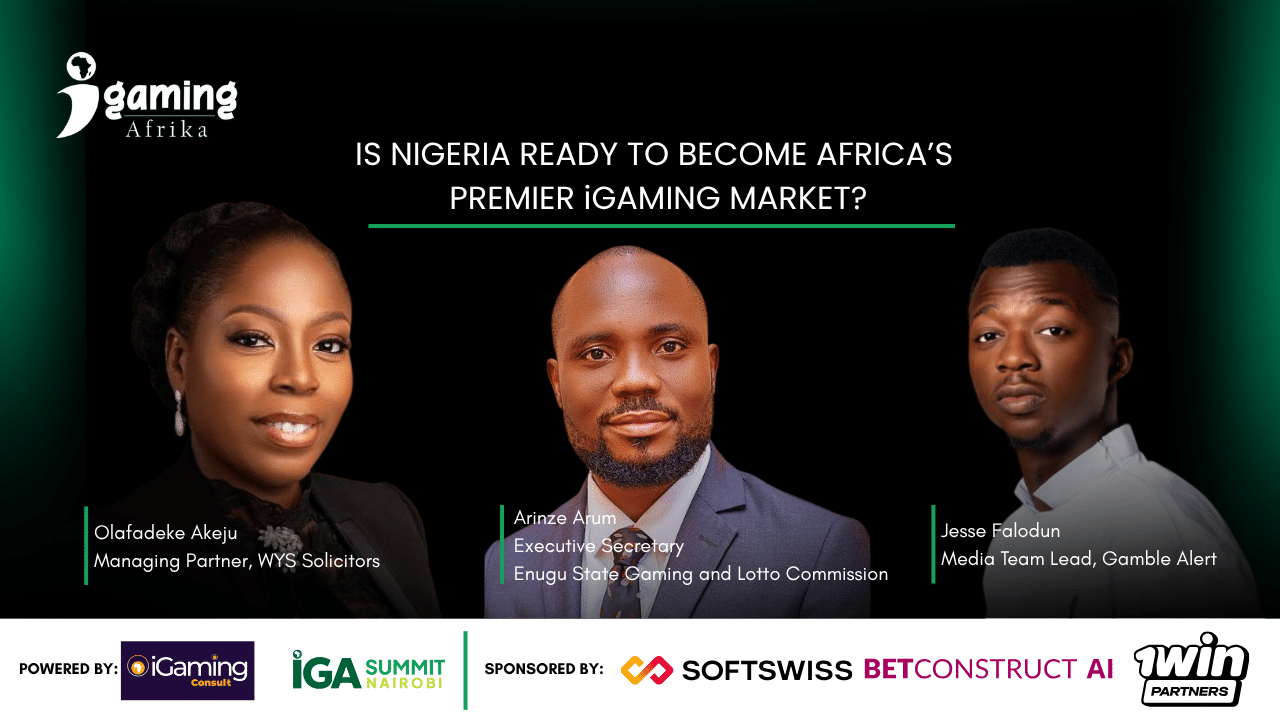
During the 36th edition of the iGaming AFRIKA webinars, moderated by Jesse Falodun of Gamble Alert, industry leaders provided insights on the current iGaming state in Nigeria and steps to moving the sector forward. The session, themed “Building Nigeria’s iGaming Market into Africa’s Premier iGaming Market: Strategies for Regulation, Responsibility, and Growth,” moves past just highlighting the problem and focusing more on the strategic solution that can push the industry for the next five to ten years.
This industry has been growing steadily, with an increasing number of active users in recent years, from 16.2 million active participants in 2023 to 187.8 million in 2024. There has also been a notable shift in preference amongst the users, with many moving from the traditional lotteries to online casino games and sports betting.
While the technological adaptation is steadily growing, it’s quite saddening that the infrastructure powering the growth is mostly foreign. The industry is rapidly integrating into a larger economy, yet its reliance on imported B2B technology, ranging from sportsbook software and odds data services to casino aggregation platforms and CRM systems, creates significant economic friction.






During the webinar, Olafedeke Akeju, Founder of SLEC Africa and Managing Partner at WYS Solicitors, pointed out the true metric that can drive the country towards a premier iGaming market. She emphasized that the fundamental shift required is in how the country participates in the continent’s iGaming value chain.
“If Nigeria wants to become Africa’s premier iGaming market, success cannot simply mean that Nigerians are Africa’s biggest consumers of gaming products. It should also mean that Nigeria becomes one of Africa’s leading producers and exporters of gaming technology, intellectual property, talent, and regulatory expertise”.

Despite generating substantial revenue from gaming activities locally, the failure to localize backend infrastructure means the Nigerian economy does not retain the majority of its profits. Highlighting this discrepancy, Akeju pointed to the financial drain caused by outsourcing tech and operations. “Much of that revenue is paid out in capital flight to investors and also to service providers, also to personnel,” she said.
This structural imbalance prevents the market from maturing into a self-sustaining ecosystem. The current reality is that while domestic operators secure local licenses and acquire millions of players, the technical backbone that processes wagers, manages players’ risk, and curates casino content is often leased from European and other international tech giants.
Read Also: Can Africa Move Responsible Gambling Beyond Tick-Box Compliance?
To solve this economic friction, Nigeria must now look towards aggressively investing in localized tech infrastructure. The country already boasts 1.1 million developers, and the missing link is now channeling that expertise into the iGaming sector.
Arinze Arum, Executive Secretary and CEO of the Enugu State Gaming and Lotto Commission, challenged the industry’s status quo by posing a critical question to stakeholders. He said, “Do we constantly rely on foreign and imported technology, or can we invest and promote the local content, the local talent that we have?” He went on to stress that the ongoing reliance on external software providers directly drains the market’s potential.
Despite its massive potential, the Nigerian iGaming industry still faces various challenges that can slow down its transformation into a premier market. Arinze Arum identified four primary obstacles that are still holding the industry back.
First is the regulatory fragmentation between the state and the Nigerian federation, stressing the need for clarity. He noted how the lack of synchrony among different iGaming regulatory institutions in Nigeria causes a volatile investment environment. Second is the largely existing illegal gambling sector. This means that the legitimate, tax-paying operators bear the heavy burden of compliance, while the illegal ones operate freely, creating an uneven playing field. Arinze also noted the over-extraction of revenue as a major challenge, which stifles the industry. While recent developments like the Nigerian Tax Act offer some hope for consolidation, taxation should, however, be structured to ensure operator viability rather than just extracting maximum short-term revenue. Lastly, he mentioned that the poor compliance culture is also a major setback, since operators view it as a reactive measure rather than collaborative.
Arinze further went on to say that what is needed is clarity. Who regulates, what standards apply, the licensing requirements, tax obligations, and the steps to be taken in case of non-compliance.
For Nigeria to move from Africa’s second-largest consumer iGaming market to a premier one, the dynamic between the regulators and operators must evolve from adversarial to collaborative. The regulators must now prioritize market integrity and consumer protection, rather than over-focusing on revenue generation. Licenses should therefore be a determinant of an operator’s fitness, and the subsequent oversight should not be hostile.
Additionally, the regulatory framework must match the speed of technological adaptation. Many of its existing laws were drafted with traditional retail betting shops in mind. Applying such laws to the modern digital industry creates a severe setback. Olafedeke stressed that regulators cannot force new technology into an old legal box. Instead, the industry now needs regulatory sandboxes. These controlled pilot programs allow tech companies and operators to test new products under regulated supervision before lawmakers draft permanent legislation. This test-and-learn approach sees that the country can safely introduce advanced betting products while fully understanding their impact on consumer safety and market integrity.
Lastly, the operators must now rethink their internal practices. Historically, operators have always treated compliance as a reactive chore, especially when the government audit looms. Moving forward, companies should now practice proactive compliance through building responsible gaming safeguards, transparent financial reporting, and strict data security in their daily operations.