Can Africa Move Responsible Gambling Beyond Tick-Box Compliance?


Responsible gambling cannot remain a tick-box compliance exercise if Africa’s gaming industry is to grow sustainably. Meaningful player protection requires stronger enforcement, better technology and closer collaboration among regulators, operators, advocacy groups and communities.


Those issues took centre stage during Episode 35 of the iGaming AFRIKA webinars titled, “Responsible Gambling: Policy or PR? Protecting Minors from Underage Gambling.”The discussion examined whether growing awareness of safer gambling across Africa has translated into meaningful action, particularly when it comes to protecting minors.
The session was hosted by iGaming AFRIKA in partnership with iGaming Consult Africa and iGA Summit. The webinar featured Fisayo Oke, CEO of Gamble Alert, Gabriel Joseph, CEO of Gamble Aware NG and Ladipo Abiose, CEO of GamblePause Initiative Africa. The discussion was moderated by Mary Wanja, Content Director at iGaming AFRIKA, and sponsored by SOFTSWISS, 1Win Partners and BetConstruct.
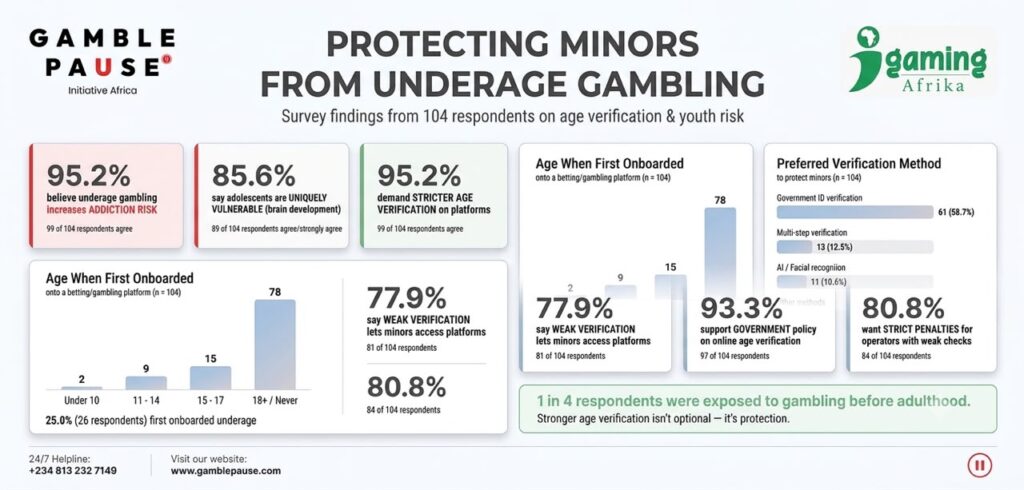
Ladipo said responsible gambling initiatives have become necessary because of the social challenges accompanying the industry’s rapid expansion. Citing findings from a recent GamblePause survey, Abiose said concern over underage gambling is becoming increasingly difficult to ignore. Of the 104 respondents surveyed, 95% believed underage gambling increases the likelihood of addiction later in life, while one in four said they had been exposed to gambling before reaching legal age.





The survey also found strong backing for stricter age verification systems, with more than 93% of respondents supporting tougher identity checks and eight in 10 called for stronger penalties against operators that fail to protect minors.
Building on the discussion, Mary steered the conversation toward accountability. She questioned whether the collaborative approach that is frequently advocated for truly yields meaningful results or it simply disperses responsibility and dilutes accountability. In response, Fisayo argued that the industry’s understanding of collaboration remains too narrow and insisted that player protection cannot be achieved by regulators and operators alone.

“When we talk about the cooperation amongst stakeholders, it is not just operators and regulators we are talking about. We are talking about family members, loved ones, communities, advocacy groups, civil society organisations, mental health professionals, the media, and everyone who is involved in a community has a role to play,” he said.
To illustrate his point, he cited the example of a minor gambling using a parent’s account. Even where operators have robust age verification processes, he said, parents and guardians can unintentionally undermine those safeguards by allowing children access to their devices, accounts or payment methods. In such cases, responsibility cannot rest solely with the operator because the wider support system has also failed to protect the child.
While he acknowledged that responsible gambling has gained traction in many jurisdictions, Fisayo said that fragmented regulations continue to limit cooperation and make it difficult to establish consistent player protection standards across the continent. “We currently do not have a standardized framework around responsible gambling,” he said. “That has not to say that we have not made any progress, but… we have a long way to go in terms of achieving excellence when it comes to cooperation.”
Advertising emerged as one of the panel’s most debated topics, with speakers arguing that the industry’s marketing practices continue to shape public perceptions of gambling in ways that often conflict with responsible gambling objectives. Gabriel said research by his organisation found that many players enter gambling believing it is a pathway to financial gain and not entertainment. “We realised that one of the perceptions in terms of people coming into gaming was that they were coming in for financial gain,” he said. “Many adverts promise financial gains. Many adverts glamorize gambling as a source of income.”
According to him, the challenge extends beyond the content of advertisements. He pointed to gaps in regulatory oversight and said that responsibility for gambling advertising is often shared between gaming regulators and advertising authorities, which creates uncertainty over who should enforce standards. The rise of digital marketing has made that task even more difficult, particularly as online platforms, influencers and even businesses without gambling licences increasingly promote betting products. He warned that advertisements from unlicensed businesses are especially problematic because they may not understand or be required to follow the responsible gambling standards expected of licensed operators.
The discussion also examined how operators can market their products more responsibly. Ladipo argued that operators should give responsible gambling tools the same visibility as their products. He said many players remain unaware of features such as self-exclusion simply because operators do not actively promote them. He further called on operators to integrate responsible gambling messaging into mainstream marketing campaigns and pointed out to advertisements that explain how tools such as self-exclusion work.
While self-exclusion and deposit limits are widely recognised across the industry, Gabriel argued that the greatest opportunity lies in preventing harm before it occurs and not just responding after players have already developed problematic gambling behaviours. “For us, the tools that are most effective are actually preventive tools,” he said. “We’re talking about things like AI monitoring software that are embedded in operator platforms that allows them to spot player patterns that are problematic.”
Gabriel added that technology capable of identifying behavioural indicators such as prolonged gambling sessions, erratic deposit patterns and repeated attempts to recover losses allows operators to intervene earlier. By contrast, tools such as self-exclusion and deposit limits often come into play only after problems have already emerged. He also argued that the effectiveness of existing safeguards depends as much on enforcement as on their availability. While many jurisdictions require operators to offer tools such as self-exclusion, deposit limits and timeouts, he said implementation remains inconsistent. Some operators fail to apply self-exclusion requests properly which allows players to regain access to their accounts before the exclusion period expires, while others bury responsible gambling resources deep within their websites, making them difficult for players to find. “A lot of people don’t even know that these tools exist,” he said.
Ladipo agreed that technology should be central to future player protection efforts but argued that age verification deserves greater attention. While self-exclusion remains an important safeguard, he said preventing minors from accessing gambling products in the first place would have a far greater long-term impact on reducing gambling-related harm. “We need to advocate for technologically based verification systems to be embedded on their products,” he said. “Once we are able to put this mechanism in place, I believe that we are headed towards the right direction in ensuring that we protect minors.”
Fisayo pointed to two internationally recognised frameworks that he believes could help strengthen player protection if adapted to African markets. He identified the Reno Model and the Public Health Model. According to him, the Reno Model recognises that every stakeholder has a clearly defined role in protecting players, from regulators and operators to communities and advocacy groups. The Public Health Model, meanwhile, shifts the focus from reacting to individual cases of gambling harm to preventing harm across the wider population by embedding responsible gambling measures from the very beginning of the player journey.
The panel also stressed that African markets should develop solutions suited to local realities and not rely entirely on imported models. Ladipo said that technology offers the best opportunity to scale responsible gambling across the continent, particularly through tools designed for African users. “We cannot keep going to secondary schools for awareness. I do not think it is sustainable,” he said. He highlighted GamblePause’s multilingual blocking application, which incorporates more than 40 African languages alongside parental controls, self-exclusion features and support services to make responsible gambling resources more accessible across diverse communities.
Gabriel similarly argued that stronger identity verification, restrictions on youth-targeted advertising and wider adoption of digital verification toolswould significantly reduce underage gambling. “We need technology to be able to drive forward,” he said as he suggested that biometric age estimation and more robust Know Your Customer (KYC) procedures could become valuable safeguards as African markets continue to digitise.