Rwanda was one of three African markets that lost demand in the first half of 2026, and by August demand was 76% lower than a year earlier after a July fall that H1 did not capture.


Rwanda’s half-year print was −36.2%. These numbers look big, but monthly data through August 2026 shows that first-half number was a midpoint. The 2025 tax rewrite and a later pause at betPawa sit on that curve; July then removed most of the demand that was left.
Blask metrics:
- Blask Index — real-time measure of iGaming search demand for brands and markets.
- BAP (Brand’s Accumulated Power) — a brand’s share of total market demand in a country and period.
- CEB (Competitive Earning Baseline) — projected revenue baseline in USD, shown as an average with a min–max range.
What changed in the tax
Rwanda gazetted a package of income-tax amendments on 29 May 2025. The gaming clauses took effect three months later, around 29 August 2025.



Before the rewrite, operators paid two company taxes: corporate income tax, and a 13% monthly charge on GGR that they could deduct. After 29 August 2025 the new rules removed corporate income tax and put a 40% tax on NGR in its place. A separate tax on player winnings also rose, from 15% to 25%, taken when the player cashes out.
That rewrite raised the cost of staying licensed. The sharper operator break arrived in 2026, when the brand that held most of the market paused the operations.

Demand: a grind, then a July break
Search demand in Rwanda fell in two tempos. The tax year produced a long descent, and July removed most of what remained.
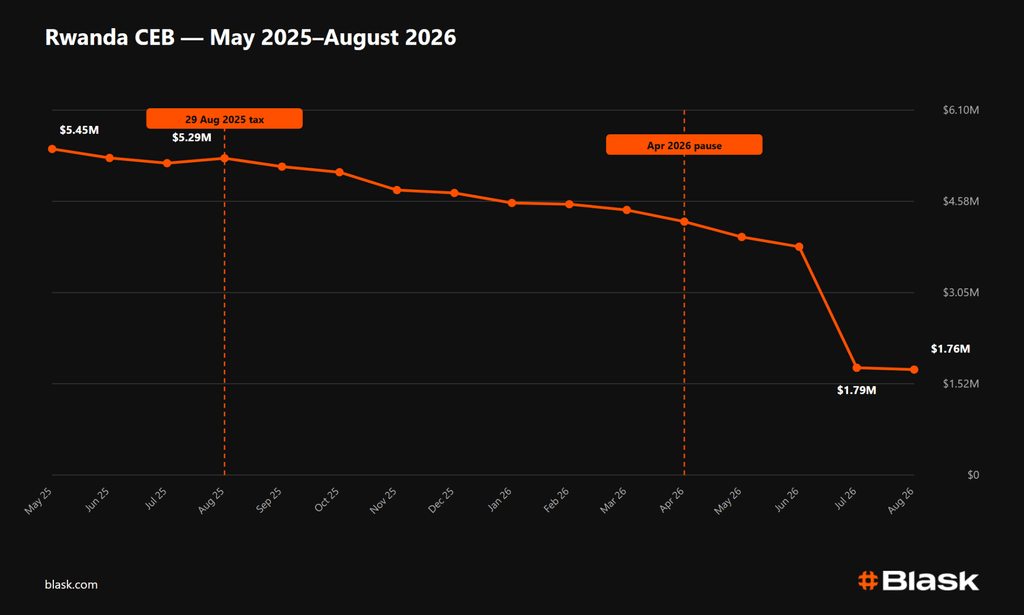
From May 2025 the series ground lower through the tax date and through H1 2026, the same slope the first-half article recorded. July then fell 64.5% MoM. August left the market 76% below August 2025.
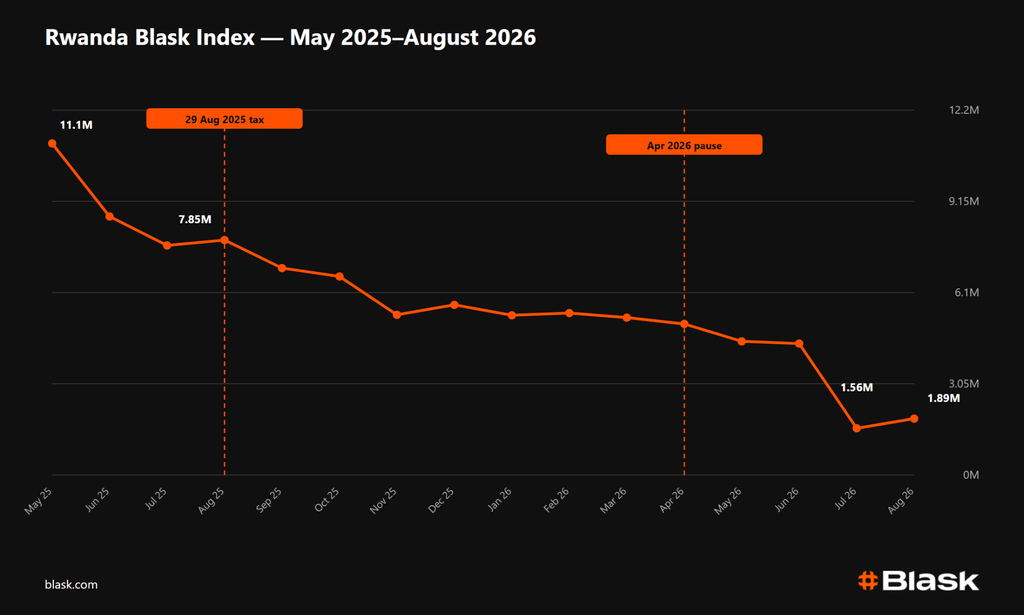
On 20 April 2026, Choplife Gaming, which runs betPawa in Rwanda, paused online casino and deposits while it argued withholding-tax timing and cost deductibility with the Rwanda Revenue Authority. Casino, the company said, had been about 80% of its Rwanda business.
The revenue baseline absorbed the tax year better than search demand. In July both series broke together, and the August floor did not rebuild.
Read Also: Nigeria’s onshore flip: licensed demand took the market
Through June 202, the CEB drop was milder than the Index. But by August the average sat 66.7% below August 2025.
The brand that held the market left the table
In August 2025 betPawa held 87.4% BAP. Winner (AFR), Gorilla Games, Forzza, and Fortebet split the rest in low single digits. By August 2026 betPawa was outside the top five. Gorilla Games led on 49.6%, Winner held 38.4%, and Fortebet 9.2%.
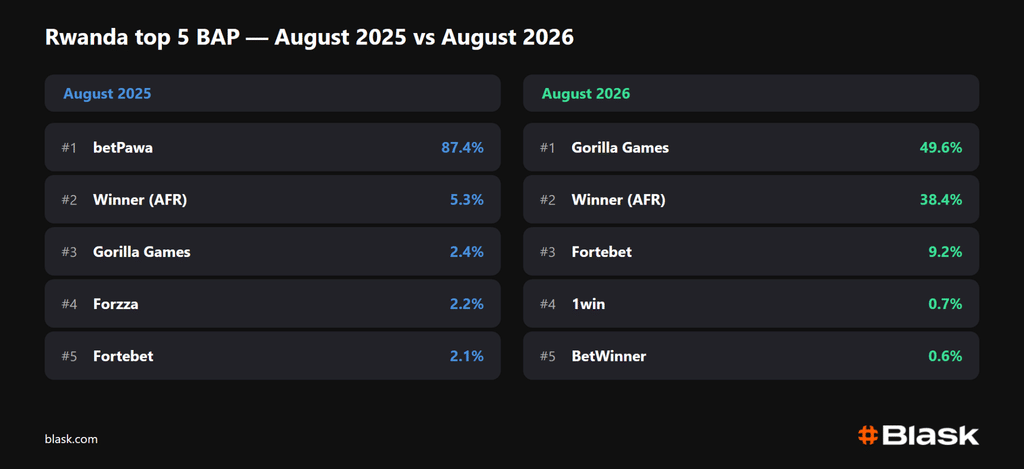
Choplife’s April note is the mechanism that fits the BAP reset. The company said Rwanda tax remittance fell from about RWF 1.8B in January 2026 to RWF 108M in March. Once that brand left the measured top, July’s Index drop hit a market with no single name large enough to hold the national curve.
Bottom line
H1 2026 put Rwanda at −36.2% versus H1 2025, one of only three African markets that lost Index in that cut. By August the monthly Index sat 76% below August 2025 and CEB sat 66.7% lower, after a July break that followed the 2025 gaming-tax rewrite and betPawa’s April pause. Gorilla Games, Winner, and Fortebet now split what is left of a smaller market.
About Blask
Blask is an AI-powered platform for iGaming and gambling market analytics. The company turns fragmented open-source signals into real-time insight on brand visibility, player demand, and baseline revenue metrics, helping teams move first, spend smarter, and reduce risk across global markets