Africa’s iGaming landscape has evolved rapidly over the past decade, shaped by a rare mix of diversity, complexity and untapped potential. From established, tightly regulated jurisdictions to emerging, mobile-first economies, the continent presents a mosaic of gaming cultures, technological realities and consumer behaviours. Working closely with operators across multiple markets has provided a clear view of both the constraints that still define day-to-day play and the opportunities now opening up as access, payments and regulation continue to develop.


Market Maturity Across Africa
Player behaviour across Africa varies significantly depending on market maturity, and long-term observation highlights clear tendencies that help illustrate how engagement develops in different regions. In more established markets, activity often suggests a leaning toward slightly higher spend and generally longer engagement periods, influenced by factors such as stronger trust in regulated operators and the presence of more developed payment ecosystems.
Conversely, emerging markets tend to exhibit more micro-betting behaviour alongside shorter, more frequent sessions, shaped by practical considerations such as connectivity constraints, widespread reliance on lower-spec devices, and the comparatively higher cost of mobile data. These trends, seen consistently across multiple territories, underscore why product and content strategies need to be calibrated market by market rather than treated as one uniform ‘Africa’ approach.
Content Trends and Player Demand
Player demand across Africa consistently reflects a preference for simple, rewarding formats that are accessible across a wide range of devices. Live casino has seen notable growth in developed markets thanks to improving connectivity and increasing player confidence. Wheel-based formats, multiplier mechanics, and live game-show experiences are gaining traction across territories due to their simplicity, entertainment value, and alignment with familiar lottery dynamics.
Lottery-style gaming remains one of the strongest universal product categories on the continent. Its low-stakes, high-upside format fits naturally within the economic profile and gaming preferences of many African consumers, making it a durable foundation for content portfolios and a frequent entry point for new players.






Localisation as a Growth Driver
Effective localisation is not optional in Africa; it is fundamental to both acquisition and retention. Players respond best to content that reflects their language, currency, cultural references, and levels of gaming familiarity. Any product that feels foreign or overly complex risks immediate abandonment.
In practice, localisation spans far more than translation. It can mean adapting core mechanics for local betting habits, aligning presentation with familiar retail or lottery cues, and working with operators on branded experiences that reinforce recognition and trust. Tooling that reduces the time and cost of compliant, market-specific customisation (including faster reskinning workflows) is becoming increasingly important as suppliers and operators expand across multiple jurisdictions.
Operational Challenges Shaping the Market
Despite its potential, Africa’s iGaming industry faces a range of tangible infrastructure, payment, and regulatory challenges.
Connectivity limitations and widespread use of low-spec devices require suppliers to optimise products for speed, stability, and minimal data consumption. Features such as auto-reconnection and lightweight front-end builds are essential in ensuring session continuity.

Payments present another major challenge. With mobile money dominating most ecosystems and airtime billing remaining important in several regions, the reliability and speed of withdrawals significantly influence player trust.
Regulation remains highly fragmented across the continent, requiring operators and suppliers to adopt market-by-market strategies, secure local partnerships, and invest in robust compliance frameworks, including KYC and responsible gambling technologies.
The Future: Deeper Partnerships and Local Innovation
The next phase of Africa’s iGaming growth will be defined by deeper, more collaborative supplier–operator relationships. Content will increasingly be co-developed to meet market-specific needs, informed by shared behavioural insights and aligned around personalisation strategies.
High-growth verticals such as crash games, instant-win formats, live game shows, and hybrid lottery experiences will continue to shape the entertainment landscape. Meanwhile, advancements in compliance technology and streamlined payment integrations will support sustainable long-term expansion.
For suppliers and operators alike, the opportunity now is to build for the realities of each market: local payments, resilient UX on constrained devices, and content that feels genuinely familiar. BetGames’ experience across Africa reinforces that the winners in the next cycle will be those who treat localisation, trust and operational reliability as product features, rather than afterthoughts.
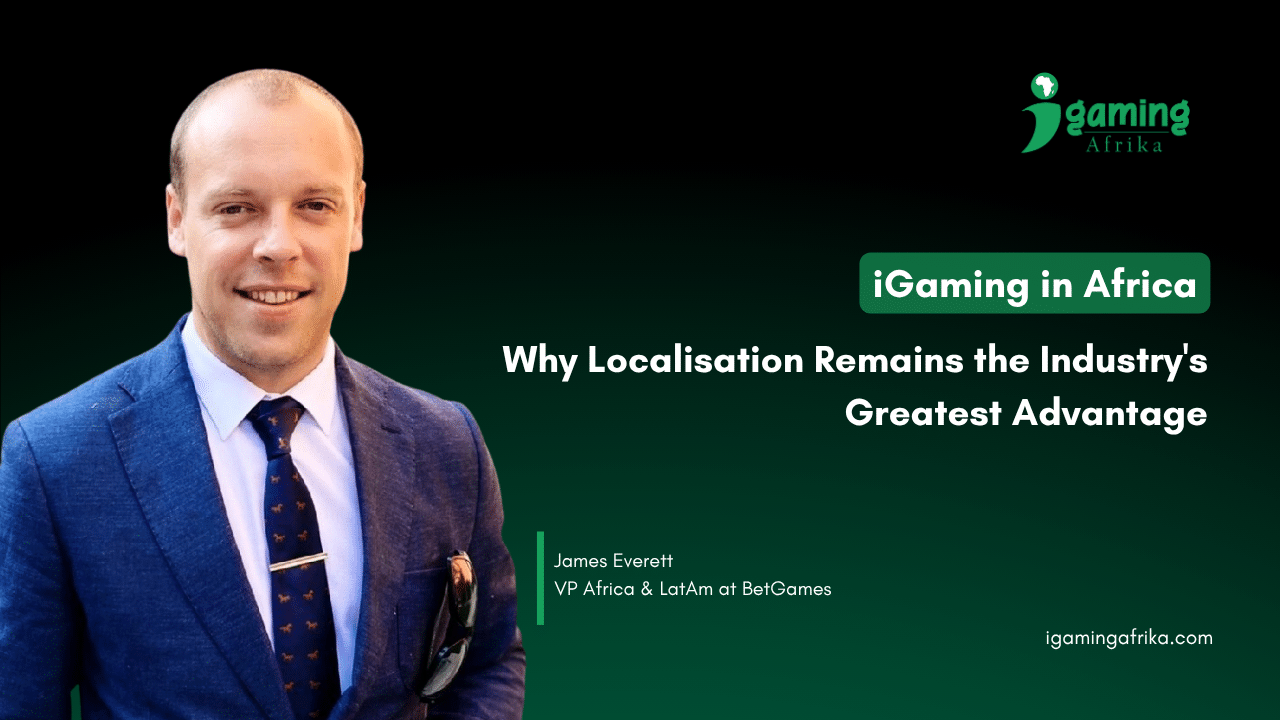
Author: James Everett, VP Africa & LatAm at BetGames