Africa’s Regulated Gambling Market: Balancing Rapid Change, Digital Growth and Responsible Expansion

As Africa’s gambling sector navigates a period of accelerating regulation and digital transformation, operators and suppliers are re‑evaluating how best to align growth strategies with evolving compliance and responsible gambling demands. While market maturity varies across the continent, the push toward more structured, sustainable frameworks is unmistakable.


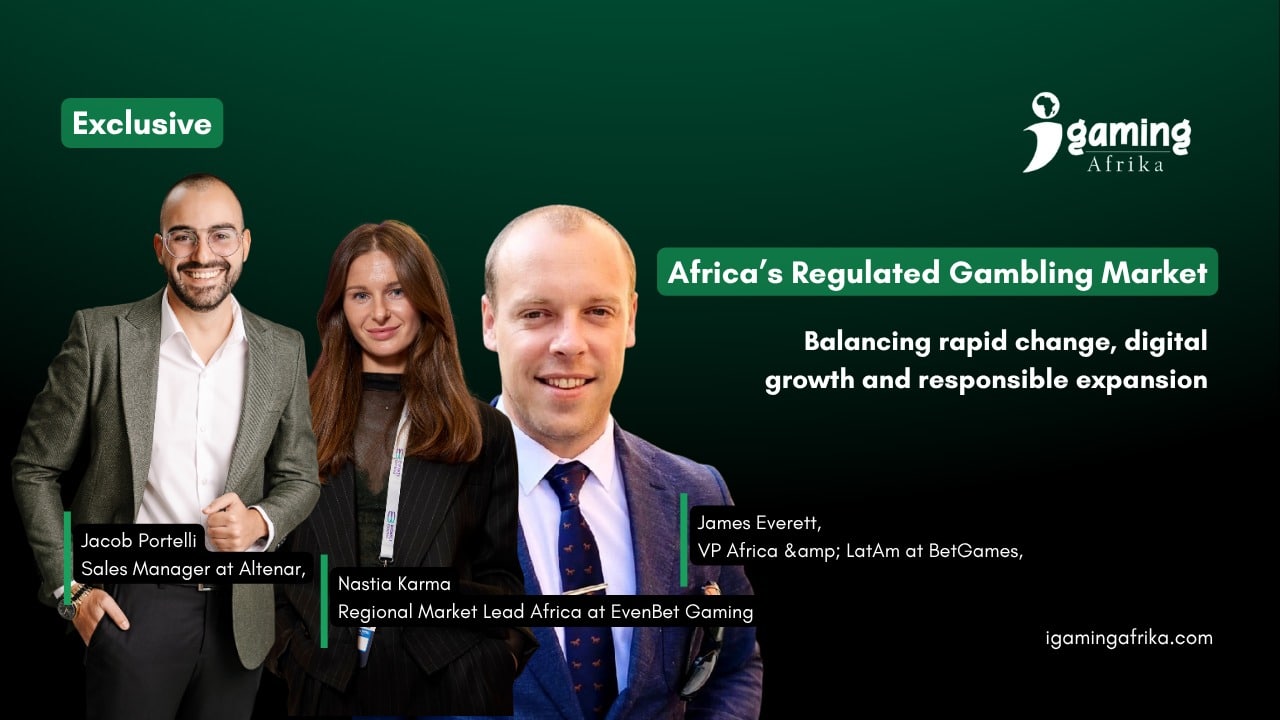
In an exclusive roundtable discussion with iGaming AFRIKA, Jacob Portelli, Sales Manager at Altenar, James Everett, VP Africa & LatAm at BetGames, and Nastia Karma, Regional Market Lead Africa at EvenBet Gaming, share their perspectives on how regulation is reshaping African markets, how digital channels are redefining player engagement, and what a long‑term regulatory framework must deliver to support both innovation and player safety.
iGaming AFRIKA: The rate of regulatory change across Africa varies significantly by jurisdiction. How would you characterise the current phase of regulation on the continent?
Nastia Karma: Africa’s iGaming regulation is in a transitional and fragmented phase. Some markets, such as South Africa, are relatively mature but still complex, while others like Nigeria, Kenya and Ghana are actively refining tax and licensing frameworks to capture growing demand. Emerging jurisdictions, including Angola and Mozambique, are reforming laws to attract investment and formalise online gambling.
Across the board, governments increasingly recognise the sector’s revenue potential, which is driving tighter oversight and new tax regimes. However, inconsistent enforcement and the continued presence of unlicensed operators remain key challenges. Overall, the market is evolving quickly, but without a unified approach, each country is balancing growth, taxation and player protection in its own way.





James Everett: Africa is moving into a more structured and formalised regulatory phase, even though maturity varies widely across markets. While countries like South Africa have established licensing, taxation, and compliance systems, many others remain fragmented or unevenly enforced. The overall trend is clear: regulators are tightening standards, prioritising responsible gambling, and demanding stronger KYC/AML controls. This shift is pushing operators toward market‑specific licensing, local partnerships, and investment in compliance technology. In short, Africa is transitioning from rapid expansion to sustainable, regulated growth where trust and long-term stability take priority.
Read Also: Playing the Long Game: Strategies for Success in Africa’s Diverse iGaming Markets

Jacob Portelli: Africa’s regulatory landscape has entered a phase of ‘strategic formalisation’ with an initial ‘wild west era’ of simple licensing regimes giving way to more sophisticated, standards-driven frameworks. Key markets such as South Africa, Kenya, and Nigeria, along with emerging markets like Côte d’Ivoire, are shifting beyond revenue collection to prioritise technical standards, data localisation, and robust AML/KYC protocols. For providers like Altenar, this marks a positive evolution, creating a more stable and predictable environment for investment.
We are seeing a maturation ripple, where early adopters are shaping the regulatory ambitions of neighbouring nations. The result is a gradually more harmonised, yet still diverse, continental landscape ready for sustainable growth.
iGaming AFRIKA: Digital adoption is accelerating across the continent, driven by mobile penetration and fintech innovation. How is this reshaping product offerings and player expectations?
Jacob Portelli: Mobile usage has become the dominant mode of engagement across the continent. This shift, driven by the maturity of fintech and mobile money (MoMo) ecosystems, has fundamentally reshaped player expectations. Users increasingly expect a seamless experience where the wallet, the sportsbook, and the payout function as a single, rapid loop.
At Altenar, we’ve responded by prioritising lite versions of our front end to ensure high performance on low-end devices and in environments with inconsistent data connectivity. At the same time, product offerings are becoming more localised. European odds alone no longer satisfy market demand. We are seeing rising interest in features like Book-a-Bet for retail-to-mobile conversion and the integration of high-frequency products like Virtuals and Crash games that provide instant gratification within the mobile interface.
Nastia Karma: Digital adoption in Africa is fundamentally reshaping iGaming into a mobile-first, low-friction experience, driven by widespread smartphone usage and the dominance of mobile money ecosystems. For most players, particularly in key markets, mobile is not just the primary channel – it is the only channel. This has pushed operators to design lightweight, data-efficient platforms that perform reliably on entry-level devices and low-bandwidth connections.
At the same time, the rise of mobile payment solutions such as M-Pesa, MoMo and Paga has redefined transaction behaviour. Players expect instant deposits and withdrawals, often in micro-stakes ranging from just a few cents to a few dollars, which contrasts sharply with higher deposit thresholds seen in more mature markets. This shift is also influencing product strategy, with a strong emphasis on sports betting and simplified user journeys that prioritise speed and ease of use. As a result, expectations are centred around convenience and trust in payments, rather than the feature-heavy experiences often seen elsewhere.
James Everett: Africa’s mobile‑first environment is reshaping everything from product design to payment flows. With most users on low-spec devices, limited data, and inconsistent networks, operators are delivering lightweight, fast-loading mobile experiences, including PWAs, USSD options, and features that survive connectivity drops. Payment expectations have risen too: mobile money and instant withdrawals are now critical trust drivers. Product preferences are shifting as well – crash games, instant wins, and lottery-style formats dominate, while Live Casino grows only in well-connected markets. Digital adoption ultimately rewards speed, accessibility, and locally relevant UX.
Read Also: Why Virtual Never Sleeps: Kiron Interactive’s Strategy to Win Africa’s Gaming Market
iGaming AFRIKA: From a player engagement perspective, how does Africa differ from other global regions?
James Everett: Player engagement in Africa is shaped by economics, infrastructure, and cultural betting habits. Markets are largely high-volume, low-value, with players favouring micro-bets, short sessions, and strong promotional incentives. Sports betting, especially football, dominates GGR, while casino adoption is selective and geared toward crash, instant, and lottery-style content. Engagement expectations are practical: platforms must be data-light, fast, familiar, and localised in language, currency, and game style. Compared to Western markets, Africa rewards simplicity, speed, and trust over feature-rich or high-spend experiences.
Jacob Portelli: The primary differentiator in Africa is the social and community-driven nature of betting. While European or North American markets often lean towards solitary, data-heavy analysis, engagement in many African markets is deeply rooted in local football culture and social interaction. This is why the retail-to-online bridge remains so strong in the African market. The physical betting shops continue to serve as trusted social hubs that shape brand perception long before players engage online.
Additionally, price sensitivity and a “small stake, big win” mindset drive a much higher volume of multi-bets compared to other regions. Engagement strategies must therefore focus on rewarding loyalty and providing high-value entertainment that respects the player’s data usage and device limitations, factors that are often overlooked in more digitally mature markets.
Nastia Karma: Player engagement in Africa is shaped by mobile-first behaviour, micro-stakes betting and strong social dynamics. Unlike mature markets, there is little desktop usage, and sports betting, particularly football, dominates, with limited casino uptake. Players typically place smaller, more frequent bets, often tied to daily matches, creating a high-frequency, low-value engagement model. For many, betting is not just entertainment but also a potential income supplement.
Social interaction is also central, with communities forming on platforms like WhatsApp and Telegram to share tips and promotions. Combined with a younger player base and lower disposable incomes, this creates a more community-driven and utility-focused engagement style compared to the leisure-led approach seen in Europe or North America.
iGaming AFRIKA: Responsible gambling is becoming central to regulatory discussions. How can operators prioritise player safety while still achieving commercial growth?
Jacob Portelli: Prioritising player safety isn’t just a regulatory requirement, it’s a commercial imperative for long-term sustainability. In Africa, where the industry is a significant employer and tax contributor, protecting the player base ensures the industry’s social licence to operate.
We achieve this through smart personalisation. By using AI-driven data analytics, we can identify high-risk betting patterns early and trigger automated interventions before behaviours become problematic. For operators, this proactive approach reduces regulatory risk and builds a more loyal, sustainable customer base.
Commercial growth then comes from “wallet share” and retention rather than high-churn, high-risk play. At Altenar, we integrate these tools directly into the core of our technology, making responsible gaming a seamless part of the user journey rather than a friction point.
Nastia Karma: Operators must take a mobile-first, integrated approach to responsible gambling. Player protection tools such as deposit limits, self-exclusion and clear messaging should be embedded directly into the user experience. Given the prevalence of mobile money, operators can also leverage fintech and mobile ID systems to strengthen age verification and monitor player behaviour more effectively. Simplicity is key, particularly in markets with varying levels of financial literacy. Importantly, prioritising player safety supports long-term growth. Building trust with users and regulators enhances retention and brand reputation, reducing reliance on aggressive acquisition strategies.
James Everett: Responsible gambling in Africa is becoming essential for regulatory alignment and long-term commercial value. Operators can prioritise safety by implementing locally relevant RG tools, simplified self-exclusion, and affordability checks suited to micro-betting environments. Payment transparency, especially fast withdrawals, also reduces harmful behaviours and builds trust. As regulation tightens, investment in KYC, AML, and behavioural monitoring technology helps operators meet compliance expectations while enhancing customer lifetime value. Ultimately, robust RG isn’t a cost but a growth enabler in trust-driven markets.
iGaming AFRIKA: Looking ahead, what does the ideal future scenario for Africa’s regulated gambling ecosystem look like?
Nastia Karma: The ideal future is a more harmonised, sustainable and player-centric ecosystem. Greater alignment between regulators through shared standards on licensing, taxation and player protection would reduce fragmentation and limit the grey market. Sustainable tax models are also critical, ensuring operators remain competitive while encouraging players to stay within regulated channels. At the same time, regulation and product design must remain mobile-first, reflecting how users engage with gambling across the continent.
Ultimately, a successful long-term framework is one where licensed operators can thrive in a stable and transparent environment, players are protected through accessible and effective safeguards, and governments benefit from consistent, sustainable revenue streams.
Jacob Portelli: The ideal future for Africa’s gambling ecosystem is one of harmonised innovation. I envision a landscape where regulatory frameworks are consistent enough to allow for cross-border scalability for operators, while remaining flexible enough to respect local cultural nuances. In this scenario, the “grey market” is largely eliminated because the regulated environment is more attractive, offering stronger player protection and superior localised products.
We would see a total convergence between retail and digital, powered by 5G and advanced fintech, positioning betting as a mainstream, socially responsible entertainment vertical. Ultimately, the goal is an ecosystem in which technology providers, operators, and regulators work in a continuous feedback loop that drives innovation while upholding the highest standards of integrity and player safety.
James Everett: The ideal future combines harmonised but locally flexible regulation with deeper collaboration between suppliers, operators, and regulators. More consistent standards around KYC, AML, advertising, and RG would ease fragmentation and help multi-market expansion. Content would remain tailored to infrastructure realities – lightweight instant games and crash formats alongside expanding Live Casino where connectivity allows. Payment ecosystems would deliver seamless mobile money, instant withdrawals, and wider cash-to-digital access. Above all, the future should prioritise trust, localisation, and responsible innovation to support sustainable market growth.