Why Africa’s Illegal Gambling Problem Is Also a Player Protection Crisis

Illegal gambling is often measured by the revenue governments lose and the unfair competition faced by licensed operators. Those costs matter, but they do not fully explain what the black market means for the person placing a bet.


A player on an unlicensed platform may have no guarantee that a game is fair, that a win will be paid, or that personal information will be protected. If a dispute arises, the regulator may have no authority over the operator, and the player may have nowhere to seek redress.
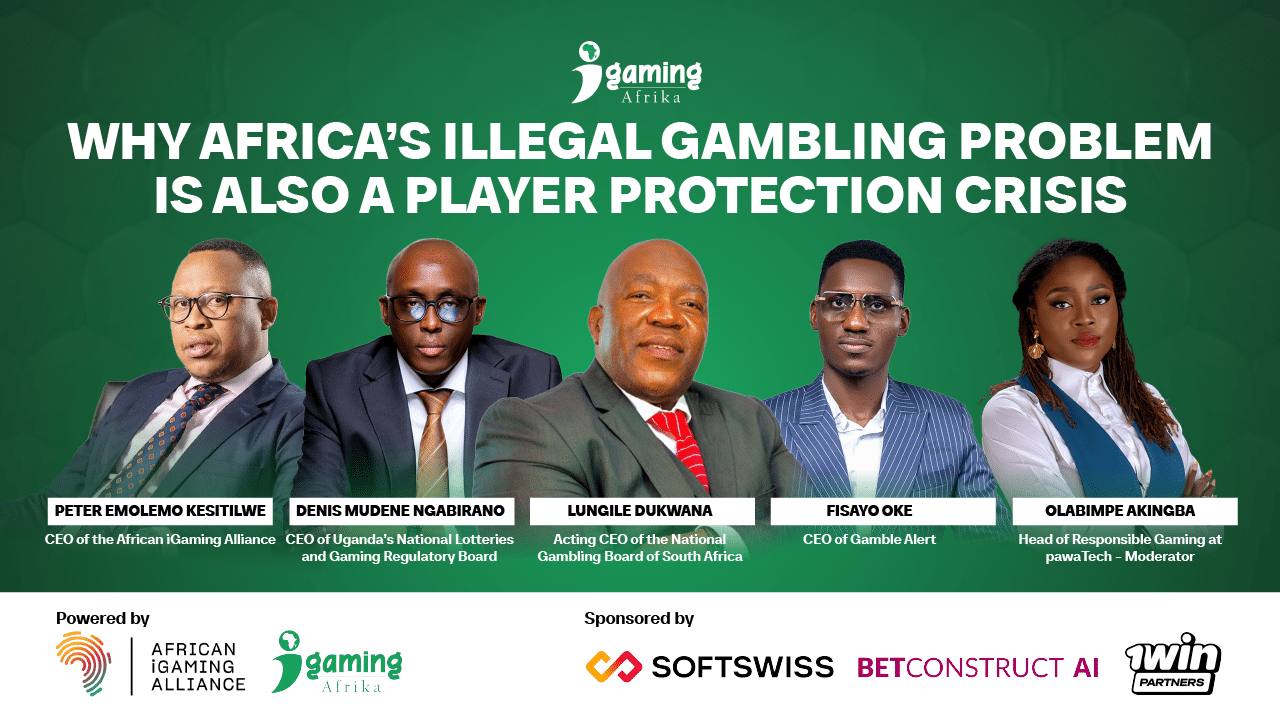
This was the focus of a recent webinar titled “The Hidden Cost of Illegal Gambling: What Does the Black Market Mean for Player Protection?”, hosted by the African iGaming Alliance in partnership with iGaming AFRIKA during Africa Safer Gambling Week, held from 7 to 11 September 2026.
The session brought together Peter Emolemo Kesitilwe, CEO of the African iGaming Alliance, Denis Mudene Ngabirano, CEO of Uganda’s National Lotteries and Gaming Regulatory Board, Lungile Dukwana, Acting CEO of the National Gambling Board of South Africa and Fisayo Oke, CEO of Gamble Alert. Olabimpe Akingba, Head of Responsible Gaming at pawaTech and a Board representative of the African iGaming Alliance, moderated the webinar that was sponsored by SOFTSWISS, 1Win Partners and BetConstruct.






Illegal gambling leaves the player without recourse
The protections attached to a gambling licence are not always visible to the customer. A player may only see the odds, available games, payment options, and speed of withdrawal. Behind a licensed platform, however, is a set of obligations that the operator must meet. These may include verifying the identity and age of customers, protecting their personal information, keeping player funds secure, and providing a process for resolving disputes.
A regulator can intervene when a licensed operator fails to meet those obligations. It has an identifiable company to investigate and licence conditions against which the operator’s conduct can be assessed. The regulator may order corrective action or impose sanctions where a breach has occurred. That route may not exist when a player uses an illegal platform. The operator may be based outside the country, conceal its ownership or operate through a website that can be closed and replaced. Even if the company has paid customers in the past, it has no enforceable duty to continue doing so.

“Illegal gambling fundamentally removes the player from the protections of the regulated environment,” Kesitilwe said. “That is why illegal gambling is not simply about lost government revenue or unfair competition. Fundamentally, it is a protection issue.”
An unpaid withdrawal may be the most obvious risk of using an illegal gambling platform, but it is not the only one. Opening and funding an account requires players to hand over sensitive information, including their identity documents, phone numbers, and payment details. With a licensed operator, there are rules governing how this information should be collected, stored, and used. An illegal operator offers no such assurance, which leaves the player exposed even if no dispute over winnings ever occurs.
Mudene said unlicensed operators may also manipulate games, withhold winnings, and expose minors and vulnerable people to harm. In Uganda, the regulator encourages players to check its website before opening an account or depositing money.
“Illegal operators may promise bigger rewards, but they cannot guarantee fairness, they cannot protect your data, or even pay your winnings. So verify the license before you deposit. So verify the license before you deposit,” he explained.
Why players still choose illegal platforms
The risks of illegal gambling do not automatically prevent players from using unlicensed platforms. Gamble Alert’s interactions with players show that many people do not know which operators are licensed. Some assume that a platform must be legal because its website is accessible, its advertisements are visible and it accepts familiar payment methods. This assumption is understandable.
An illegal operator can have a professional website, active customer support and a visible social media presence. It may work with influencers and appear on payment platforms already used by the customer. Each of these creates an impression of legitimacy, although none confirms that the operator is authorised to accept bets in that country.
Fisayo explained that the players encountered by Gamble Alert generally fall into three groups. Some do not know the difference between licensed and illegal operators. Others know the difference but do not consider it important. A third group deliberately seeks illegal platforms after restrictions have been placed on their accounts within the licensed market. For most players, the immediate gambling experience carries more weight than licensing status. Odds, ease of registration, product choice and payment speed can determine which platform they use.
He argued that a licence must offer the player a clear and consistent benefit. Customers need to know that a licensed operator will protect their information, honor valid payments, and respond properly when a complaint is raised. If those standards differ widely among licensed companies, the public may struggle to understand what the licence represents.
Read Also: iGaming AFRIKA Partners with African iGaming Alliance for Africa Safer Gambling Week Webinar
“If you have 20 licensed gaming operators who are doing all of these RG functions, and you have a number of others who are not, there is hardly any difference then between the licensed and the unlicensed market. If you do not have all of these, it would just mean that we are asking the players to go to the licensed market only so that they can contribute to the revenue of the country. The license must mean more than that. The license must mean more than that,” he said.
Fisayo also compared the financial exposure involved in illegal gambling with the risk faced by people who place money in Ponzi schemes. In both cases, the customer depends on the continued cooperation of a business that may not be accountable when the money is lost. “By patronizing operators who are operating outside regulation, you are actually accepting the exact same kind of financial risk, financial jeopardy as Ponzi scheme victims,” he said.
The black market weakens responsible gambling controls
The same platforms that attract players with fewer restrictions also weaken the responsible gambling measures applied within the licensed market. Uganda requires licensed operators to provide self-exclusion and controls linked to deposits, expenditure and gambling time. Before issuing a licence, the National Lotteries and Gaming Regulatory Board examines the operator’s systems to confirm that these tools are available and can help customers manage their gambling.
South Africa has similar requirements for licensed operators. Dukwana said operators are expected to support the National Responsible Gambling Programme and provide self-exclusion mechanisms. The country is now working to strengthen self-exclusion as a national regulatory requirement instead of leaving it mainly within the conditions set by individual licensing authorities.
These protections can only work while the player remains within the regulated market. A customer who reaches a deposit limit can avoid the restriction by opening an account with an illegal operator. A person who has requested self-exclusion can also continue gambling on a website that does not recognise the request. The black market therefore gives players a way around measures introduced to help them reduce or stop their gambling.
This is especially concerning for people already experiencing gambling-related harm. A platform that asks fewer questions and applies no limits may appear to solve the immediate problem created by a restricted account. In practice, it removes the controls that could prevent further harm. Fisayo cautioned against assuming that education alone will change this behaviour because a person experiencing addiction may understand the risks of illegal gambling and still feel unable to stop.
“The loss of control is actually a hallmark of gambling addiction,” he said.
Dukwana said this lack of accountability also weakens customer verification and increases the risk of underage gambling in South Africa. Illegal platforms may not establish who is using an account, whether the customer is legally permitted to gamble or whether the information submitted belongs to the person placing the bets.
“The danger is that if you are a player and you decide to go into the illegal space, you may not even be known. One of the biggest elements is that they don’t even commit to the issues of KYC – ‘Know Your Customer’ That is why you will find a lot of underage gambling in South Africa. You can’t gamble if you are under 18, so if it’s on that platform that is illegal, they don’t do the KYC. So it’s possible that you may be gambling with people that are under 18, which is our concern on the one hand. But secondly, you don’t have a recourse in the event that they are not paying the winnings. ” said Lungile.
KYC checks, however, are not foolproof. Children may use a parent’s identification documents or account details, causing the operator’s verification system to register the player as an adult. Dukwana said operators must not compromise on KYC requirements but added that parents also have a responsibility to monitor how their children use mobile phones, personal documents, and payment accounts.
Read Also: Is Nigeria Ready to Become Africa’s Premier iGaming Market?
When regulation makes the illegal market more attractive
Licensed operators compete with businesses that do not pay local taxes or meet the cost of compliance. They invest in player-verification systems, responsible gambling tools, and controls on advertising, while illegal operators can use the money saved to offer better odds, larger bonuses, and fewer restrictions. For a player comparing platforms, the illegal offer may therefore look more attractive, even though it comes without the same protection.
Kesitilwe acknowledged that regulation itself can contribute to this problem when taxes become excessive or compliance requirements are unnecessarily complex. His concern was not that player-protection standards should be relaxed, but that regulators should consider how players and operators are likely to respond to each measure.
“The strongest regulatory framework is not necessarily the one with the greatest number of restrictions,” he said.
In his view, a major regulatory intervention should answer three questions. Will it reduce harm or improve player protection? Can it be enforced in practice? Will it keep gambling activity within the licensed market or encourage players to move elsewhere?
The final question concerns channelisation, which measures how much gambling takes place through licensed operators. A regulation may place strict controls on the legal market, but it will protect fewer people if those controls lead players to unlicensed platforms. The challenge is to maintain high standards without making the regulated market so restrictive that illegal operators become the easier option.
“We should never compete with the illegal market by lowering our standards,” Kesitilwe said. “We should compete by making the regulated market safer, trusted, accessible and sufficiently attractive that players have no reason to leave it.”
Blocking an illegal gambling website may prevent access for a time, but it does not necessarily stop the operator. The same business can register another domain, continue advertising, and receive deposits through existing payment accounts. Effective enforcement therefore depends on disrupting the services that allow the operator to remain active.