Sibongile Simelane on How Accountability and Unified Regulations Will Redefine Harm Minimisation in South Africa

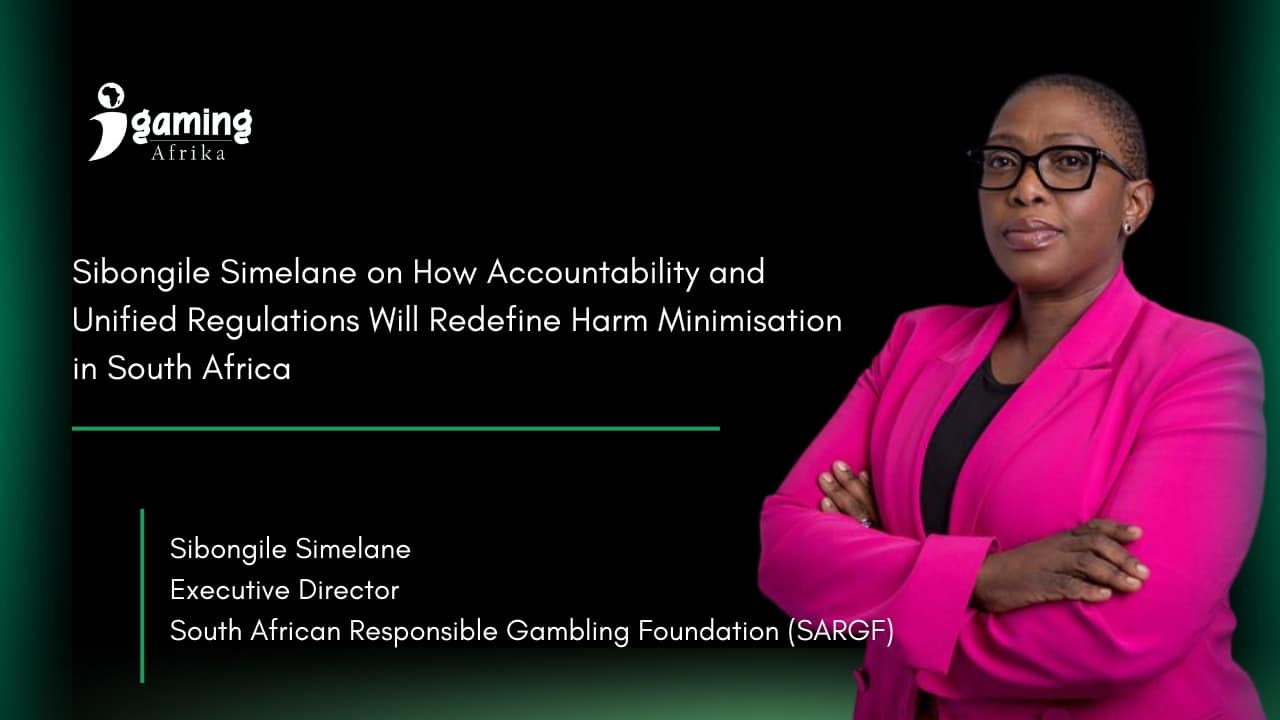
Sibongile Simelane, the Executive Director of the South African Responsible Gambling Foundation (SARGF), recently sat down with iGaming AFRIKA during the SiGMA Africa 2026 Summit to discuss how the foundation is revolutionizing South Africa’s player protection approach. She explained that the focus is shifting away from the stigma of “responsible gambling” to the urgent and clinical emphasis on harm minimization. Through initiatives like counseling and inpatient rehabilitation, SARGF is transforming policy into a lifeline for those who battle with addiction and, at the same time, creating a new era of industry-wide accountability.


The African iGaming industry has evolved towards mobile-first and digital gambling platforms to reach a rapidly growing user base. Therefore, player protection should not be negotiable. In her discussion, Sibongile highlighted a significant shift in industry terminology, moving away from the use of “responsible gambling” due to its potential for stigmatization. Instead, the foundation has adopted an urgent framing of harm minimization and reduction.
An example of this strategy is the National Responsible Gambling Program, which offers services like psycho-evaluations, intensive treatment, counseling, and inpatient rehabilitation to individuals with comorbid conditions, such as substance abuse.
Simelane emphasized the importance of this shift, stating: “Actually, we are no longer calling it responsible gambling because of the connotation that is stigmatized. We’re calling it harm reduction and harm minimization. And we do this through our flagship program called the National Responsible Gambling Program. We do treatment and counseling and psycho-evaluation to somebody that has actually other mental health conditions.”






A central strategy to SARGF’s impact is its extensive network of collaborations, which Simelane identifies as the core strength of their interventions. The foundation coordinates national public awareness campaigns in partnership with the National Gambling Board and provincial legislative authorities.
Notably, Simelane highlights the involvement of the private sector, noting that many operators have demonstrated significant commitment by co-running campaigns and investing in responsible gaming. Additionally, to reach even lower levels of society, the foundation also collaborates with community-based organizations that are able to acknowledge the different nature of local realities.

Despite these successful partnerships, Simelane maintains that the industry needs a unified regulatory framework to ensure that no vulnerable individuals fall through the cracks. She emphasized that accountability among industry stakeholders is essential. While most operators implement tools such as deposit limits and “cool-off” periods, there are no mechanisms in place to create an industry-wide system in which a vulnerable player could bypass controls and just switch operators. Simelane stressed that, although individual efforts are commendable, they are insufficient without a united legal framework.
“For instance, we talk so much about tools that are aimed at minimizing harm, such as cool-off periods, deposit limits, and self-exclusions. But if those are not implemented across the board, like each and every operator decides what they do and how they do it and when they do it, those efforts are not working because people, if they have taken a cool-off period from one operator, nothing stops them from going to the other operator and actually continuing to play. So we want harmonized intervention and regulatory framework.”
SARGF operates as an advocate of change by identifying regulatory gaps and communicating these areas of improvement to policymakers and industry stakeholders. Constant and frequent contact between regulators, operators, and community-based groups is the key to ensuring harm reduction. Despite these efforts, Simelane stated that in the last 5 years, an estimated 375 problem gamblers relapsed to gambling after having undergone and completed their programs. This shows the ongoing nature of the battle against addiction and the importance of localized community engagement.
Simelane said: “It’s not looking good. So over the past five years, we’ve seen about 375 people relapsing. It may seem like a small number, but we’re talking about 375 people with families and individuals who have a long-term battle with problem gambling.”
Ultimately, prioritizing player protection is the cornerstone of the industry’s long-term sustainability. Fostering a safe environment is a vital safeguard against the mental, financial, and social harm that gambling addiction can inflict on individuals and their families. As Simelane warns, these interventions are “very tedious and very tiring,” but they demand a relentless spirit: “You drop the ball, you lose it.”